
Antistrophus silphii
Gillette, 1891
Apical Rosinweed Gall Wasp
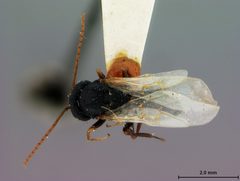
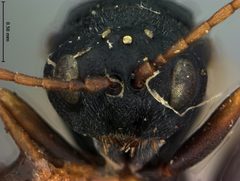
Antistrophus silphii is a gall-forming cynipid native to North American prairies. The induces stem galls on rosinweed (Silphium integrifolium), a tall prairie forb. Galls are large, solid, and succulent when young, becoming harder with age. The wasp has a single per year, with emerging in early summer.
Pronunciation
How to pronounce Antistrophus silphii: /ænˈtɪstrəfəs ˈsɪlfiaɪ/
These audio files are automatically generated. While they are not always 100% accurate, they are a good starting point.
Identification
Distinguished from A. lygodesmiaepisum by plant: A. silphii occurs on Silphium integrifolium (wholeleaf rosinweed), while A. lygodesmiaepisum occurs on Lygodesmia juncea (rush skeletonweed). Galls of A. silphii form at stem apices and contain white latex when fresh. Distinguished from other prairie cynipids by timing (June ), gall position ( vs. mid-stem), and host specificity. Callirhytis on oaks produce harder, woodier galls without latex.
Images
Habitat
Tallgrass prairie and prairie remnants. Associated exclusively with Silphium integrifolium in mesic to dry-mesic prairie conditions. plant requires open, sunny conditions with well-drained soils.
Distribution
North American prairies, with records from Missouri, Kansas, Nebraska, Iowa, and surrounding states. Distribution corresponds closely to that of its plant, Silphium integrifolium.
Seasonality
active in June and early July. Gall formation begins after oviposition; galls remain on stems through winter. Single per year ().
Diet
Larva feeds on nutritive tissue within the gall, which the induces the plant to produce. do not feed; mouthparts reduced.
Host Associations
- Silphium integrifolium - Forms stem galls; specificity is strict
Life Cycle
. Mated female oviposits into meristem of Silphium integrifolium stem in early summer. Plant tissue proliferates into a spherical gall enclosing the larva. Larva develops through summer and autumn, in the gall. occurs in spring; emerges through exit hole in early summer. No .
Behavior
Females oviposit into growing stem tips, chemically manipulating plant growth to form galls. Larvae remain sedentary within galls. are short-lived and do not disperse far from patches.
Ecological Role
Induces primary stem galls on a prairie forb. Galls may serve as microhabitats for secondary occupants () or , though specific associates for this are poorly documented. Represents a form of herbivory that redirects plant resources from to gall tissue.
Human Relevance
No direct economic importance. Serves as an indicator of intact prairie due to plant specificity. Occasionally encountered in prairie restoration monitoring. Not a pest of agriculture.
Similar Taxa
- Antistrophus lygodesmiaepisumCongeneric forming similar galls on Lygodesmia juncea; distinguished by plant and slightly different gall position
- Callirhytis quercuspunctataOak gall cynipid with spherical galls, but on Quercus (oaks), not Silphium; galls lack latex and are woody rather than succulent
- Eurosta solidaginisGoldenrod gall fly (Diptera: Tephritidae) forms similar spherical stem galls on goldenrods; distinguished by order, plant, and gall internal structure
Misconceptions
Larvae are frequently mistaken for dipteran maggots due to soft, legless appearance. The "" leads some to expect stinging , but cynipids are harmless to humans. Galls are sometimes mistaken for fungal growths or plant tumors rather than induced animal structures.
More Details
Gall characteristics
Galls are among the largest produced by North American cynipids, reaching 2-3 cm diameter. Fresh galls exude white latex when cut, a distinctive trait shared with other Silphium-associated cynipids. Gall walls are thick and fleshy when young, becoming harder and woodier by autumn.
Taxonomic history
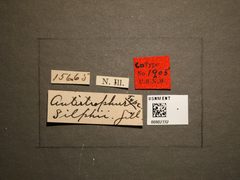
Described by Gillette in 1891 from prairie collections in the central United States. The epithet "silphii" directly references its Silphium. Long confused with related species due to morphological similarity of ; host association remains the most reliable identification criterion.