
Philanthus crabroniformis
F. Smith, 1856
beewolf
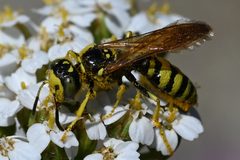
Philanthus crabroniformis is a of bee-hunting wasp, commonly known as a 'beewolf,' native to North America. The species belongs to the Crabronidae and primarily preys upon bees in the family Halictidae. Females construct nests in sandy soils and provision them with paralyzed prey for their larval offspring. The species has been documented in sympatry with P. gibbosus, with which it shares similar prey preferences but exhibits distinctive nest approach that may represent an evolutionary response to parasitic pressure from miltogrammine flies.
Pronunciation
How to pronounce Philanthus crabroniformis: /fɪˈlænθəs kræˈbroʊnɪˌfɔrmɪs/
These audio files are automatically generated. While they are not always 100% accurate, they are a good starting point.
Images
Habitat
Sandy soils, including bare, coarse sand, sandy-clay, or sandy loam substrates suitable for nest excavation.
Distribution
North America; recorded from Canada (including Alberta) and the United States.
Diet
Bees, primarily members of the Halictidae (sweat bees).
Behavior
Females exhibit distinctive nest approach patterns when returning with prey, differing from sympatric Philanthus . Males are territorial and perch on low vegetation to intercept females or chase off competing males. Females actively stalk bees at flowers, sting them between the front legs to paralyze them, and transport prey beneath the body using the middle legs. Multiple prey items are required to provision a single larval . The species engages in burrow sharing, with sibling females sometimes occupying birth nests temporarily before dispersing. Males may spend nights and periods of inclement weather in female burrows, often returning to the same burrow repeatedly.
Ecological Role
of bees; control of Halictidae. visit flowers for nectar and may contribute to pollination. The serves as to various including satellite flies ( Sarcophagidae, Metopia, Senotainia, Hilarella), velvet ants (Dasymutilla nigripes), and cuckoo wasps (Hedychrydium dimidiatum).
Similar Taxa
- Philanthus gibbosusSympatric with similar prey preferences and nesting ; distinguished by distinctive nest approach and potentially subtle morphological differences.
- Nomada (cuckoo bees)Superficially similar appearance that can lead to misidentification; cuckoo bees lack the predatory and nest construction of beewolves.
Sources and further reading
- BugGuide
- Wikipedia
- GBIF taxonomy match
- iNaturalist taxon
- NCBI Taxonomy
- Catalogue of Life
- The Amazing World of 'Gwentomologist' Gwen Erdosh | Bug Squad
- Bug Eric: Wasp Wednesday: Beewolves
- So, how big do insects get? - Buglife Blog - Buglife
- T.G.I.Flyday – Andrenosoma fulvicaudum | Beetles In The Bush
- Bug Eric: August 2011
- Bug Eric: June 2012
- The behaviour of Philanthus crabroniformis (Hymenoptera: Sphecidae)