
Eucerceris rubripes
Cresson, 1879
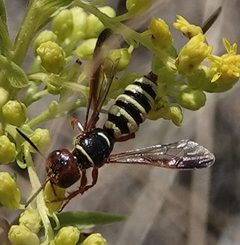
Eucerceris rubripes is a of weevil wasp in the Crabronidae, tribe Cercerini. The Eucerceris was subject to extensive taxonomic revision by George R. Ferguson, who specialized in Cerceris and related genera. Like other cercerine , females provision nests with weevils (Curculionidae) as food for their larvae. The species has been recorded visiting flowering saltcedar (Tamarix) for nectar in Colorado.
Pronunciation
How to pronounce Eucerceris rubripes: /juːˈsɜːrsɛrɪs ruːˈbraɪpiːz/
These audio files are automatically generated. While they are not always 100% accurate, they are a good starting point.
Identification
Eucerceris are distinguished from the closely related Cerceris by subtle morphological characters, particularly in male genitalia and wing venation. George R. Ferguson's taxonomic work on these genera provides the primary reference for species-level identification. The specific epithet 'rubripes' (red-footed) suggests reddish coloration on the legs, though this should be verified against .
Images
Habitat
Observed in association with saltcedar (Tamarix), an introduced, shrub in western North America. The tree observations suggest use of isolated flowering shrubs in semi-arid or arid environments.
Distribution
North America. Specific records include Colorado Springs, Colorado, USA.
Seasonality
Active during summer months; observed in June in Colorado.
Diet
feed on nectar. Females provision nests with weevils (Curculionidae) as larval food.
Host Associations
- Curculionidae - preyweevils provisioned as larval food
- Tamarix - nectar source observed visiting flowers
Behavior
Males establish territories around flowering shrubs and defend them from other males. Females visit these sites for nectar and mating.
Ecological Role
of weevils; potential agent for weevil . Contributes to pollination of flowering shrubs while foraging for nectar.
Similar Taxa
- CercerisClosely related in tribe Cercerini; distinguished by subtle morphological characters, particularly male genitalia and wing venation. Ferguson (1970s-1980s) revised both genera.
- PhilanthusAlso in Philanthinae, but hunts bees rather than weevils; males similarly territorial around nectar sources.
More Details
Taxonomic History
The Eucerceris was revised by George R. Ferguson, who completed work begun by Herm Scullen. Ferguson's expertise in Cerceris and Eucerceris was noted by entomologist Eric Eaton as instrumental in advancing understanding of these difficult genera.
Research Significance
The ' Tree' study in Colorado Springs documented Eucerceris rubripes among 40+ wasp visiting a single saltcedar shrub, demonstrating the ecological importance of isolated flowering resources in arid landscapes.