
Cerceris clypeata
Dahlbom, 1844
weevil wasp
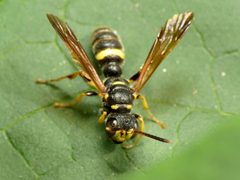
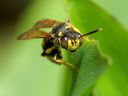
Cerceris clypeata is a solitary weevil in the Crabronidae, found in North America. Males exhibit probable marking on grass stems and vegetation using cephalic gland secretions, a trait rarely recorded in this but common in the Philanthinae. The is closely related to other Cerceris wasps that specialize on particular prey groups, though specific prey associations for C. clypeata remain undocumented.
Pronunciation
How to pronounce Cerceris clypeata: //sɛrˈsɛrɪs ˌklɪpiˈɑːtə//
These audio files are automatically generated. While they are not always 100% accurate, they are a good starting point.
Identification
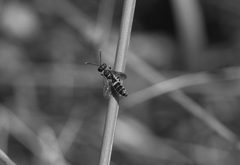
Males can be distinguished by their marking : dragging the tip and placing the on grass stems or leaves while , depositing secretions from cephalic glands. This behavior distinguishes them from other Cerceris in the field. Females have not been described in published studies, and no nest architecture details are available for this species.
Images
Habitat
Farm hayfields with grass stems; open areas with vegetation suitable for male marking . Specific nesting substrate preferences are unknown.
Distribution
North America; confirmed records from Canada (Ontario) and the United States.
Diet
Presumed to specialize on weevils (Curculionidae) based on and congeneric patterns, but this has not been empirically confirmed.
Behavior
Males mark grass stems and plant parts by up stems or around leaves while placing their and tip on the vegetation, depositing secretions from cephalic glands. Males very occasionally defend small marking sites against intruders. No nests, females, or provisioning have been observed.
Similar Taxa
- Cerceris fumipennisSimilar and , but specializes on jewel beetles (Buprestidae) rather than weevils; used as biosurveillance tool for emerald ash borer; males do not exhibit the marking documented in C. clypeata
- Cerceris bicornisCongeneric weevil with similar prey preferences; distinguished by specific marking in C. clypeata males and likely differences in facial markings (C. bicornis females have two yellow facial markings)
- Cerceris rybyensisEuropean congeneric that preys on wild bees; lacks male marking and occupies different geographic range
Sources and further reading
- BugGuide
- Wikipedia
- GBIF taxonomy match
- iNaturalist taxon
- NCBI Taxonomy
- Catalogue of Life
- Bembicid Holdings | Entomology Research Museum
- Working with Cerceris fumipennis—Epilogue | Beetles In The Bush
- Working with Cerceris fumipennis—Part 2 | Beetles In The Bush
- Working with Cerceris fumipennis—Part 1 | Beetles In The Bush
- Wasp, Geographic Data Improve Surveillance for Emerald Ash Borer
- Predatory Wasps and Citizen Scientists are Taking on the Emerald Ash Borer
- Probable marking behavior of Cerceris clypeata (Philanthinae, Crabronidae, Hymenoptera)
- Figure 1 from: Alcock J, Simmons LW (2018) Probable marking behavior of Cerceris clypeata (Philanthinae, Crabronidae, Hymenoptera). Journal of Hymenoptera Research 67: 121-125. https://doi.org/10.3897/jhr.67.30517