
Microbembex monodonta
(Say, 1824)
sand bee
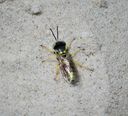
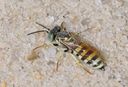
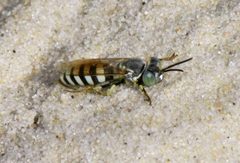
Microbembex monodonta is a solitary ground-nesting sand wasp in the tribe Bembicini, found across the Americas from the Caribbean to South America. The nests in in sandy areas, constructing oblique burrows that end in single terminal . Females demonstrate sophisticated visual navigation, using panoramic landmarks to locate their camouflaged nest entrances with . They cover and disguise burrow openings with sand before departing to forage, then rely exclusively on visual cues to return.
Pronunciation
How to pronounce Microbembex monodonta: /maɪˌkroʊˈbɛm.bɛks ˌmɒn.əˈdɒn.tə/
These audio files are automatically generated. While they are not always 100% accurate, they are a good starting point.
Identification
As a member of the Microbembex, this is distinguished from related sand wasps by subtle morphological characters. Microbembex species are generally smaller and more slender than the superficially similar Bembix. The specific epithet "monodonta" (single-toothed) likely refers to a distinctive mandibular or other mouthpart characteristic, though precise diagnostic features for this species require examination. The genus can be separated from Bicyrtes and other Bembicini by genitalic and other subtle structural features best assessed with reference to taxonomic keys.
Images
Habitat
Sandy areas with sparse vegetation, including vegetated sand blowouts and abandoned farmland with exposed sandy substrates. Nests occur in where suitable sandy soil is available. Documented from a 3,600 m² vegetated sandy blowout in an abandoned farm area in Wisconsin, USA.
Distribution
Widespread across the Americas: Caribbean Sea, Central America, North America, and South America. Specific documented locations include Spring Green Preserve, Sauk County, Wisconsin, USA.
Life Cycle
Solitary digger wasp with simple nest architecture. Each female constructs an oblique burrow terminating in a single where one is deposited. The female provisions the cell for her larva, though specific prey items have not been documented for this . The burrow entrance is covered and camouflaged with sand before the female departs to forage.
Behavior
Covers and camouflages burrow entrance with sand before leaving to forage. Flies low facing forward when returning to the nest, landing without hesitation and digging precisely at the invisible entrance. Relies exclusively on visual cues—specifically local landmarks viewed within the context of the wider panoramic scene—for nest location. Can be trained to use introduced objects (cork stoppers, wooden cubes) as local visual cues. When returning, follows shifted local landmarks, indicating flexible use of visual information. Cannot precisely locate burrows when the wider panoramic view is blocked, even when local cues remain present. Non-visual cues (olfactory, tactile, auditory/vibrational) are not required for precise homing and can be locally masked without impairing navigation.
Similar Taxa
- BembixLarger, more robust sand wasps in the same tribe Bembicini; Microbembex are generally smaller and more slender with different genitalic structure.
- BicyrtesSimilar-sized sand wasps in tribe Bembicini with different facial and wing venation characters; Bicyrtes have distinctive markings and prey on different insects.
- BembecinusSmaller sand wasps in subtribe Stizina (not Bembicina) with strongly convergent at the bottom of the and second submarginal in the forewing; Bembecinus hunt leafhoppers rather than provisioning with other prey.
More Details
Visual Navigation Research
M. monodonta has been studied as a model organism for understanding insect visual navigation. Research demonstrates that this uses a two-tiered visual system: local landmarks for fine- positioning within the context of a panoramic scene for coarse orientation. This hierarchical visual strategy allows precise homing to camouflaged nests without reliance on path integration or non-visual cues.
Taxonomic History
Originally described by Thomas Say in 1824, this has been variously placed in Bembicidae or Nyssonidae in older literature, but current classification places it in Crabronidae Bembicinae. The Microbembex contains approximately 8 described species in North America, characterized by their small size and slender build relative to the more commonly encountered Bembix.
Sources and further reading
- BugGuide
- Wikipedia
- GBIF taxonomy match
- iNaturalist taxon
- Catalogue of Life
- Bembicid Holdings | Entomology Research Museum
- Bug Eric: Wasp Wednesday: Dasymutilla bioculata
- Bug Eric: Wasp Wednesday: Bembecinus
- Digger wasps Microbembex monodonta SAY (Hymenoptera, Crabronidae) rely exclusively on visual cues when pinpointing their nest entrances.