
Elampini
Genus Guides
9- Elampus
- Hedychridium(cuckoo wasps)
- Hedychrum
- Holopyga(cuckoo wasps)
- Microchridium
- Muesebeckidium
- Omalus(cuckoo wasps)
- Philoctetes
- Pseudomalus(cuckoo wasps)
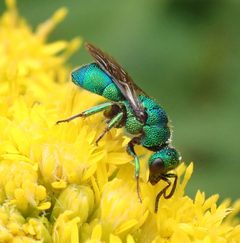
Elampini is a tribe of cuckoo wasps within the Chrysididae, comprising approximately 12 including Elampus, Hedychrum, and Holopyga. Members are kleptoparasitic that lay in the nests of other hymenopterans, particularly solitary bees and wasps. The tribe is distinguished by morphological features of the metasoma and male genitalia. Elampini are found across the Holarctic region with highest diversity in the Palearctic.


Pronunciation
How to pronounce Elampini: //ɛˈlæmpɪnaɪ//
These audio files are automatically generated. While they are not always 100% accurate, they are a good starting point.
Identification
Elampini can be distinguished from other chrysidid tribes by the structure of the male genitalia, particularly the form of the parameres and . The metasomal sterna show characteristic patterns that differ from the tribe Chrysidini. Most possess a distinct punctation pattern on the and often exhibit metallic coloration ranging from green to blue to purple. The forewing has reduced venation with a closed marginal , typical of Chrysididae but with subtle differences in the shape of the pterostigma compared to other tribes.
Images
Habitat
occur in diverse terrestrial including grasslands, open woodlands, forest edges, and anthropogenic environments such as gardens and parks. Many are associated with sandy or loamy soils where bees and construct nests. Hedychrum and Hedychridium species frequently inhabit coastal dunes and inland sand pits. Some Holopyga species show preference for montane meadows and alpine zones.
Distribution
The tribe has a predominantly Holarctic distribution with strong representation in the Palearctic region, particularly Europe, North Africa, and temperate Asia. Several (Elampus, Hedychrum, Holopyga) extend into the Nearctic. The genus Muesebeckidium is known only from the Nearctic. Microchridium has limited distribution records. No native representatives are known from the Neotropical, Afrotropical, or Australasian regions.
Seasonality
activity spans spring through autumn in temperate regions, with peak synchronized with nesting activity. Most are with adults active from May to September in the Palearctic. Southern and Mediterranean species may show extended activity periods or patterns. Early-season species (e.g., some Omalus) emerge when host bees begin nesting; late-season species correspond with second- host activity.
Host Associations
- Solitary bees (Apoidea) - Primary include Colletidae, Halictidae, Megachilidae, and Anthophoridae. laid in provisioned .
- Solitary wasps (Crabronidae, Pompilidae) - Some parasitize nest-provisioning sphecids and pompilids.
- Other Chrysididae - or cleptoparasitic relationships with other cuckoo wasps recorded in some cases.
Life Cycle
Development is hypermetamorphic with planidiform first-instar larvae adapted for mobility within nests. The larva consumes the host or young larva and then feeds on the stored provisions. Subsequent instars are maggot-like and sedentary. occurs within the host ; emerge by chewing through the cell cap or wall. typically occurs as or pupa within the host nest.
Behavior
are and thermophilic, often observed basking on sun-exposed substrates or actively searching for nests. is rapid and agile with frequent hovering. Females investigate potential host nests by antennal inspection of nest entrances and surrounding substrate. When a suitable host is located, the female enters the nest and deposits an . Adults do not construct nests and possess no pollen-collecting structures. Males establish territories near host nesting and pursue females in rapid chases.
Ecological Role
As kleptoparasites, Elampini function as regulators of solitary bees and , influencing structure and nesting success rates. Their presence indicates established populations of suitable host and thus serves as an indicator of healthy and wasp communities. The tribe contributes to nutrient cycling by consuming excess provisions in host that might otherwise decompose.
Human Relevance
No direct economic importance. Occasionally encountered by entomologists and naturalists. Some are documented in surveys due to their association with nesting sites. No known medical or agricultural significance; stings are rare and not considered medically significant. Metallic coloration makes specimens desirable for insect collections.
Similar Taxa
- ChrysidiniLargest tribe in Chrysididae; distinguished by male genitalia structure, particularly the parameres, and different metasomal sternal . Chrysidini often have more robust body form and different punctation .
- ParnopiniSmall tribe with distinctively flattened body form and modified hind legs for nest entry. Parnopini show different wing venation with reduced stigma and distinct male genitalic .
More Details
Taxonomic history
The tribal classification of Chrysididae has undergone substantial revision. Elampini was historically treated as a (Elampinae) by some authors. Current molecular phylogenetic studies support Elampini as monophyletic but suggest some traditionally included may require reclassification. The genus Omalus has been particularly problematic, with some groups showing affinities to other tribes.
Male genitalia as diagnostic tool
Reliable identification of Elampini and frequently requires examination of male genitalia. The parameral structure, aedeagal shape, and presence or absence of endophallic spines provide characters used in keys. This necessitates collection and dissection of specimens for definitive identification in many cases.