
Omalus
Panzer, 1801
cuckoo wasps, jewel wasps
Species Guides
6- Omalus aeneus(Cuckoo Wasp)
- Omalus downeyi(Downey's Cuckoo Wasp)
- Omalus glomeratus
- Omalus iridescens
- Omalus plicatus
- Omalus variatus
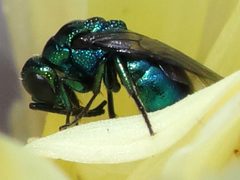
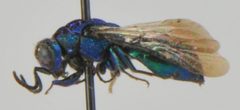
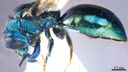
Omalus is a of cuckoo wasps ( Chrysididae), commonly known as jewel wasps for their metallic coloration. These small employ a distinctive reproductive strategy: females insert into living aphids at the hunting sites of their , using the prey as an unwitting vehicle to transport their offspring into host . This indirect nest-entry strategy avoids the need for wasps to physically enter host nests. The genus includes multiple across Europe, Asia, and North America, with some introduced species established in the United States.
Pronunciation
How to pronounce Omalus: /ˈoʊ.mə.lʊs/
These audio files are automatically generated. While they are not always 100% accurate, they are a good starting point.
Identification
Omalus are tiny cuckoo wasps, typically under 5 millimeters in length, with metallic coloration. They can be distinguished from related such as Pseudomalus and Holopyga by subtle morphological features of the and ; precise identification often requires examination of specific structural characters described in taxonomic revisions. are frequently observed around colonies or extrafloral on plants, where they feed on honeydew. Unlike many other , they do not directly enter nests.
Images
Habitat
include areas where -hunting crabronid (such as Pemphredon and Passaloecus) are active, typically featuring woody vegetation with pre-existing cavities, hollow stems, or pithy twigs suitable for nesting. are found near aphid colonies on trees, weeds, and other plants, particularly at extrafloral .
Distribution
Native to the Palearctic region including Europe, Asia, and northern Africa. Multiple occur in North America, including both native and introduced ; Omalus aeneus has been documented in North America through formal taxonomic review. Distribution records from GBIF include Denmark, Norway, and Sweden.
Seasonality
activity corresponds with periods of abundance and activity. In temperate regions, this typically includes spring (May) and late summer through fall (August-September), matching the bimodal distribution of aphid .
Diet
feed on honeydew, the sugary liquid waste product secreted by aphids and related true bugs. They have been observed sipping exudates from plants and visiting colonies specifically to obtain this food source.
Host Associations
- aphid-hunting crabronid wasps - Primary include Pemphredon, Passaloecus, and Psenulus. Omalus are that develop in host .
- aphids - oviposition siteFemales insert into living aphids at hunting sites; aphids serve as transport vehicles into host nests when collected by host as prey.
Life Cycle
are inserted into living aphids outside nests. When host collect the parasitized aphids as prey for their offspring, the Omalus eggs are transported into host . The Omalus larva hatches, kills the host larva, and consumes the food provisions (paralyzed aphids) stored by the host. Mature larvae and cocoons have been described for some , with structural features characteristic of the .
Behavior
Females exhibit a distinctive "hitch-hiking" oviposition strategy: inserting into living aphids rather than entering nests directly. are highly mobile and frequently observed feeding on honeydew at colonies. They rarely visit flowers. When disturbed, cuckoo wasps typically curl into a defensive ball, protected by their sculptured, hard .
Ecological Role
of solitary -hunting . By parasitizing , they regulate of crabronid wasps that prey on aphids. This creates a complex three-trophic-level interaction: Omalus exploits both the host wasp and the aphid prey that serves as its oviposition substrate and transport vehicle.
Human Relevance
Occasionally encountered by naturalists and entomologists studying aphid wasps or monitoring solitary nests. Artificial nest blocks designed for solitary bees and wasps may inadvertently Omalus . No direct economic impact documented, though they represent fascinating examples of indirect strategies.
Similar Taxa
- PseudomalusRelated of cuckoo wasps with similar size, metallic coloration, and cleptoparasitic . Some formerly classified in Omalus (e.g., Pseudomalus auratus, previously Omalus auratus). Distinguished by specific morphological characters of the and .
- HolopygaRelated cuckoo wasp sharing the indirect nest-entry strategy via oviposition. Similar but distinct morphological features; both genera exhibit the same remarkable reproductive .
- ChrysisLarger and more commonly encountered cuckoo wasp . Chrysis typically enter nests directly to oviposit, rather than using the indirect -mediated strategy characteristic of Omalus.
More Details
Historical Taxonomic Changes
The Pseudomalus auratus was formerly classified as Omalus auratus, reflecting ongoing revisions within the Chrysididae. The has been subject to formal taxonomic review in North America (Bohart & Campos, 1960).
Research Significance
The discovery and documentation of Omalus biaccinctus inserting into living aphids (Winterhagen 2015, Paukkunen et al. 2015) represents a major advance in understanding chrysidid . This strategy was suspected but not formally described for Omalus until recently, and may occur across multiple in the .
Sources and further reading
- BugGuide
- Wikipedia
- GBIF taxonomy match
- iNaturalist taxon
- NCBI Taxonomy
- Catalogue of Life
- Bug Eric: Wasp Wednesday: Pseudomalus auratus
- Bug Eric: "New" Insight Into Behavior of Some Cuckoo Wasps (Chrysididae)
- Bug Eric: Aphid Killers: Pemphredon Wasps
- Bug Eric: Wasp Wednesday: Passaloecus
- Omalus sculpticollis as the Main Enemy of Psenulus fuscipennis (Hymenoptera, Chrysididae, Crabronidae) in the Crimea, Ukraine
- Description of the Mature Larvae of Chrysis gracillima and Omalus biaccinctus and New Data on the Biology of Trichrysis cyanea (Hymenoptera: Chrysididae)
- Strategy for sneaking into a host's home: The cuckoo wasp Omalus biaccinctus (Hymenoptera: Chrysididae) inserts its eggs into living aphids that are the prey of its host