
Pseudomalus
Ashmead, 1902
cuckoo wasps, jewel wasps
Species Guides
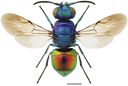
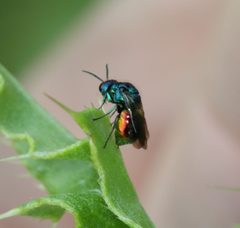
3Pseudomalus is a of cuckoo wasps ( Chrysididae), commonly known as jewel wasps for their brilliant metallic coloration. in this genus are kleptoparasites that exploit the nests of solitary and bees. A distinctive behavioral trait involves females ovipositing into aphids, which are then captured by crabronid wasps and carried to their nests—indirectly delivering the cuckoo wasp larva to its eventual . The genus includes both Palearctic natives and at least one introduced species (P. auratus) now established in North America.

Pronunciation
How to pronounce Pseudomalus: //ˌsjuːdoʊˈmeɪləs//
These audio files are automatically generated. While they are not always 100% accurate, they are a good starting point.
Images
Distribution
Native to the Palearctic region (Europe, Asia, northern Africa). Pseudomalus auratus has been introduced to North America, where it was first recorded prior to 1828 and was historically limited to the Atlantic seaboard but now occurs more widely across the continent. Distribution records also exist from Scandinavia (Denmark, Norway, Sweden) and the northeastern United States (Vermont).
Diet
have been observed feeding on honeydew secreted by aphids and on tacky exudates from plants such as sunflower (Helianthus annuus). They are also found at extrafloral and around colonies.
Host Associations
- Aphids - oviposition siteFemales lay inside aphids; the must then be captured by a crabronid and carried to its nest for the to continue
- Crabronidae - Kleptoparasite in nests; larvae kill larva and consume food provisions. Includes smaller that nest in hollow twigs and pre-existing wood cavities
- Ceratina - Small carpenter bees (Apidae); nests in hollow twigs and cavities
- Hylaeus - Masked bees (Colletidae); nests in pre-existing cavities
- Anthidium - Wool-carder or cotton bees (Megachilidae)
Life Cycle
Females oviposit directly into aphids. When a crabronid captures the parasitized and carries it to its nest as food provision, the cuckoo wasp hatches and the larva develops in the nest. The larva kills the crabronid larva and consumes the food stores (aphids). This indirect host-finding strategy avoids the risk of the female entering host nests directly. in Ichneumonidae and Torymidae are known to kill Pseudomalus larvae.
Behavior
rarely visit flowers. They are frequently found around colonies and extrafloral on various plants. One observation suggests adults may occasionally damage aphids while feeding on honeydew, then struggle with defensive wax exuded by the aphid and abandon the attempt. The indirect oviposition strategy—using aphids as trojan horses to enter nests—is a defining behavioral trait of this and related genera (Omalus, Holopyga).
Ecological Role
Kleptoparasite of solitary and bees; functions as a tertiary consumer in . May also serve as prey for wasps in Ichneumonidae and Torymidae.
Human Relevance
Pseudomalus auratus was likely introduced to North America accidentally prior to 1828 through global commerce. No significant economic or medical importance is documented. The is of scientific interest for its complex parasitic .
Similar Taxa
Misconceptions
Until recently, many researchers believed that cuckoo wasps in this and related genera entered nests directly to oviposit. It is now understood that they use an indirect strategy involving oviposition into aphids that are subsequently captured by host .
More Details
Behavioral Documentation
The indirect oviposition was first formally described for Omalus by Winterhagen (2015), for Holopyga by Veenendaal (2012), and discussed for Pseudomalus in Paukkunen et al. (2015). Photographic documentation of this behavior has been achieved through social media and citizen science platforms.
Taxonomic Note
The name is sometimes misspelled 'Psedomalus' in sources. Some have been transferred between Pseudomalus and Omalus, reflecting historical taxonomic revisions in the Chrysididae.