
Pseudomalus auratus
(Linnaeus, 1758)
cuckoo wasp, jewel wasp
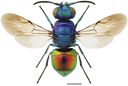
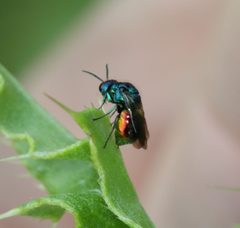
Pseudomalus auratus is a small cuckoo wasp in the Chrysididae, notable for its striking metallic coloration with emerald green and contrasting with a ruby red . Native to the Palearctic region, it has been accidentally introduced to North America, likely before 1828. The exhibits an unusual indirect parasitic strategy: females oviposit into aphids, which are then captured by crabronid and carried to their nests, where the cuckoo wasp larva emerges to kill the larva and consume the stored provisions.

Pronunciation
How to pronounce Pseudomalus auratus: /ˌsjuːdəˈmeɪləs ɔːˈreɪtəs/
These audio files are automatically generated. While they are not always 100% accurate, they are a good starting point.
Identification
Distinguished from other small chrysidids by the specific combination of green/blue metallic and with red , rather than uniform coloration. Separated from native North American Pseudomalus by its established Palearctic origin and documented introduction history. The Pseudomalus can be distinguished from related Omalus by subtle structural characters of the thorax and abdomen, though these require microscopic examination. Similar in size to many other jewel wasps, but the contrasting red and green color pattern is distinctive among North American fauna.
Images
Habitat
Open areas, forest edges, and thickets where nesting sites occur. Specifically associated with locations providing hollow twigs, pre-existing wood cavities, and similar situations used by solitary and hosts. frequently found near colonies and extrafloral on plants such as milkweeds, catalpas, and sunflowers.
Distribution
Native to the Palearctic: widespread across Europe (including UK, Scandinavia, Mediterranean region), east through Russia to Manchuria, Korea, and Japan; also North Africa and Near East. Introduced to North America, historically along the Atlantic seaboard but now with expanded range; recorded from Ohio and Colorado among other states.
Seasonality
period from late May to early October in the Palearctic region.
Host Associations
- Ceratina - small carpenter bees, Apidae; larva kleptoparasitizes nest provisions
- Hylaeus - masked bees, Colletidae
- Anthidium - wool-carder or cotton bees, Megachilidae
- Pemphredon - including P. lethifera and P. unicolor, Crabronidae
- Passaloecus - including P. gracilis, P. turionum, P. brevicornis
- Rhopalum coarctatum - Crabronidae
- Psenulus - Crabronidae
- Trypoxylon - Crabronidae
Life Cycle
Females oviposit directly into aphids; the parasitized must then be captured by a crabronid and transported to its nest. The cuckoo wasp hatches after the aphid is stored as nest provision, the larva kills the crabronid larva, and consumes the food stores. Larval development occurs in blackberry and raspberry branches and dead wood where hosts nest. emerge from host nests. of Pseudomalus auratus larvae include Ichneumonidae and Torymidae.
Behavior
have been observed feeding on honeydew from aphids and visiting extrafloral . Females do not enter nests directly but employ the indirect strategy of ovipositing into aphids that serve as prey for host . The is kleptoparasitic, with larvae stealing provisions rather than being fed directly by a parent.
Ecological Role
Human Relevance
Accidentally introduced to North America, likely through global commerce prior to 1828, representing one of the earlier documented insect introductions to the continent. Subject of recent scientific interest due to the discovery and documentation of its unusual indirect parasitic . No known economic impact; too small to be a significant nuisance.
Similar Taxa
- Omalus puncticollisSimilar size and coloration; distinguished by structural characters and , though both employ -mediated
- HolopygaRelated with similar kleptoparasitic and metallic coloration; separated by abdominal structure and color pattern
- Native North American ChrysididaeMany small green or blue cuckoo wasps occur in North America; P. auratus distinguished by red and documented Palearctic origin
More Details
Discovery of parasitic behavior
The indirect parasitic strategy of ovipositing into aphids was only recently fully documented photographically and described in scientific literature, though suspected earlier. This represents a significant finding in understanding chrysidid .
Taxonomic history
Formerly classified in Omalus as Omalus auratus; transferred to Pseudomalus based on morphological revisions. Older North American literature may use the former combination.
Sources and further reading
- BugGuide
- Wikipedia
- GBIF taxonomy match
- iNaturalist taxon
- NCBI Taxonomy
- Bug Eric: Wasp Wednesday: Pseudomalus auratus
- Bug Eric: January 2016
- Bane of dogbane, the beautiful and the ugly: Dogbane leaf beetle, Chrysochus auaratus, and dogbane webworm, Saucrobotys futilalis — Bug of the Week
- Guest Blogger: Dogbane for Dinner | Beetles In The Bush
- Hooray for the red, white, and blue! Milkweed longhorned beetle, Tetraopes tetraophthalmus; dogbane tiger moth, Cycnia tenera; and familiar bluet, Enallagma civile — Bug of the Week
- Bug Eric: June 2024