
Cephalonomia waterstoni
Gahan, 1931
parasitic grain wasp, rusty grain beetlewasp
Cephalonomia waterstoni is a small in the Bethylidae that attacks larvae and pupae of stored-product beetles, particularly the rusty grain beetle (Cryptolestes ferrugineus, formerly Laemophloeus ferrugineus). It is an ectoparasitoid that paralyzes larvae before laying on them. The has been extensively studied for its potential as a agent in grain storage facilities. Development is rapid, with the completing in approximately two weeks at 30°C and three weeks at 25°C.
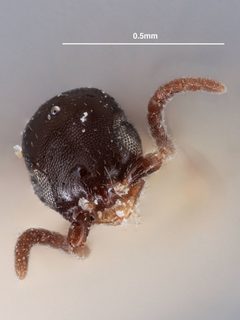
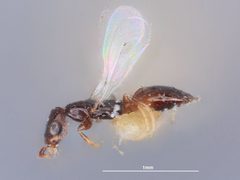
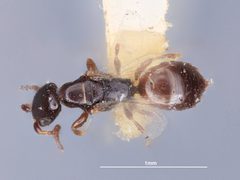
Pronunciation
How to pronounce Cephalonomia waterstoni: /ˌsɛfələˈnoʊmiə ˈwɔtərˌstoʊni/
These audio files are automatically generated. While they are not always 100% accurate, they are a good starting point.
Identification
Distinguished from other Cephalonomia by association and subtle morphological characters; males identifiable by brownish-black first antennal flagellomeres versus yellowish in females. Separation from other bethylid of stored products requires examination of genitalic and other fine morphological details not summarized in available sources.
Images
Appearance
are small, compact typical of Bethylidae. Males are smaller than females with less rectangular-shaped and longer . The first flagellar segments of male antennae are brownish-black, while those of females are yellowish. in antennal coloration and head shape allows easy differentiation of sexes.
Habitat
Stored grain environments including warehouses, grain elevators, and flour mills; associated with grain supporting of beetles. Has been documented in "hot spots" within bulk grain stores where host populations accumulate.
Distribution
Recorded from Great Britain; associated with stored-product facilities globally where beetles occur. Documented in Manitoba, Canada in association with wheat storage .
Seasonality
Active year-round in temperature-controlled storage facilities; development rate temperature-dependent with faster cycles at higher temperatures (30°C versus 25°C).
Host Associations
- Cryptolestes ferrugineus - primary Rusty grain beetle; formerly placed in Laemophloeus. Strong preference demonstrated; larval trails used as kairomonal cues for location
- Cryptolestes minutus - acceptable Viable development but not preferred
- Cryptolestes turcicus - acceptable Viable development but not preferred
- Laemophloeus ferrugineus - primary Former name for Cryptolestes ferrugineus; used in older literature
Life Cycle
, larval, and cocoon (prepupal and pupal) stages. Eggs laid in groups of 1-3 (rarely 4) per larva. Egg and larval stages last approximately 6 days at 25°C and 4 days at 30°C. Complete : 2 weeks at 30°C, 3 weeks at 25°C. Relative humidity (60-80% RH) has minimal effect on development duration within tested ranges. Larvae develop as ectoparasitoids on paralyzed host larvae.
Behavior
Females locate using olfactory cues, specifically responding to volatile compounds and larval trails () emitted by host beetles. Females readily oviposit on previously paralyzed larvae and can be induced to oviposit on larvae already bearing . are short-lived without food; females survive approximately 4 weeks when provided with host larvae at 25-30°C and 80% RH, while males survive only a few days regardless of host availability. Males fed sucrose solution live several days longer than starved males.
Ecological Role
Specialized contributing to biological suppression of stored-product pest . Functions as a natural control agent in grain storage ; has demonstrated capacity to check under experimental conditions.
Human Relevance
Investigated as a agent for management of rusty grain beetle and related stored-product pests in warehouses, mills, and grain elevators. Laboratory rearing techniques have been developed to support potential mass release programs. Not known to sting humans or cause direct damage to stored products.
Similar Taxa
- Cephalonomia tarsalisCongeneric of stored-product pests; distinguished by range and fine morphological characters including antennal and genitalic structure
- Laelius utilisAnother bethylid ectoparasitoid of stored-product beetles (Trogoderma variabile); distinguished by association and cuticular hydrocarbon profiles
- Anisopteromalus calandraePteromalid of stored-product pests; distinguished by -level characters (Pteromalidae vs. Bethylidae) and Dufour gland chemistry
More Details
Sex ratio manipulation
Virgin females produce only male offspring via . Fertilized females adjust offspring sex ratio through clutch size: single eggs produce mainly females, pairs produce mainly one male and one female, trios produce mainly one male and two females. Higher temperatures (30°C) favor production of more male-biased sex ratios through increased laying of paired eggs.
Fecundity
At 25°C and 80% RH, females lay approximately 40 on 30 larvae; at 30°C and 80% RH, approximately 65 eggs on 40 larvae. Pre-oviposition period is about 5 days at 25°C and 1.5 days at 30°C.
Mortality factors
mortality increases with decreasing saturation deficit, ranging from 9% at S.D. 12.7 mm to 36.5% at S.D. 5.0 mm. Starved adults of both sexes live approximately 4 days (range 0.5-9.5 days) without food or water.
Sources and further reading
- BugGuide
- Wikipedia
- GBIF taxonomy match
- iNaturalist taxon
- THE BIOLOGY OF CEPHALONOMIA WATERSTONI GAHAN
- Host Preference of Cephalonomia Waterstoni Gahan, a Bethylid Parasitoid of Laemophloeus Species
- Olfactory host location in the rusty grain beetle parasitoid Cephalonomia waterstoni (Gahan) (Hymenoptera: Bethylidae)
- The Biology of Cephalonomia waterstoni Gahan (Hym., Bethylidae), a Parasite of Laemophloeus (Col., Cucujidae)
- Larval Trails of Cryptolestes ferrugineus (Coleoptera: Cucujidae) as Kairomonal Host-Finding Cues for the Parasitoid Cephalonomia waterstoni (Hymenoptera: Bethylidae)
- Temperature-Dependent Functional Response of the Parasitoid Cephalonomia waterstoni (Gahan) (Hymenoptera: Bethylidae) Attacking Rusty Grain Beetle Larvae (Coleoptera: Cucujidae)
- Comparative Analysis of Cuticular Hydrocarbons from the Ectoparasitoids Cephalonomia waterstoni and Laelius utilis (Hymenoptera: Bethylidae) and Their Respective Hosts, Cryptolestes ferrugineus (Coleoptera: Cucujidae) and Trogoderma variabile (Coleoptera: Dermestidae)
- Morphology and chemistry of Dufour glands in four ectoparasitoids: Cephalonomia tarsalis, C. waterstoni (Hymenoptera: Bethylidae), Anisopteromalus calandrae, and Pteromalus cerealellae (Hymenoptera: Pteromalidae)