
Cryptolestes ferrugineus
(Stephens, 1831)
rusty grain beetle, rust-red grain beetle
Cryptolestes ferrugineus, the , is a small lined flat bark beetle and major pest of stored grain products. Native to Europe, it has achieved worldwide distribution through human commerce, infesting stored cereals, grain products, and dry plant materials. The is characterized by rapid growth, strong capability for between storage facilities, and cryptic hiding in cracks and crevices. Its economic impact stems from direct feeding damage to grain germ and endosperm, of products, and resistance to some .
Pronunciation
How to pronounce Cryptolestes ferrugineus: //ˌkrɪptoʊˈlɛstiːz ˌfɛruˈdʒɪniəs//
These audio files are automatically generated. While they are not always 100% accurate, they are a good starting point.
Identification
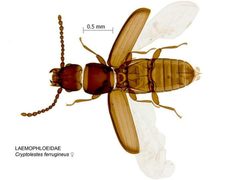
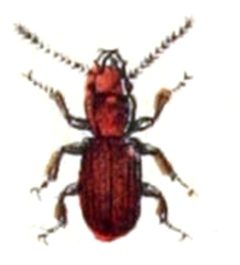
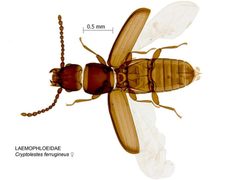
A small measuring 1.5–2.5 mm in length with a flattened, elongated body typical of lined flat bark beetles. Coloration is reddish-brown (rusty), giving rise to its . are long and thread-like. Distinguished from the closely related flat grain beetle Cryptolestes pusillus by subtle morphological differences and composition; C. ferrugineus produces ferrulactone II as its pheromone component.
Images
Habitat
Stored grain facilities including warehouses, grain elevators, and food processing plants; specifically infests bulk stored cereals and cereal products. Inhabits the spaces of grain masses and seeks in cracks, crevices, and structural voids within storage structures.
Distribution
distribution associated with stored grain products worldwide. Native to Europe, now present across temperate and tropical regions globally including North America, Oceania, and Asia. Distribution records include Serbia, the Azores (Santa Maria, Terceira), and widespread occurrence across grain-producing and grain-importing regions.
Seasonality
Year-round activity in controlled storage environments; driven by temperature and humidity conditions rather than seasonal cycles. Multiple per year occur under optimal conditions.
Diet
Stored cereals and cereal products; feeds primarily on the germ and endosperm of grain kernels.
Life Cycle
Complete with , larva, pupa, and stages. Development time varies with temperature and humidity; short enables rapid increase. Multiple per year under favorable conditions. Eggs laid in grain or food material.
Behavior
Highly mobile with strong capability allowing between storage facilities; can fly to locate new food sources. Exhibits -seeking , aggregating in cracks, crevices, and structural voids. Movement patterns influenced by temperature gradients; acclimation to 15°C or 35°C results in preference for temperatures above 30°C and 35°C respectively, with longer acclimation periods increasing . One-day-old adults show reduced movement response to temperature gradients compared to older individuals.
Ecological Role
Pest in anthropogenic stored product ; no documented natural ecosystem role. Serves as a model organism for studies of stored product insect , genetics, and resistance.
Human Relevance
Major economic pest of stored grain with significant impact on global food security. Causes direct damage through feeding on grain germ and endosperm, reducing nutritional value and seed viability. Contaminates grain products with , cast skins, and dead bodies. Subject to extensive research on including -based monitoring, , and development of resistance. Target of regulatory phytosanitary measures in international grain trade.
Similar Taxa
- Cryptolestes pusillusSimilar and shared in stored grain products; distinguished by composition and subtle structural differences
- Other Cryptolestes species members share flattened body form and stored product associations; microsatellite markers developed for C. ferrugineus show cross- utility for identification
Sources and further reading
- BugGuide
- Wikipedia
- GBIF taxonomy match
- iNaturalist taxon
- NCBI Taxonomy
- UBI Professor Demonstrates 'How to Draw a Bug' at Bohart Museum Open House | Bug Squad
- Encyrtid Holdings | Entomology Research Museum
- Listening to Larvae: How Acoustics Can Measure Efficacy of Palm Weevil Management
- Northern Ireland, invertebrate finds in review 2023 - Buglife Blog - Buglife
- Long-Distance Palm Weevil Flyers Threaten California Date Palms
- I Brake for Dung Beetles! | Beetles In The Bush
- Microsatellite markers for Cryptolestes ferrugineus (Coleoptera: Laemophloeidae) and other Cryptolestes species
- Biology, Ecology, and Behavior of Rusty Grain Beetle (Cryptolestes ferrugineus (Stephens))
- Ecology ofCryptolestes ferrugineus: New findings using conventional and population genetic approaches into a pest of growing importance
- Rust-red grain beetle,Cryptolestes ferrugineus, and flat grain beetle,Cryptolestes pusillus: Antennal and behavioral responses to synthetic components of their aggregation pheromones
- Thermostability, photostability, and toxicity of clove oil nanoparticles against Cryptolestes ferrugineus (Stephens) (Coleoptera: Laemophloeidae)
- Distribution of Cryptolestes ferrugineus (Coleoptera: Cucujidae) in response to temperature gradients in stored wheat
- Factors affecting the refuge-seeking behaviour of Cryptolestes ferrugineus (Stephens) (Coleoptera: Cucujidae)
- Effects of refuge content and food availability on refuge-seeking behaviour in Cryptolestes ferrugineus (Stephens) (Coleoptera: Cucujidae)
- Effects of temperature acclimation and age on movement of Cryptolestes ferrugineus (Coleoptera: Laemophloeidae) adults in response to temperature gradients
- A Concise Asymmetric Synthesis of the Aggregation Pheromone of Cryptolestes ferrugineus, Ferrulactone II, and Its Enantiomer.