
Cryptolestes
Species Guides
6- Cryptolestes cornutus
- Cryptolestes ferrugineus(rusty grain beetle)
- Cryptolestes punctatus
- Cryptolestes pusillus(Flat Grain Beetle)
- Cryptolestes turcicus(flour mill beetle)
- Cryptolestes uncicornis
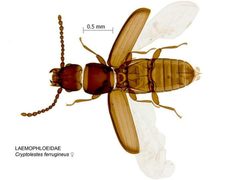
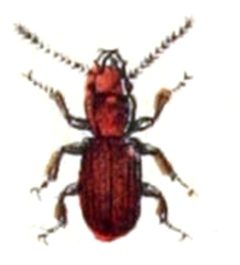
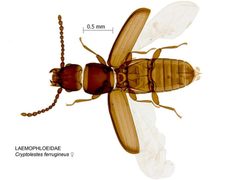
Cryptolestes is a of small beetles in the Laemophloeidae. Several are economically significant pests of stored products, particularly food grains. The genus includes four particularly notorious species: C. ferrugineus (), C. pusilloides, C. pusillus (), and C. turcicus (flour mill ). Species within this genus are morphologically similar and often require examination of genitalia for definitive identification.
Pronunciation
How to pronounce Cryptolestes: /ˌkrɪptəˈlestes/
These audio files are automatically generated. While they are not always 100% accurate, they are a good starting point.
Identification
in this are difficult to distinguish from one another based on external alone. Definitive identification typically requires close examination of the genitalia. The genus is characterized by small size and flattened body form typical of the Laemophloeidae.
Images
Habitat
Stored products, particularly food grains, flour mills, and warehouses. have been observed in wheat, barley, bran, rice, and associated spillage. Some overwinter indoors in temperate regions.
Distribution
distribution in association with stored products. C. ferrugineus has colonized temperate and tropical regions worldwide. Documented from Kyushu, Japan; Canada (Alberta to Quebec); and numerous other regions through human-mediated transport.
Behavior
show temperature-mediated movement patterns in grain columns, with responses influenced by acclimation temperature and age. One-day-old adults show reduced movement response to temperature gradients compared to older individuals. Some produce ; C. ferrugineus shows high specificity for pheromone components, while C. pusillus shows less specificity and has been observed to prefer C. ferrugineus pheromone components over its own.
Ecological Role
Pest of stored products. influenced by temperature, humidity, and larval .
Human Relevance
Economically important pests of stored food grains and grain products. C. ferrugineus, C. pusilloides, C. pusillus, and C. turcicus are considered the most damaging . occur in grain storage facilities, flour mills, and warehouses. Subject to control efforts including and development of .
More Details
Pheromone biology
Electroantennogram studies have demonstrated that females of C. ferrugineus and C. pusillus show larger antennal responses than males to synthetic components. C. pusillus was found to respond equally well to both components of its pheromone, contrary to earlier reports that only one component was active. This represents the first documented case of a cucujid preferring heterospecific pheromone components.
Genetic research
Microsatellite markers have been developed for C. ferrugineus and demonstrated to have potential utility for genetic studies of at least four additional Cryptolestes . These tools enable investigation of genetic structure and patterns.
Sources and further reading
- BugGuide
- Wikipedia
- iNaturalist taxon
- NCBI Taxonomy
- Microsatellite markers for Cryptolestes ferrugineus (Coleoptera: Laemophloeidae) and other Cryptolestes species
- Rust-red grain beetle,Cryptolestes ferrugineus, and flat grain beetle,Cryptolestes pusillus: Antennal and behavioral responses to synthetic components of their aggregation pheromones
- Distribution of Cryptolestes of stored products in Kyushu (Col., Cucujidae)
- Ecology ofCryptolestes ferrugineus: New findings using conventional and population genetic approaches into a pest of growing importance
- The biology of Cryptolestes capensis (Waltl) (Coleoptera, Cucujidae)
- Distribution of Cryptolestes ferrugineus (Coleoptera: Cucujidae) in response to temperature gradients in stored wheat
- REPRODUCTIVE CAPACITY OF TWO STRAINS OF CRYPTOLESTES TURCICUS (COLEOPTERA: CUCUJIDAE)
- Thermostability, photostability, and toxicity of clove oil nanoparticles against Cryptolestes ferrugineus (Stephens) (Coleoptera: Laemophloeidae)
- Effects of temperature acclimation and age on movement of Cryptolestes ferrugineus (Coleoptera: Laemophloeidae) adults in response to temperature gradients
- A Concise Asymmetric Synthesis of the Aggregation Pheromone of Cryptolestes ferrugineus, Ferrulactone II, and Its Enantiomer.