
Laemophloeidae
Ganglbauer, 1899
Lined Flat Bark Beetles
Genus Guides
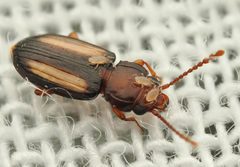
14is a of small beetles in the superfamily Cucujoidea, commonly known as . range from 1–5 mm in length and are characterized by dorso-ventrally compressed bodies adapted for living under bark. The family contains approximately 450 across 40 , with highest diversity in tropical regions. While most species inhabit dead wood and feed on fungi, several species in the genus Cryptolestes are significant pests of stored grain products worldwide.
Pronunciation
How to pronounce Laemophloeidae: /liːmoʊˈfleɪəˌdiː/
These audio files are automatically generated. While they are not always 100% accurate, they are a good starting point.
Identification
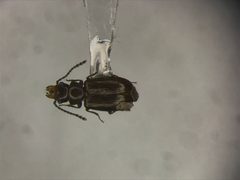
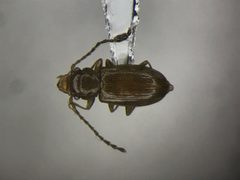
Key diagnostic features include: dorso-ventrally compressed body shape; and pronotal discs bordered by ridges or grooves; inverted male genitalia. Modified male with hook-like or blade-like scapes occur in Cryptolestes, Dysmerus, and Microbrontes. Rostrate forms in Rhinomalus, Rhinophloeus, and Metaxyphloeus. For -level identification of stored grain pests, molecular methods are often necessary due to cryptic , particularly within Cryptolestes.
Images
Habitat
Most laemophloeids inhabit the space under bark of dead trees, where they occur in association with fungal growth. Some with subcylindrical body forms, such as Leptophloeus and Dysmerus, occur in the galleries of bark beetles (Curculionidae: Scolytinae). A few genera, notably Cryptolestes, have adapted to stored grain environments. The jumping described in Laemophloeus biguttatus larvae was observed in specimens collected from fungal under bark of Quercus hemisphaerica.
Distribution
Represented on all continents except Antarctica. is greatest in tropical regions. Documented occurrences include North America (e.g., North Carolina), Japan, and Turkey (Siirt province). GBIF records indicate presence in Denmark, Norway, and Sweden.
Seasonality
of Cryptolestes ferrugineus have been observed in pistachio orchards in Turkey during May and June. Activity patterns in natural under bark are likely year-round but influenced by temperature and moisture conditions.
Diet
Most laemophloeids are primarily fungivores, feeding on fungi under bark of dead trees. Some with subcylindrical bodies occurring in bark beetle galleries may feed upon the bark beetles themselves. in Cryptolestes are pests of stored grain products. Cryptolestes ferrugineus and larvae are facultatively cannibalistic and predatory, consuming , pupae, and of other species.
Host Associations
- Fungi under bark of dead trees - food sourcePrimary diet for most laemophloeids
- Bark beetles (Curculionidae: Scolytinae) - prey or cohabitantFor with subcylindrical bodies such as Leptophloeus and Dysmerus
- Stored grain products - food source and For pest in Cryptolestes
- Quercus hemisphaerica - tree for Laemophloeus biguttatus in jumping study
- Mattesia oryzaephili (Neogregarinorida: Lipotrophidae) - of Cryptolestes ferrugineus
- Cephalonomia spp. (Hymenoptera: Bethylidae) - associated with Cryptolestes ferrugineus
Life Cycle
Holometabolous development with , larval, pupal, and stages. Late instar larvae of at least some (Laemophloeus biguttatus, Placonotus testaceus) exhibit a distinctive jumping . Specific details on egg, pupal stages, and duration of development vary by species and are not well documented for the as a whole.
Behavior
Larvae of Laemophloeus biguttatus and Placonotus testaceus perform a novel power-amplified jumping : they arch their body while gripping the substrate with legs for approximately 0.22 seconds, then rapidly curl ventrally after leg release to launch into the air. Takeoff velocities reach 0.47 m/s with horizontal distances of 11.2 mm (about 2 body lengths) and vertical heights of 7.9 mm (about 1.5 body lengths). This mechanism may involve latch-mediated spring actuation (LaMSA) using leg-substrate interaction as the latch. of Cryptolestes ferrugineus exhibit lateralized mating behavior: left-biased males (approaching from left and turning 180° left) show higher mating success (37%) than right-biased males (26%). Adults are highly sensitive to temperature and moisture gradients, capable of detecting temperature differences as small as 1°C and moisture differences of 1 percentage point in grain, moving preferentially toward warmer (25–30°C) and higher-moisture zones.
Ecological Role
Members of the under bark of dead trees, where they contribute to decomposition processes through . Some may function as facultative or scavengers in bark beetle galleries. In stored grain , Cryptolestes species act as secondary pests and can influence community structure through and on other stored product insects.
Human Relevance
Several Cryptolestes are significant pests of stored grain products, causing economic losses in agriculture and food storage. The most important pest species are Cryptolestes ferrugineus (), Cryptolestes pusillus, and Cryptolestes turcicus. These species are targets of biosecurity monitoring, with molecular diagnostic tools developed for species identification due to cryptic . Clove oil nanoparticles have been investigated as a against C. ferrugineus, with LC50 values of 0.676–0.734% at 72–120 hours. The is also studied for its novel larval jumping mechanics.
Similar Taxa
- CucujidaeHistorically treated as a of Cucujidae; distinguished by inverted male genitalia and other -level characters
- PassandridaeAnother of flat bark beetles associated with stored products; separated by morphological features in identification keys
- SilvanidaeOften found in similar and stored products; distinguished by body shape and antennal structure
More Details
Taxonomic history
was historically treated as a of Cucujidae, but was elevated to status in the mid-20th century along with other former cucujid subfamilies.
Molecular diagnostics
Cryptolestes exhibit substantial taxonomic challenges with cryptic . A proposed 'operational species-level genetic gap' of approximately 5% helps define species boundaries for biosecurity purposes.
Morphological specializations for jumping
Despite the sophisticated jumping , microCT and SEM imaging of Laemophloeus biguttatus larvae revealed no obvious morphological modifications dedicated to jumping, suggesting the behavior relies on behavioral and biomechanical rather than structural adaptations.
Sources and further reading
- BugGuide
- Wikipedia
- GBIF taxonomy match
- iNaturalist taxon
- NCBI Taxonomy
- Catalogue of Life
- Molecular Resources for the Stored Grain Cryptolestes Cryptic Pest Species (Coleoptera: Laemophloeidae)
- A novel power-amplified jumping behavior in larval beetles (Coleoptera: Laemophloeidae)
- Keys for the identification of beetles associated with stored products—II. Laemophloeidae, Passandridae and Silvanidae
- Thermostability, photostability, and toxicity of clove oil nanoparticles against Cryptolestes ferrugineus (Stephens) (Coleoptera: Laemophloeidae)
- A Novel Power-Amplified Jumping Behavior in Larval Beetles (Coleoptera: Laemophloeidae)
- The first findings on rusty grain beetle, Cryptolestes ferrugineus (Stephens, 1831) (Coleoptera, Cucujoidea: Laemophloeidae) in pistachio orchard in Siirt province (Turkey)
- Movement and distribution of Cryptolestes ferrugineus (Coleoptera: Laemophloeidae) adults in response to moisture in wheat filled in different lengths of columns
- Correction: A novel power-amplified jumping behavior in larval beetles (Coleoptera: Laemophloeidae)
- Response of Cryptolestes ferrugineus (Coleoptera: Laemophloeidae) adults to small temperature (0–6 °C) and moisture (1%) differences in wheat
- Functional Asymmetries Routing the Mating Behavior of the Rusty Grain Beetle, Cryptolestes ferrugineus (Stephens) (Coleoptera: Laemophloeidae)
- Interaction of Mattesia oryzaephili (Neogregarinorida: Lipotrophidae) with Cephalonomia spp. (Hymenoptera: Bethylidae) and their hosts Cryptolestes ferrugineus (Coleoptera: Laemophloeidae) and Oryzaephilus surinamensis (Coleoptera: Silvanidae)