
Cryptolestes turcicus
(Grouvelle, 1876)
flour mill beetle
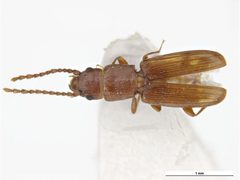
Cryptolestes turcicus is a small commonly known as the flour mill beetle, a member of the Laemophloeidae (lined flat bark beetles). It is a significant pest of stored grain products, particularly in flour mills and warehouses. The has been introduced widely through human commerce and now occurs in North America and Europe. can maintain themselves only within a temperature range of 17°C–37°C and at relative humidities above 40%, with optimal near 28°C and 90% relative humidity.
Pronunciation
How to pronounce Cryptolestes turcicus: //ˌkrɪptoʊˈlɛstiːz ˈtɜːrsɪkəs//
These audio files are automatically generated. While they are not always 100% accurate, they are a good starting point.
Identification
As a member of Laemophloeidae, Cryptolestes turcicus can be recognized by the characteristics of flattened, elongate bodies and long typical of lined flat bark beetles. It is distinguished from such as C. ferrugineus and C. capensis by subtle morphological differences and ecological preferences, though specific diagnostic characters require detailed examination. The may be separated from C. ferrugineus by differences in their and natural occurrence patterns.
Images
Habitat
Flour mills, warehouses, and facilities storing processed cereals and grain products. The thrives in warm, humid conditions associated with stored food products.
Distribution
Originally described from Europe, now distributed in North America and Europe. Documented in Canada from Alberta to Quebec, England (Slough), and additional records from Serbia, Albania, and the Azores (São Miguel).
Seasonality
Active year-round in heated indoor environments; growth most rapid near 28°C with high humidity.
Diet
Feeds upon wheatfeed and processed cereal products; a pest of stored grains.
Life Cycle
Pre- developmental periods vary with temperature and humidity. Development and occur within 17°C–37°C at relative humidities above 40%.
Ecological Role
Pest of stored and processed cereals in anthropogenic environments. Has no known beneficial ecological role.
Human Relevance
Economic pest of flour mills and grain storage facilities. Different strains show varying susceptibility to such as methyl bromide. Reproductive capacity differs between strains, with implications for pest management strategies.
Similar Taxa
- Cryptolestes ferrugineusSimilar and as a stored product pest, but differs in and natural occurrence patterns
- Cryptolestes capensisAnother congeneric stored product pest with distinct biological characteristics
- Lygaeus turcicusShares the specific epithet and pattern, but belongs to a different order (Hemiptera) and is not closely related; this is a true , not a
More Details
Strain Variation
Two distinct strains have been documented: one from the Pest Laboratory in Slough, England, and another from a local flour mill. These strains differ in susceptibility to methyl bromide and in reproductive capacity, suggesting potential cryptic diversity or to different environments.
Environmental Requirements
Laboratory studies on wheatfeed demonstrate that cannot persist below 17°C or above 37°C, and require relative humidity well above 40% for survival and .
Sources and further reading
- BugGuide
- Wikipedia
- GBIF taxonomy match
- iNaturalist taxon
- NCBI Taxonomy
- Meloidae Holdings | Entomology Research Museum
- Bug Eric: Small Milkweed Bug
- Brazil Bugs #5 – Lagartixa | Beetles In The Bush
- Botanizing at Creve Coeur Lake | Beetles In The Bush
- Bug Eric: The Germans Are Back
- Plantae | Beetles In The Bush | Page 7
- REPRODUCTIVE CAPACITY OF TWO STRAINS OF CRYPTOLESTES TURCICUS (COLEOPTERA: CUCUJIDAE)
- A NEW SYNONYM OF CRYPTOLESTES TURCICUS (GROUVELLE) (COLEOPTERA: CUCUJIDAE) WITH ADDITIONAL DISTRIBUTIONAL RECORDS
- THE BIOLOGY OF CRYPTOLESTES TURCICUS (GROUVELLE) (COLEOPTERA: CUCUJIDAE), A PEST OF STORED AND PROCESSED CEREALS