
Laemophloeus
Dejean, 1835
Species Guides
7- Laemophloeus apache
- Laemophloeus biguttatus(Two-spotted Flat Bark Beetle)
- Laemophloeus fasciatus(Square-spotted Flat Bark Beetle)
- Laemophloeus fervidus(lined flat bark beetle)
- Laemophloeus megacephalus
- Laemophloeus shastanus(lined flat bark beetle)
- Laemophloeus terminalis
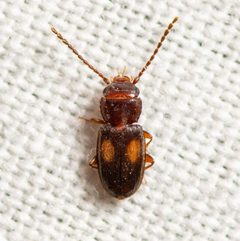
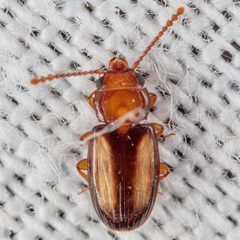
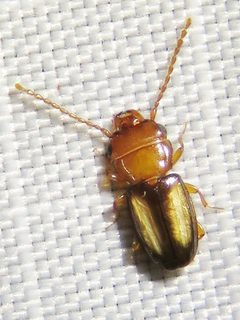
Laemophloeus is the type of the Laemophloeidae, containing 28 valid following modern taxonomic revision. Species are moderate to large for the family (2–4 mm). The genus occurs in the Palaearctic and Nearctic realms, extending into tropical regions of the New World. Several species are significant pests of stored grain and cereal products.
Pronunciation
How to pronounce Laemophloeus: //leɪmɒfˈloɪ.i.əs//
These audio files are automatically generated. While they are not always 100% accurate, they are a good starting point.
Identification
of Laemophloeus are distinguished from related by their congeneric status with the type species Laemophloeus monilis. Following Lefkovitch's revision, the genus was restricted from over 100 species to 28, with many former members now placed in other genera such as Charaphloeus. Species previously listed under Laemophloeus in broad sense should be designated as Laemophloeus (sens. lat.).
Images
Habitat
Under bark of dead trees; also associated with stored grain and cereal products. Some complete much of their within grain kernels.
Distribution
Palaearctic and Nearctic realms, extending into tropical regions of the New World. Specific distributions include: Europe (L. kraussi, L. monilis, L. muticus, L. nigricollis), North America (L. apache, L. biguttatus, L. fasciatus, L. fervidus, L. shastanus, L. terminalis), Central and South America (multiple species), Mexico (L. buenavista, L. sexarticulatus, L. taurus), Galapagos (L. insulatestudinas), Japan and Siberia (L. submonilis, L. ribbei).
Diet
Primarily fungi, especially ascomycetes, when found under bark of dead trees. Some feed on germ of wheat and other grains; maize germ also consumed.
Host Associations
- Cephalonomia waterstoni - Bethylid of Laemophloeus larvae; equally viable on L. minutus, L. ferrugineus, and L. turcicus but shows marked preference for L. ferrugineus
Life Cycle
, four larval instars, and pupa. Development duration highly temperature-dependent: at 75% relative humidity, egg to takes 69–103 days at 70°F, 26–38 days at 80°F, 19–33 days at 90°F, and 17–26 days at 100°F. First instar larvae require breaks in grain bran layers to penetrate kernels; cannot enter undamaged whole grains. mainly intergranular in wheat; cocoons formed in flour, with some larvae pupating in loose webbing.
Behavior
Oviposition in L. minutus stimulated by constant presence of males. observed in larval and stages when diet is unfavorable. Some larvae are free-living for part of their lives; proportion free-living decreases as total increases.
Ecological Role
Decomposer under bark of dead trees through . Some are significant pests of stored grain, attacking germ of wheat and other cereals. Serves as for .
Human Relevance
Several are pests of stored grain and cereal products, including wheat, rye, maize, and flour. can occur in bulk storage facilities. Manitoba wheat and whole-meal flour are particularly favorable substrates for development.
Similar Taxa
- CharaphloeusFormerly included now transferred to this ; four South American species (C. aeneus, C. deletus, C. gounellei, C. pilatei) moved from Laemophloeus (sens. lat.) based on examination of type material
Sources and further reading
- BugGuide
- Wikipedia
- GBIF taxonomy match
- iNaturalist taxon
- NCBI Taxonomy
- Catalogue of Life
- THE BIOLOGY OF LAEMOPHLOEUS FERRUGINEUS (STEPH.)
- The Biology ofLaemophloeus minutusOliv. (Col. Cucujidae)
- Host Preference of Cephalonomia Waterstoni Gahan, a Bethylid Parasitoid of Laemophloeus Species
- Study of an infestation by Laemophloeus sp. (Coleoptera Cucujidae) in bulk wheat
- A NEW SPECIES OF LAEMOPHLOEUS (COL.: CUCUJIDAE) ASSOCIATED WITH STORED PRODUCTS
- Reclassification of four South American species of Laemophloeus Dejean, 1835 into Charaphloeus Casey, 1916 (Coleoptera, Laemophloeidae)
- The Biology of Cephalonomia waterstoni Gahan (Hym., Bethylidae), a Parasite of Laemophloeus (Col., Cucujidae)
- Observations on the Life History of Laemophloeus minutus (Ol.) (Col. Cucujidae) when bred on various Stored Cereals and Cereal Products