
Laemophloeus megacephalus
Grouvelle, 1876
Laemophloeus megacephalus is a of lined flat bark beetle in the Laemophloeidae. The specific epithet "megacephalus" refers to its relatively large . The species has been documented across a broad geographic range spanning the Caribbean, Central America, and North America. As a member of the flat bark beetle family, it is associated with dead or decaying wood .
Pronunciation
How to pronounce Laemophloeus megacephalus: //ˌliːməˈfloʊ.iəs ˌmɛɡəˈsɛfələs//
These audio files are automatically generated. While they are not always 100% accurate, they are a good starting point.
Identification
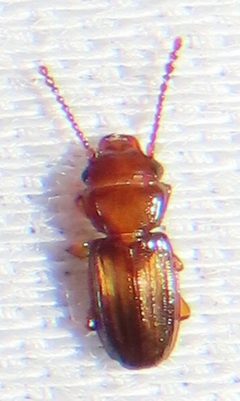
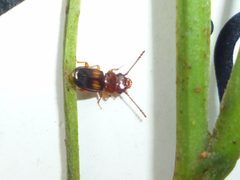
The specific epithet "megacephalus" provides a key diagnostic feature: the is conspicuously large relative to the pronotum and . This distinguishes it from with more proportionate head sizes. Definitive identification requires examination of genitalic characters and comparison with .
Images
Appearance
As a lined flat bark beetle, the body is dorsoventrally flattened, an for living under bark. The name "megacephalus" (meaning "large ") indicates a proportionally enlarged head relative to body size. Like other Laemophloeidae, it likely has parallel-sided with distinct longitudinal or lines.
Habitat
Associated with dead or decaying wood and subcortical environments, typical of the Laemophloeidae. Specific microhabitat preferences within this are not well documented.
Distribution
Documented from the Caribbean, Central America, and North America. GBIF records confirm presence across these regions without specifying particular countries or islands.
Ecological Role
As with other flat bark beetles, likely contributes to wood decomposition and nutrient cycling in forest through association with dead wood. Specific ecological functions for this have not been documented.
Similar Taxa
- Other Laemophloeus speciesDistinguished by the enlarged characteristic of L. megacephalus; generally have more typical head proportions relative to body size.
More Details
Etymology
The specific epithet "megacephalus" derives from Greek "mega" (large) and "kephale" (), directly describing the ' most notable morphological feature.