
Laemophloeus terminalis
Casey, 1884
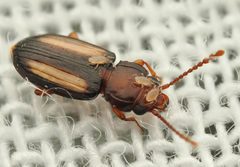
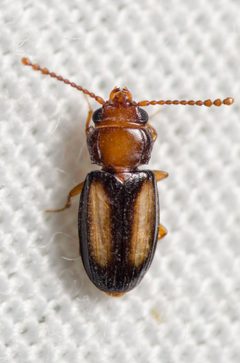
Laemophloeus terminalis is a of lined flat bark beetle in the Laemophloeidae, first described by Casey in 1884. The species is distributed across North America. Members of this are typically associated with dead or dying bark and are recognized for their flattened body form adapted for living in tight spaces under bark. The specific epithet "terminalis" likely refers to a terminal (end) marking or structure, though the original description would be needed to confirm this.

Pronunciation
How to pronounce Laemophloeus terminalis: //ˌliːməˈflɔɪəs tɜːˈmɪnəlɪs//
These audio files are automatically generated. While they are not always 100% accurate, they are a good starting point.
Identification
As a member of the Laemophloeus, this would be expected to show the characteristic features of lined flat bark beetles: strongly flattened body, parallel-sided with distinct longitudinal or (giving the "lined" appearance), and with a distinct club. Specific identification to L. terminalis would require examination of the original description by Casey (1884) or comparison with type material, as distinguishing features among the numerous Laemophloeus species are often subtle and require detailed examination of antennal structure, pronotal shape, and elytral .
Images
Habitat
Based on -level characteristics, in Laemophloeidae are typically found under the bark of dead or dying trees, where they occupy the narrow spaces between bark and wood. They are associated with moist, decaying wood and are often collected in bark beetle galleries or in association with fungal decay.
Distribution
North America. The has been recorded across the continent based on collection data and observations, with 388 observations documented on iNaturalist.
Ecological Role
Members of Laemophloeidae are generally considered scavengers or fungivores in dead wood , contributing to the decomposition of woody material and nutrient cycling in forest . Their specific ecological role in this capacity has not been separately documented for L. terminalis.
Similar Taxa
- Other Laemophloeus speciesThe Laemophloeus contains numerous that are morphologically similar, requiring detailed examination of or original descriptions for reliable identification. L. terminalis would be distinguished by specific features of antennal club structure, pronotal margins, and elytral punctuation patterns as described by Casey (1884).
- Other Laemophloeidae generaRelated in the (such as Cryptolestes, Placonotus, and others) share the flattened body form but differ in details of antennal structure, pronotal shape, and elytral . These genera are distinguished by characters of the antennal club and the presence or absence of specific pronotal features.
More Details
Taxonomic history
Described by Thomas L. Casey in 1884, this has remained in the Laemophloeus without major taxonomic revision. The Laemophloeidae has undergone significant reclassification, having been variously treated as a of Cucujidae or as a distinct family. Current classification recognizes Laemophloeidae as a valid family within Cucujoidea.
Collection records
The is represented by 388 observations on iNaturalist, indicating it is moderately well-documented but not extensively studied. Detailed biological information is sparse in the literature, typical for many small, inconspicuous species that lack economic importance.