
Neorileya
Ashmead, 1904
Neorileya is a of minute in the Eurytomidae, Rileyinae. These micro-Hymenoptera are parasitoids of true bugs (Hemiptera), with documented in Coreidae, Pentatomidae, and Reduviidae. The genus contains at least seven described distributed across the New World from central California to Argentina. Neorileya species develop as endoparasitoids within host eggs, with some species causing significant mortality in agricultural pest .
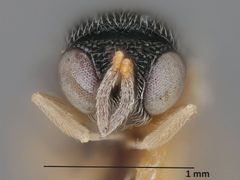
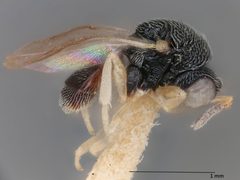
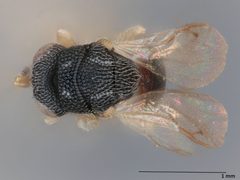
Pronunciation
How to pronounce Neorileya: /ˌniː.oʊ.rɪˈliː.jə/
These audio files are automatically generated. While they are not always 100% accurate, they are a good starting point.
Identification
Identification to requires expert examination and is challenging even for . Initial -level placement distinguishes Neorileya from Encyrtidae (the other principal family of ) by antennal structure, wing venation, and other microscopic characters. Within Eurytomidae, genus-level determination requires reference to Gates (2008) systematic revision of Rileyinae, which provides diagnostic morphological characters separating Neorileya from related genera. identification is difficult and typically requires reared specimens or molecular analysis; has been used to characterize new species.
Images
Appearance
Extremely small , typically 2–3 millimeters in length. Body form consistent with micro-Hymenoptera: compact, with reduced wing venation typical of Chalcidoidea. Specific morphological characters distinguishing Neorileya from related require microscopic examination and reference to Gates (2008) revision of Rileyinae.
Habitat
Found in supporting their , including agricultural settings such as guava orchards and natural vegetation like mesquite. have been observed on masses laid on vegetation, including loose bark of mesquite trees. Rearing studies conducted at 25°C with >60% relative humidity and 12-hour light:dark cycles.
Distribution
New World distribution ranging from central California to Argentina. Documented occurrence in Brazil (São Paulo state), with specific collection at Campinas (-22.9947°S, -47.1033°W). GBIF records indicate presence in Brazil.
Host Associations
- Leptoglossus stigma (Hemiptera: Coreidae) - Caused 70% mortality in field-collected masses in Brazilian guava orchards; of Neorileya kavatii
- Thasus neocalifornicus (Hemiptera: Coreidae) - Field observation of on string; tentative identification as Neorileya ashmeadi suggested by Dr. Michael Gates
- Brochymena sp. (Hemiptera: Pentatomidae) - Collected on and emerging from on mesquite in south Texas; possibly acting as facultative hyperparasitoid of Trissolcus brochymenae
- Reduviidae (Hemiptera) - Documented in Gates (2008) revision; anonymous commenter reported from reduviid
- Tettigoniidae (Orthoptera) - Documented in Gates (2008) revision; notable as are unrelated to true bugs (Hemiptera)
Life Cycle
Endoparasitoid development within . Eggs collected from field and reared in laboratory conditions (25°C, >60% RH, 12-hour L:D) until . Complete occurs entirely within the host egg. Mode of emergence (solitary or gregarious) not explicitly documented for but may vary by .
Behavior
females locate and oviposit into of . Efficient at finding host egg masses in field conditions, as evidenced by high rates (70% mortality in one study). No defensive stinging reported; consistent with other stingless micro-Hymenoptera.
Ecological Role
Natural enemy of leaf-footed bugs, stink bugs, and other agricultural pests. Contributes to in agroecosystems, particularly in Integrated Fruit Production systems. Potential for development as agent, as discussed for Neorileya kavatii in Brazilian guava production.
Human Relevance
agent for pest management in guava orchards and potentially other crops. Research interest for sustainable agriculture due to high rates against Leptoglossus stigma. Misidentification risk due to minute size may lead to overlooking these in ecological studies.
Similar Taxa
- EncyrtidaeAlso includes ; distinguished by antennal structure and wing venation requiring microscopic examination
- Eurytomidae (other genera)Requires reference to Gates (2008) revision of Rileyinae for -level separation based on morphological characters
More Details
Taxonomic authority
Gates (2008) ' Revision and Generic of World Rileyinae (Hymenoptera: Eurytomidae)' is the definitive reference for -level systematics, published in University of California Publications in Entomology 127: 332 pp.
Species diversity
Gates (2008) recognized six ; Neorileya kavatii was described subsequently from Brazil, bringing minimum known diversity to seven species.
Hyperparasitism
One observation suggests possible facultative hyperparasitism: Neorileya sp. emerging from pentatomid that were also parasitized by Trissolcus brochymenae (Scelionidae), indicating complex trophic interactions.