
Balcha
Walker, 1862
Species Guides
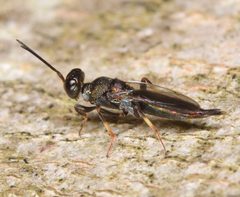
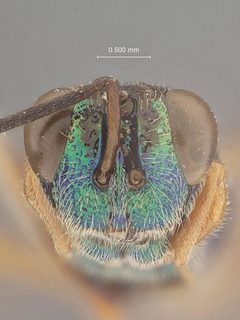
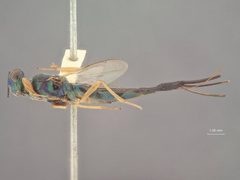
1Balcha is a of in the Eupelmidae (Hymenoptera: Chalcidoidea). The genus comprises 16 described worldwide, including eight newly described species and two newly combined species. Members are ectoparasitoids of wood-boring beetles, with Balcha indica notable as an accidental introduction to North America where it attacks the emerald ash borer (Agrilus planipennis).
Pronunciation
How to pronounce Balcha: /ˈbælkə/
These audio files are automatically generated. While they are not always 100% accurate, they are a good starting point.
Identification
The 16 of Balcha are segregated into four species groups based on morphological features. Species-level identification requires examination of detailed morphological characters; a key to world species is available in taxonomic revisions. Balcha indica can be distinguished from other eupelmids attacking emerald ash borer by its larger size and different oviposition compared to introduced agents such as Tetrastichus planipennisi and Spathius agrili.
Images
Habitat
Associated with trees infested by wood-boring beetles. Balcha indica specifically inhabits ash trees (Fraxinus spp.) infested by emerald ash borer, including forested areas with extensive ash mortality.
Distribution
Worldwide distribution with native range in Asia (Oriental region). Balcha indica has been recorded in the eastern United States: Virginia (first collected 1995), Michigan, Maryland, Pennsylvania, and West Virginia (Morgan County, 2013).
Seasonality
of Balcha indica have been collected in spring, summer, and fall. Year-round stages are observed on emerald ash borer-infested ash trees. Likely no more than two per year in the mid-Atlantic and Midwest United States (May–October growing season), with overlapping generations due to long adult lifespan.
Host Associations
- Agrilus planipennis - emerald ash borer; larvae, , and pupae (2nd–4th instar larvae, prepupae, and early white pupae)
- Fraxinus pennsylvanica - associated withgreen ash; tree for emerald ash borer
- Fraxinus spp. - associated withash trees; general tree association
Life Cycle
For Balcha indica under laboratory conditions (25±2°C, 65±10% RH, 14:10 L:D): to averages ~83 days (range 47–129 days). Egg stage up to 4 days (50% hatch within 2 days). First instar up to 9 days (50% within 5 days). Intermediate and final larval stages indistinguishable until ; 50% pupate ~62 days after oviposition. is via ; virgin females produce daughters. Multiple eggs may be laid on a , but only one survives to adulthood.
Behavior
Solitary ectoparasitoid that paralyzes larvae, , and/or pupae before oviposition. are attached to hosts via sticky silk strands. First instar larvae possess a sclerotized capsule and ; subsequent larval stages are maggot-like without visible head capsules. No apparent preference among emerald ash borer larval instars, prepupae, or pupae when presented equally. rate peaks at 3–6 weeks and again at 16–17 weeks of age.
Ecological Role
of wood-boring beetles. Balcha indica serves as a potential agent for emerald ash borer in North America, complementing introduced agents. Achieved approximately 4% of emerald ash borer in western Pennsylvania. May help suppress wood-boring pest populations in managed and natural forests.
Human Relevance
Studied as a agent for the emerald ash borer, a destructive pest of ash trees in North America. Accidental introduction to the United States provides potential service in pest suppression without deliberate release.
Similar Taxa
- Tetrastichus planipennisiBoth are of emerald ash borer introduced for ; Tetrastichus is a deliberate agent, while Balcha indica arrived accidentally. Tetrastichus is smaller and has different oviposition .
- Spathius agriliBoth attack emerald ash borer and were introduced for ; Spathius is a deliberate release, while Balcha indica is adventitious. Spathius is gregarious, producing multiple offspring per , whereas Balcha is solitary.
More Details
Taxonomic history
The was revised in 2005, with 16 recognized including eight new species (B. camptogastra, B. dictyota, B. enoptra, B. eximiassita, B. laciniosa, B. punctiscutum, B. reburra, B. reticulifrons) and two new combinations (B. reticulata, B. splendida). Balcha indica was newly recorded from the eastern United States as an accidental introduction from the Oriental region.
Laboratory rearing notes
provided with honey as food in laboratory conditions. Lifetime averages 36 (maximum 94 eggs) with mean adult lifespan of 59 days (maximum 117 days). Oviposition begins ~1 week after and peaks at 4–5 weeks with mean 8 eggs per week. Ovipositor length 4–6 mm.
Sources and further reading
- BugGuide
- Wikipedia
- GBIF taxonomy match
- iNaturalist taxon
- NCBI Taxonomy
- Catalogue of Life
- The world species of Balcha Walker (Hymenoptera: Chalcidoidea: Eupelmidae), parasitoids of wood-boring beetles
- Biology and Life History ofBalcha indica, an Ectoparasitoid Attacking the Emerald Ash Borer,Agrilus planipennis, in North America
- New Distributional Record for <i>Balcha Indica</i> (Hymenoptera: Eupelmidae) in Eastern West Virginia Discovered During Emerald Ash Borer Parasitoid Recovery Surveys