
Calosotinae
Bouček, 1958
Genus Guides
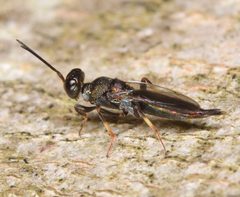
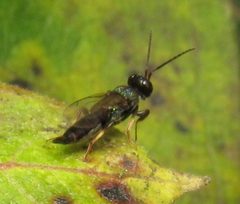
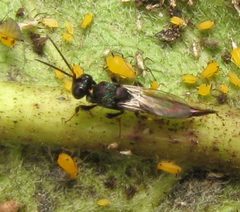
4Calosotinae is a of chalcidoid wasps within Eupelmidae, established by Bouček in 1958. The 1989 revision by Gibson recognized eight : Archaeopelma, Licrooides, Paraeusandalum, Eusandalum, Chirolophus, Calosota, Balcha, and Tanythorax. The subfamily is characterized by specific structural features of , though phylogenetic relationships within Eupelmidae remain unresolved. No derived character states definitively support monophyly of Eupelmidae, suggesting it may represent a grade-level united by convergent adaptations for jumping ability.
Pronunciation
How to pronounce Calosotinae: /ˌkæloʊsəˈtiːniː/
These audio files are automatically generated. While they are not always 100% accurate, they are a good starting point.
Identification
Calosotinae can be distinguished from Eupelminae and Metapelmatinae (the other Eupelmidae ) using structural characters detailed in Gibson (1989). The subfamily includes with diverse morphologies: Archaeopelma, Licrooides, Paraeusandalum, Eusandalum, Chirolophus, Calosota, Balcha, and Tanythorax. Specific diagnostic characters involve features of the mesosoma, wing venation, and leg structure, though these require microscopic examination.
Images
Distribution
The eight of Calosotinae have worldwide distribution. Specific regional distributions are noted for each genus in Gibson (1989), though the abstract does not enumerate these.
Similar Taxa
- MetapelmatinaeOther of Eupelmidae; distinguished by structural characters detailed in Gibson's key, though phylogenetic relationships between the two subfamilies remain unresolved
- EupelminaeThird of Eupelmidae; distinguished from Calosotinae by structural characters, with no definitive synapomorphies uniting all three subfamilies as monophyletic
More Details
Taxonomic History
Gibson (1989) proposed new generic synonyms: Notosandalum De Santis and Exosandalum Bouček = Eusandalum Ratzeburg; Metacalosoter Masi = Calosota Curtis. Four were newly described: Archaeopelma, Licrooides, Paraeusandalum, and Tanythorax.
Phylogenetic Uncertainty
No derived character states are unique to Eupelmidae or to Eupelmidae + (Tanaostigmatidae + Encyrtidae). Eupelmidae may represent a grade-level with membership determined by similar suites of apomorphic states enhancing jumping ability rather than shared ancestry.