
Balcha indica
(Mani & Kaul, 1973)
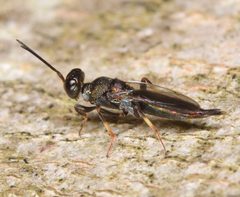
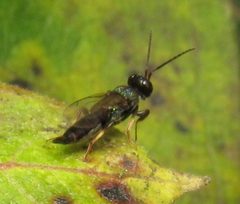
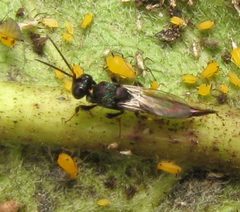
Balcha indica is a solitary ectoparasitoid in the Eupelmidae, native to Asia and accidentally introduced to North America. It attacks larvae, , and pupae of the emerald ash borer (Agrilus planipennis), an wood-boring threatening ash trees. Under laboratory conditions, the exhibits extended longevity (mean 59 days, maximum 117 days) and reproduces via . Development from to adult takes approximately 83 days at 25°C, suggesting one to two per year in temperate North American regions. The species has been recovered from field surveys in Michigan, Pennsylvania, Ohio, Ontario, Virginia, and West Virginia, where it functions as an adventitious agent of this invasive pest.
Pronunciation
How to pronounce Balcha indica: /ˈbælkə ˈɪndɪkə/
These audio files are automatically generated. While they are not always 100% accurate, they are a good starting point.
Images
Habitat
Ash trees (Fraxinus spp.) infested with emerald ash borer; specifically within ash twigs and beneath bark where larvae, , and pupae occur.
Distribution
Native to Asia (Oriental region); introduced to North America with confirmed records from Maryland, Michigan, Virginia, Pennsylvania, Ohio, West Virginia (Morgan County), and Ontario, Canada.
Seasonality
collected in spring, summer, and fall; year-round presence of stages documented in field surveys.
Diet
Ectoparasitoid feeding on larvae, , and pupae of emerald ash borer (Agrilus planipennis); diet in nature unknown, but laboratory-reared adults accept honey.
Host Associations
- Agrilus planipennis Fairmaire - primary larvae, , and pupae; no apparent preference among 2nd-4th instar larvae, prepupae, or pupae
Life Cycle
(maximum 4 days, ~50% hatch in 2 days) → first instar (maximum 9 days, 50% in 5 days; sclerotized capsule and present) → intermediate/final larval stages (maggot-like, no visible head capsule) → pupa (50% pupate ~62 days after oviposition) → (50% emerge ~83 days after oviposition, range 47–129 days). Complete ~83 days at 25°C, 65% RH, 14:10 L:D . Likely semivoltine to in field with overlapping generations due to extended adult longevity.
Behavior
Females paralyze before oviposition. attached to host via sticky silk strand. Multiple eggs may be laid on single host, but solitary : only one individual survives past first instar to adulthood. Oviposition begins ~1 week after , peaks at 4–5 weeks (mean 8 eggs/week).
Ecological Role
Potential agent against emerald ash borer; rates up to ~4% documented in western Pennsylvania. Most abundant native in some locations. May complement programs using parasitoids from China; competitive interactions with other introduced parasitoids (Tetrastichus planipennisi, Spathius agrili) require further study.
Human Relevance
Accidentally introduced agent of emerald ash borer, a destructive pest of ash trees in North America. Subject of laboratory rearing studies to assess potential for .
Sources and further reading
- BugGuide
- GBIF taxonomy match
- iNaturalist taxon
- NCBI Taxonomy
- Catalogue of Life
- EIVE 1.0 – The largest system of ecological indicator values in Europe | Blog
- Mean ecological indicator values: which system and which weighting approach to use
- Biology and Life History ofBalcha indica, an Ectoparasitoid Attacking the Emerald Ash Borer,Agrilus planipennis, in North America
- New Distributional Record for <i>Balcha Indica</i> (Hymenoptera: Eupelmidae) in Eastern West Virginia Discovered During Emerald Ash Borer Parasitoid Recovery Surveys
- The world species of Balcha Walker (Hymenoptera: Chalcidoidea: Eupelmidae), parasitoids of wood-boring beetles