
Paracrias
Ashmead, 1904
Paracrias is a of in the Eulophidae, occurring exclusively in the New World with greatest diversity in the tropics. Larvae are gregarious parasitoids of stages of beetles, primarily within Curculionoidea. records include weevils (Curculionidae), leaf-rolling weevils (Attelabidae), and bruchine seed beetles (Chrysomelidae). The genus has been studied for its potential as a agent of seed and bud pests.
Pronunciation
How to pronounce Paracrias: /ˌpærəˈkraɪəs/
These audio files are automatically generated. While they are not always 100% accurate, they are a good starting point.
Images
Habitat
Associated with seeds, buds, and syconia of plants; specifically documented from seeds of Melanoxylon brauna and syconia of fig trees (Ficus spp.). Laboratory rearing has occurred under uncontrolled temperature, humidity, and conditions.
Distribution
New World distribution with records from Rica, Brazil (Minas Gerais State), and the eastern United States (Maryland). Greatest diversity occurs in tropical regions.
Host Associations
- Homoeolabus analis - leaf-rolling weevil (Attelabidae) on Quercus and Castanea
- Ceratopus sp. - weevil larvae (Curculionidae) in fig syconia
- Sennius spodiogaster - bruchine (Chrysomelidae: Bruchinae) on seeds of Melanoxylon brauna
- Sennius cupreatus - bruchine (Chrysomelidae: Bruchinae) on seeds of Melanoxylon brauna
Life Cycle
Larvae are gregarious that develop on stages of beetles. emerge from infested seeds or other host substrates.
Behavior
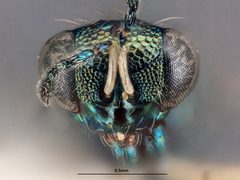
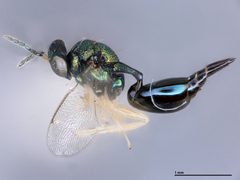
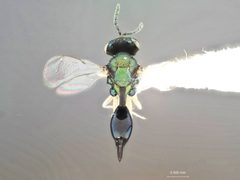
present: males have all flagellomeres distinctly separated, longer petiole, and brighter body color compared to females. Females have prepectus entirely reticulated and less bright body color.
Ecological Role
of larvae that damage seeds, buds, and plant reproductive structures; potential agent for seed pests and fig crop pests.
Human Relevance
Investigated for applications against bruchine seed beetles and other weevil pests. Association with native tree (Melanoxylon brauna) and crop plants (figs) suggests potential for managed and natural pest suppression.
Sources and further reading
- BugGuide
- Wikipedia
- GBIF taxonomy match
- iNaturalist taxon
- NCBI Taxonomy
- Catalogue of Life
- Paracrias pluteus (Hymenoptera, Eulophidae) in Brazil: new distribution and host records, and with a new host group for Paracrias
- Figure 1 from: Pikart T, Souza G, Costa V, Hansson C, Zanuncio J (2011) Paracrias pluteus (Hymenoptera, Eulophidae) in Brazil: new distribution and host records, and with a new host group for Paracrias. ZooKeys 102: 77-82. https://doi.org/10.3897/zookeys.102.1343
- Figure 2 from: Pikart T, Souza G, Costa V, Hansson C, Zanuncio J (2011) Paracrias pluteus (Hymenoptera, Eulophidae) in Brazil: new distribution and host records, and with a new host group for Paracrias. ZooKeys 102: 77-82. https://doi.org/10.3897/zookeys.102.1343
- Report of a novel biological association for Paracrias huberi Gumovsky (Hymenoptera: Eulophidae) with redescription of the female and description of the unknown male
- New records of Paracrias Ashmead (Hymenoptera, Eulophidae) as parasitoids on weevil larvae (Coleoptera, Curculionidae) in Brazil, with the description of a new species