
Centrodora
Förster, 1878
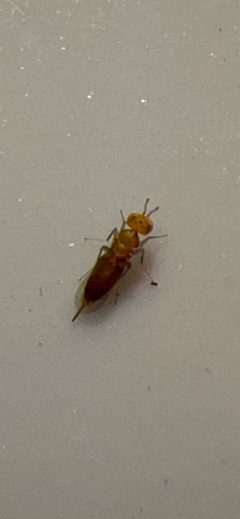
Centrodora is a of minute in the Aphelinidae, comprising approximately 60 described . The genus is notable for being the most within Aphelinidae, with species attacking of insects across multiple orders including Coleoptera, Hemiptera, Orthoptera, and Hymenoptera, as well as pupae of Diptera and nymphs of Hemiptera. Several species have been investigated as agents for crop and forest pests, including C. darwini and C. scolytivorae. The genus exhibits considerable morphological diversity, with some species groups potentially warranting elevation to separate genera.
Pronunciation
How to pronounce Centrodora: /sɛn.trəˈdɔː.rə/
These audio files are automatically generated. While they are not always 100% accurate, they are a good starting point.
Images
Distribution
occur across multiple continents including Australia (12 described species), Europe (United Kingdom, Italy, Spain), Asia (India, China, Russia), and New Zealand. Specific distribution records include: C. scolytivorae from England (Berkshire); C. italica from Italy (Sardinia, Rome, Campania, Veneto, Friuli Venezia Giulia); C. damoni from Tasmania, Australia; C. scolypopae from New Zealand.
Host Associations
- Scolytus scolytus - primary solitary endoparasitoid of European elm bark beetle larvae and pupae; C. scolytivorae
- Gonipterus spp. - eucalyptus weevil; C. damoni
- Scolypopa australis - passionvine hopper; C. scolypopae, usually with facultative
- Pachytrachis gracilis - tettigoniid; C. italica, multiple (up to 7) can emerge from single
- Eupholidoptera schmidti - tettigoniid; C. italica
- Uromenus brevicollis - tettigoniid; C. italica
- Saperda carcharias - cerambycid beetle; C. italica
- Euderus caudatus - eulophid ; C. italica
Behavior
Some exhibit ground-searching for (e.g., C. italica searches approximately 2 cm beneath soil surface). C. scolypopae shows facultative as , with as a key factor in diapause maintenance; above-average summer temperatures can trigger pre-winter in up to 60% of on sunny slopes. Sentinel egg exposure is an effective detection method for ground-dwelling species, while standard collection methods (, yellow pan traps, sweep netting, ) are unsuitable.
Ecological Role
agent of various insect pests. C. scolytivorae contributes to natural suppression of bark beetle in forest , potentially reducing tree mortality from transmission. C. scolypopae and C. damoni have been studied for control of agricultural and forestry pests. Multiple of some (e.g., C. italica) can emerge from a single , suggesting potential for high reproductive output.
Human Relevance
Investigated as agents for crop and forest pests. C. darwini has been surveyed in three recent biological control programs for crop pests. C. scolytivorae studied for control of European elm bark beetle. C. scolypopae investigated for management of passionvine hopper in New Zealand. The 's polyphagy and adaptability make attractive candidates for programs, though specificity must be carefully evaluated.
Sources and further reading
- BugGuide
- Wikipedia
- GBIF taxonomy match
- iNaturalist taxon
- NCBI Taxonomy
- Catalogue of Life
- Publications | Entomology Research Museum
- Biology and morphology of immature stages ofCentrodora scolylbopae(Hymenoptera: Aphelinidae)
- Egg parasitism in Aphelinidae (Hymenoptera: Chalcidoidea) with special reference to Centrodora and Encarsia species
- Two new host records for Centrodora italica Ferrière (Hymenoptera, Aphelinidae) from eggs of Tettigoniidae (Orthoptera, Ensifera) in northeastern Italy
- Synchronisation of the parasitoid <i>Centrodora scolypopae</i> with its host <i>Scolypopa australis</i>
- Rediscovery and redescription of Centrodora damoni (Girault) (Hymenoptera: Aphelinidae) from Australia, an egg parasitoid of Gonipterus spp (Coleoptera: Curculionidae), after nearly a century
- Influence of egg depth in host plants on parasitism ofScolylbopa australis(Homoptera: Ricaniidae) byCentrodora scolypopae(Hymenoptera: Aphelinidae)
- Fine-structural details of the photoreceptor membranes in the ocellus of the scale-insect parasite Centrodora sp. (Hymenoptera; Aphenelidae): A case of gene transfer between host and parasite?
- Figure 3 from: Ward S, Valente C, Gonçalves C, Polaszek A (2016) Rediscovery and redescription of Centrodora damoni (Girault) (Hymenoptera: Aphelinidae) from Australia, an egg parasitoid of Gonipterus spp (Coleoptera: Curculionidae), after nearly a century. Biodiversity Data Journal 4: e7766. https://doi.org/10.3897/BDJ.4.e7766
- Figure 8 from: Ward S, Valente C, Gonçalves C, Polaszek A (2016) Rediscovery and redescription of Centrodora damoni (Girault) (Hymenoptera: Aphelinidae) from Australia, an egg parasitoid of Gonipterus spp (Coleoptera: Curculionidae), after nearly a century. Biodiversity Data Journal 4: e7766. https://doi.org/10.3897/BDJ.4.e7766
- Figure 7 from: Ward S, Valente C, Gonçalves C, Polaszek A (2016) Rediscovery and redescription of Centrodora damoni (Girault) (Hymenoptera: Aphelinidae) from Australia, an egg parasitoid of Gonipterus spp (Coleoptera: Curculionidae), after nearly a century. Biodiversity Data Journal 4: e7766. https://doi.org/10.3897/BDJ.4.e7766
- Figure 9 from: Ward S, Valente C, Gonçalves C, Polaszek A (2016) Rediscovery and redescription of Centrodora damoni (Girault) (Hymenoptera: Aphelinidae) from Australia, an egg parasitoid of Gonipterus spp (Coleoptera: Curculionidae), after nearly a century. Biodiversity Data Journal 4: e7766. https://doi.org/10.3897/BDJ.4.e7766
- Figure 5 from: Ward S, Valente C, Gonçalves C, Polaszek A (2016) Rediscovery and redescription of Centrodora damoni (Girault) (Hymenoptera: Aphelinidae) from Australia, an egg parasitoid of Gonipterus spp (Coleoptera: Curculionidae), after nearly a century. Biodiversity Data Journal 4: e7766. https://doi.org/10.3897/BDJ.4.e7766
- Figure 2 from: Ortis G, Triapitsyn SV, Mazzon L (2023) Two new host records for Centrodora italica Ferrière (Hymenoptera, Aphelinidae) from eggs of Tettigoniidae (Orthoptera, Ensifera) in northeastern Italy. ZooKeys 1156: 25-31. https://doi.org/10.3897/zookeys.1156.97364
- Figure 4 from: Ward S, Valente C, Gonçalves C, Polaszek A (2016) Rediscovery and redescription of Centrodora damoni (Girault) (Hymenoptera: Aphelinidae) from Australia, an egg parasitoid of Gonipterus spp (Coleoptera: Curculionidae), after nearly a century. Biodiversity Data Journal 4: e7766. https://doi.org/10.3897/BDJ.4.e7766
- Figure 2 from: Ward S, Valente C, Gonçalves C, Polaszek A (2016) Rediscovery and redescription of Centrodora damoni (Girault) (Hymenoptera: Aphelinidae) from Australia, an egg parasitoid of Gonipterus spp (Coleoptera: Curculionidae), after nearly a century. Biodiversity Data Journal 4: e7766. https://doi.org/10.3897/BDJ.4.e7766