
Triepeolus verbesinae
(Cockerell, 1897)
cuckoo bee
Triepeolus verbesinae is a cleptoparasitic in the Apidae. As a cuckoo bee, females lay in the nests of bees rather than constructing their own nests or provisioning . The species is distributed across the United States and Mexico. Like other members of the Triepeolus, it is associated with pollen-collecting host bees, though the specific host species for T. verbesinae has not been definitively documented.
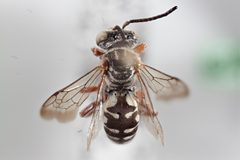
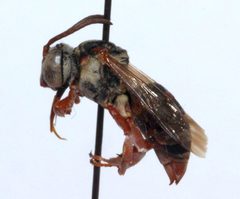
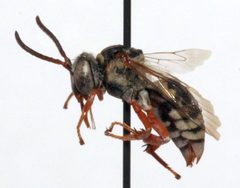
Pronunciation
How to pronounce Triepeolus verbesinae: /traɪˈɛpiˌoʊləs vərˈbɛsɪˌneɪ/
These audio files are automatically generated. While they are not always 100% accurate, they are a good starting point.
Images
Distribution
United States and Mexico.
Behavior
Females are that enter nests to deposit in . The developing larvae consume the host's pollen provisions and often the host egg or larva. Males do not participate in nest .
Ecological Role
Acts as a on other , potentially regulating bee . may visit flowers for nectar despite not collecting pollen.
Similar Taxa
- Triepeolus concavusSimilar cuckoo bee in the same ; both are cleptoparasitic bees with overlapping geographic ranges and -seeking . T. concavus has been documented parasitizing Svastra bees.
- Epeolus speciesRelated cuckoo bees in the tribe Epeolini with similar cleptoparasitic ; historically some Triepeolus were classified in Epeolus, and they share morphological and behavioral traits.
Sources and further reading
- BugGuide
- Wikipedia
- GBIF taxonomy match
- iNaturalist taxon
- NCBI Taxonomy
- Catalogue of Life
- The Native Bees in the UC Davis Bee Haven | Bug Squad
- What Native California Plants Are Best for Attracting Pollinators? | Bug Squad
- Primary Type List | Entomology Research Museum
- Researching the Hedgerows | Bug Squad
- California Poppy: No Nectar, Just Pollen | Bug Squad
- Know Your Native Bees: Here's How! | Bug Squad