
Centris
Fabricius, 1804
Oil-diggers
Species Guides
10- Centris atripes(Black-legged Oil-Digger)
- Centris caesalpiniae(Caesalpinia Oil-Digger)
- Centris cockerelli(Cockerell's Oil-Digger)
- Centris errans(Wandering Centris)
- Centris flavofasciata(Yellow-banded Oil-Digger)
- Centris hoffmanseggiae
- Centris lanosa(Wooly Oil-Digger)
- Centris nitida(Shining Oil-digger Bee)
- Centris pallida(Pallid Desert-Digger)
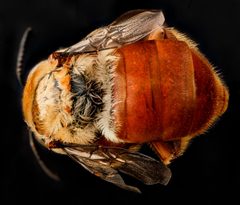
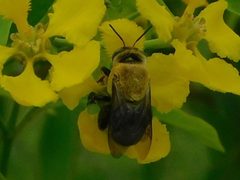
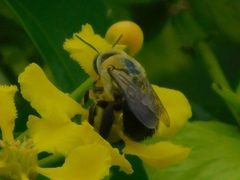
Centris is a of approximately 250 large apid bees distributed from the southern United States through South America. Females are specialized oil collectors, possessing morphological adaptations for gathering floral oils from plants, primarily in the Malpighiaceae, which they use for larval nutrition and construction. The genus is sister to the corbiculate bees (honey bees, bumble bees, ) and represents an important lineage for understanding evolution and pollination .
Pronunciation
How to pronounce Centris: /ˈkɛn.trɪs/
These audio files are automatically generated. While they are not always 100% accurate, they are a good starting point.
Identification
Distinguished from the closely related Epicharis by the absence of long, whip-like setae projecting backwards from behind the . Large body size (up to 3 cm) and rapid are characteristic. Females possess specialized structures for carrying floral oils.
Images
Habitat
Found in diverse including American deserts, open shrubby vegetation (Caatinga), semi-deciduous forest and Cerradão (Cerrado), and urban areas. Nests are excavated in clay or hard soils, with some using horizontal, sunny, sandy surfaces without vegetation.
Distribution
Neotropical and Nearctic realms, ranging from Kansas south to Argentina.
Diet
Females collect floral oils primarily from Malpighiaceae, and also from Plantaginaceae, Calceolariaceae, and Krameriaceae. Pollen is gathered from multiple plant including Solanaceae, Caesalpiniaceae, Malpighiaceae, and Ochnaceae, often using buzz pollination.
Life Cycle
Ground-nesting solitary bees. Nests consist of excavated tunnels in soil, typically with a main tunnel leading to a linear series of urn-shaped . Cell caps feature a characteristic hollow central projection. Nest construction and provisioning are performed by females alone.
Behavior
Males exhibit diverse mate-searching strategies including hovering at food plants and scent-marking territories. In some , males display alternative reproductive tactics with dimorphic and : large-morph males use scent-based searching in hot ground-level microclimates, while small-morph males use visual cues for hovering in cooler aerial microclimates. Nesting females seal nest entrances at night with soil, pebbles, and twigs.
Ecological Role
Important of multiple plant . Documented as significant pollinators of Brazil nuts (Bertholletia excelsa) and cashews (Anacardium occidentale). The relationship with Krameria is obligate for the plants, though the bees utilize multiple oil-producing .
Human Relevance
Of economic significance in pollinating crops including Brazil nuts and cashews. Subject of extensive behavioral research, particularly C. pallida as a model system for studying alternative reproductive tactics and climate change impacts on body size.
Similar Taxa
- EpicharisClosely related distinguished by presence of long, whip-like setae projecting backwards from behind the , which are absent in Centris.
Sources and further reading
- BugGuide
- Wikipedia
- GBIF taxonomy match
- iNaturalist taxon
- NCBI Taxonomy
- Catalogue of Life
- Friday flower – Krameria lanceolata | Beetles In The Bush
- Mason bees in peril when parasitic wasps arrive – Leucospid wasp, Leucospis affinis — Bug of the Week
- Nesting biology of Centris (Centris) aenea Lepeletier (Hymenoptera, Apidae, Centridini)
- Plastic nesting behavior of Centris (Centris) flavifrons (Hymenoptera: Apidae: Centridini) in an urban area
- The species of the bee genus Centris of the “hyptidis group” revisited with the description of Centris (Anisoctenodes) new subgenus (Hymenoptera: Apidae: Centridini)
- Primer registro de la abeja colectora de óleo Centris (Odontoxys) melanochlaena Smith, 1874 (Hymenoptera, Apidae) en Nicaragua First record of the oil-collecting bee Centris (Odontoxys) melanochlaena Smith, 1874 (Hymenoptera, Apidae) in Nicaragua
- Revision of the bee subgenus Centris (Wagenknechtia) Moure, 1950 (Hymenoptera: Apidae: Centridini)
- Centris pallida (Hymenoptera: Apidae) male body size decreases across five decades
- Individual reflectance of solar radiation confers a thermoregulatory benefit to dimorphic males bees ( Centris pallida ) using distinct microclimates
- Alternative Reproductive Tactics Associated with Variable Sensory Biology and Thermal Physiology in Male Centris pallida (Hymenoptera: Apidae) Bees
- Territoriality and Scent Marking By Centris Males (Hymenoptera, Anthophoridae) in Jamaica
- Keys to the Argentine species of Centris (Hymenoptera, Apidae), with descriptions of new species and notes on distribution
- Revision of the species of Centris (Xanthemisia) Moure, 1945 <br />(Hymenoptera: Apidae: Centridini) from the Caribbean island
- Sex- and Male-Morph-Specific Variation in Brain Mass and Cell Number Scaling in Solitary Centris pallida (Hymenoptera: Apidae) Bees.