
Centris errans
Fox, 1899
Wandering Centris, Florida locust-berry oil-collecting bee, spiny bear's-breech
Centris errans is a of oil-collecting in the tribe Centridini, Apidae. It is to Florida, where it is one of five Apidae species restricted to the state. The species occurs in the southernmost portion of Florida and has also been recorded in the broader Caribbean and North America regions. Like other Centris bees, it is known to collect floral oils rather than nectar from certain plants.
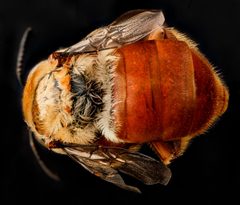

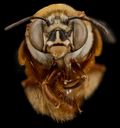
Pronunciation
How to pronounce Centris errans: /ˈsɛn.trɪs ˈɛr.ænz/
These audio files are automatically generated. While they are not always 100% accurate, they are a good starting point.
Images
Habitat
Occurs in the southernmost portion of Florida. Specific preferences are not well documented, but related Centris are associated with dry, sandy, or scrubland environments where oil-producing plants grow.
Distribution
to Florida in the United States, specifically the southernmost portion of the state. Also recorded in the Caribbean and North America more broadly.
Diet
Collects floral oils from oil-producing plants, including Krameria . These oils are mixed with pollen to provision larvae. Does not collect nectar.
Host Associations
Behavior
Ecological Role
Similar Taxa
- Centris lanosaAnother oil-collecting Centris found in similar ; distinguished by specific morphological features and geographic distribution not overlapping with the Florida- C. errans.
- Other Centris speciesShare the oil-collecting and general body plan, but C. errans is distinguished by its restricted Florida distribution and specific morphological characteristics.
More Details
Endemic status
One of only five from the Apidae that are to Florida, highlighting its conservation significance for the state's unique fauna.
Oil-collecting specialization
The 'Florida locust-berry oil-collecting ' refers to the ' specialized of collecting floral oils rather than nectar, a trait shared with other Centridini bees.