
Apis mellifera carnica
Pollmann, 1879
Carniolan honey bee, Carniolan bee
Apis mellifera carnica is a of the western honey bee native to Slovenia, southern Austria, and parts of the Balkans. It is distinguished by darker coloration than the Italian honey bee and is valued in for its gentle temperament and rapid spring colony buildup. The subspecies has been the focus of intensive breeding programs, including the New World Carniolan line developed by Susan Cobey, now an industry standard. Research indicates A. m. carnica exhibits distinct genetic responses to thermal stress and shows potential resistance traits against Varroa destructor mites through . The subspecies is the subject of international conservation efforts, with Slovenia restricting beekeeping to Carniolan bees only.
Pronunciation
How to pronounce Apis mellifera carnica: /ˈa.pɪs mɛˈlɪ.fɛ.ra ˈkar.nɪ.ka/
These audio files are automatically generated. While they are not always 100% accurate, they are a good starting point.
Identification
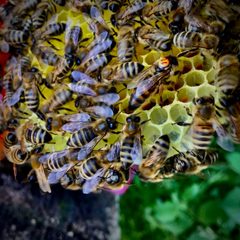
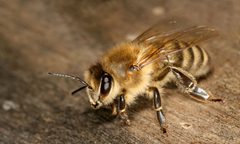
Distinguished from Italian honey bee (A. m. ligustica) by darker, gray-brown to blackish coloration rather than yellow-brown. Separated from European dark bee (A. m. mellifera) by more visible abdominal banding and notably gentler . Differs from Caucasian (A. m. caucasica) in showing faster spring colony development and reduced sensitivity to wind during pollen foraging. length (6.5-6.7 mm) is intermediate between Italian and Caucasian bees. In managed colonies, rapid spring buildup resulting in early peaks is a characteristic trait.
Images
Habitat
Native to temperate montane and forested regions of the eastern Alps and northern Balkans. Thrives in cooler climates with continental weather patterns. In managed settings, housed in standard Langstroth or Dadant hives; in natural state, occupies cavities in trees and rock formations. Research on unmanaged colonies documented in temperate forest environments using static-volume hives (45L) in southern Germany.
Distribution
Native range: Slovenia, southern Austria, parts of Croatia, Bosnia and Herzegovina, Serbia, Hungary, Romania, and Bulgaria. Center of production in Slovenia, particularly the Semic region. Introduced to North America through breeding programs; commercially propagated in California and Washington State. Distribution records from Azores islands (Corvo, Faial, Flores, Graciosa, Pico) indicate introduced .
Seasonality
In temperate forest environments, swarming occurs between mid-May and late June, with colonies producing an average of 1.7 swarms per season. Rapid spring development begins early; colonies reach peak faster than many other . rearing extends from April through July in eastern European conditions, with strongest colony development in spring period.
Diet
Nectar and pollen from diverse flowering plants; polylectic forager. Specific dietary composition varies by and season. Pollen collection correlated with meteorological conditions, particularly wind speed. Protein content of collected pollen positively correlated with production (0.391, p ≤ 0.05).
Host Associations
- Varroa destructor - Ectoparasitic mite; A. m. carnica exhibits as potential resistance mechanism, though studies show no significant correlation between grooming rate and colony level in tested Croatian
Life Cycle
Holometabolous development with complete : , larva, pupa, . Eggs hatch in approximately 3 days; larval development lasts about 6 days; approximately 12 days for (total development ~21 days from egg to adult). Queens develop more rapidly (~16 days). Colony occurs via swarming: virgin queens mate with multiple drones during . In unmanaged colonies, swarming frequency averages 1.7 events per colony per season.
Behavior
Exhibits gentle temperament with reduced defensive compared to some . Rapid spring buildup behavior results in early colony peaks. Demonstrates hoarding behavior in laboratory settings with measurable repeatability. behavior directed at Varroa destructor mites shows 12.69% average mite injury rate across tested colonies. Sequential hygienic behavior documented. Drone behavioral responses to -produced components differ from African subspecies. Less sensitive to wind speed during pollen foraging compared to A. m. caucasica (correlation -0.642 vs. -0.600).
Ecological Role
Primary in native temperate forest and montane . Contributes to pollination of agricultural crops in managed settings. As cavity-nesting , creates for associated organisms in tree hollows and rock crevices. demography studies of wild-living colonies inform conservation of genetic diversity across Europe.
Human Relevance
Major commercial valued for gentle temperament, rapid spring buildup, and with smaller winter cluster size. Foundation of New World Carniolan Breeding Program (31st , industry standard). Subject of international germplasm collection and cryopreservation efforts by Washington State University, the only U.S. laboratory permitted to import semen. Slovenia mandates exclusive use of Carniolan bees in beekeeping. Instrumental insemination techniques developed specifically for this subspecies. Target of genetic improvement programs for Varroa resistance and .
Similar Taxa
- Apis mellifera ligusticaItalian honey bee is lighter yellow-brown in color, less rapid spring buildup, longer tongue but less suited to cooler climates; both widely used in commercial
- Apis mellifera caucasicaCaucasian has longer , slower spring development, and greater sensitivity to wind during foraging; A. m. carnica produces more capped in spring conditions
- Apis mellifera melliferaEuropean dark bee is uniformly dark without abdominal banding, more defensive, and less commercially propagated; historically present in North America before Italian introduction
More Details
Genetic Research Significance
A. m. carnica was selected for gene studies due to its genetic tractability; research achieved 44% transformation rate using hyperactive transposase and optimized embryo injection techniques
Thermal Stress Response
exhibit upregulation of l(2)efl gene variants under thermal stress, with fold changes reaching 200-fold for specific variants, suggesting robust heat-shock mechanisms and potential epigenetic contributions to thermotolerance
Conservation Status
Subject of first International Symposium About the Carniolan in Slovenia; international working group formed for conservation; genetic diversity preservation considered critical for managed health
Sources and further reading
- BugGuide
- GBIF taxonomy match
- iNaturalist taxon
- NCBI Taxonomy
- Catalogue of Life
- Why Genetic Diversity Is Important in the Honey Bee | Bug Squad
- Susan Cobey: Part of WSU Team That Is 'Building a Better Bee' | Bug Squad
- Who Deliberately Runs Over Bee Hives? | Bug Squad
- The Heartbreaking Story of a Bee Scientist Who Lost Everything | Bug Squad
- Shedding New Light on Honey Bee Chromosomes | Bug Squad
- Western Honey Bee Origin: It's in the Genes | Bug Squad
- Thermal stress induces upregulation of l(2)efl in eggs of Apis mellifera jemenitica and Apis mellifera carnica (Hymenoptera, Apidae)
- Grooming behavior in relation to varroa (Varroa destructor) infestation level of Carniolan honey bee colonies (Apis mellifera carnica)
- Swarming rate and timing of unmanaged honeybee colonies ( Apis mellifera carnica ) in a forest environment
- Relationships Between the Quantity and Quality of Pollen and the Quantity of Capped Brood in Apis mellifera carnica and Apis mellifera caucasica
- Behavioural response of drone honey bees, Apis mellifera carnica and Apis mellifera scutellata, to worker-produced pheromone components
- Repeatability of hoarding behavior of honeybee workers (Apis mellifera carnica Polm) in laboratory test cages
- Quantitative analysis of social grooming behavior of the honey bee Apis mellifera carnica
- Sequential hygienic behavior in Carniolan honey bees (Apis mellifera carnica)
- Fungal extracts influence lifespan and immune responses in the Carniolan honey bee (Apis mellifera carnica, Pollmann 1879).