
Apis mellifera ligustica
Spinola, 1806
Italian honey bee, Ligurian honey bee
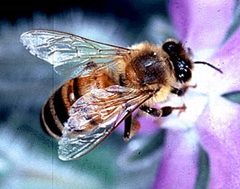
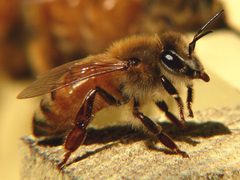
Apis mellifera ligustica, the Italian , is a of the western honey bee native to the Italian Peninsula. It was introduced to the United States in 1859 and has become the most common subspecies used in American commercial . The subspecies is characterized by its yellow coloration, gentle temperament, and strong rearing capacity. It is widely utilized for honey production and crop pollination, though it shows less resistance to Varroa mites compared to some other honey bee stocks.
Pronunciation
How to pronounce Apis mellifera ligustica: /ˈeɪ.pɪs mɛˈlɪ.fɛ.rə lɪˈɡʌs.tɪ.kə/
These audio files are automatically generated. While they are not always 100% accurate, they are a good starting point.
Identification
Distinguished from the dark European honey bee (A. m. mellifera) by lighter yellow coloration and less body hair. Differs from Carniolan bees (A. m. carnica) in having more pronounced yellow banding and less grayish coloration. Can be differentiated from by generally larger size, less defensive , and more consistent yellow coloration. Molecular identification requires analysis of mitochondrial or microsatellite markers.
Images
Appearance
exhibit a yellow to golden-brown coloration with distinct yellow bands on the . Queens are larger with a more elongated abdomen, typically showing darker coloration with some yellow markings. Drones are robust with large that meet at the top of the . The overall body is less hairy and more slender than the darker European A. m. mellifera.
Habitat
Thrives in temperate to Mediterranean climates. Requires floral resources across extended foraging seasons. In managed settings, inhabits standard Langstroth and similar hive designs. Less adapted to cold winters than northern European , requiring more intensive management in harsh climates.
Distribution
Native to the Italian Peninsula, particularly the Liguria region. Introduced and established throughout North America, South America, Australia, and many other regions worldwide. The most widely distributed globally due to commercial operations.
Seasonality
Maintains strong rearing through extended periods when resources permit; less prone to winter brood rearing cessation than some northern . In temperate regions, active from early spring through late fall with winter clustering .
Diet
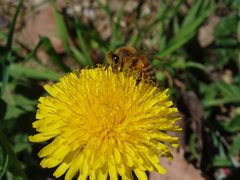
Nectar and pollen from diverse flowering plants; polylectic foragers utilizing wide range of floral resources. Require both (nectar/honey) and protein (pollen) sources for colony nutrition.
Host Associations
- Varroa destructor - Susceptible to ; significant management challenge requiring intervention
- Varroa jacobsoni - Original Varroa affecting honey bees; A. m. ligustica shows that can damage mites but less effective than A. cerana
- Tropilaelaps mercedesae - Emerging threat; can disperse via swarming and survive on foragers
Life Cycle
Holometabolous development with complete . Queens lay in wax ; larvae fed progressively by nurse bees. development: egg (3 days), larva (6 days), pupa (12 days), (21 days total). Drone development approximately 24 days. development: 16 days total with accelerated feeding on . Colony occurs through swarming, where old queen departs with worker cohort and new queens fight to assume colony leadership.
Behavior
Exhibits dueling during colony , where multiple virgin queens fight until one survivor remains. demonstrate behavior to remove phoretic Varroa mites, though less effectively than Asian . Queens produce tooting sounds that appear to inhibit worker aggression during queen combat. Workers may immobilize queens during duels, and queens may eject contents to cause rivals to be targeted by workers. Shows color generalization and associative learning in foraging contexts.
Ecological Role
Primary for numerous agricultural crops and wild plants. Contributes to plant reproductive success through pollen transfer. As a managed pollinator, supports agricultural productivity valued at billions of dollars annually in the United States alone.
Human Relevance
in commercial worldwide, particularly in North America since 1859. Primary source of honey production and rented pollination services for crops including almonds, apples, berries, and numerous vegetables. Subject of extensive breeding programs to improve resistance and productivity. Genetic material collected and cryopreserved for breeding stock improvement. Threatens native dark (A. m. mellifera) through hybridization and .
Similar Taxa
- Apis mellifera melliferaDarker coloration, more body hair, more cold-adapted; historically present in North America before Italian introduction
- Apis mellifera carnicaGrayish coloration, more rapid spring buildup, considered more gentle; darker than Italian bees with less distinct banding
- Apis mellifera scutellata (Africanized honey bee)More defensive , smaller size, tendency for frequent swarming; hybrid origin involving African
More Details
Genetic Improvement Programs
Subject of instrumental insemination and selective breeding programs at Washington State University and other institutions to enhance Varroa resistance and other desirable traits. Semen collected from European for cryopreservation and genetic diversity maintenance.
Conservation Concerns
Commercial propagation has led to genetic threatening protected of native European dark bees (A. m. mellifera) in northwest Europe, including the legally protected population on Læsø Island, Denmark.
Sources and further reading
- BugGuide
- GBIF taxonomy match
- iNaturalist taxon
- NCBI Taxonomy
- Catalogue of Life
- Western Honey Bee Origin: It's in the Genes | Bug Squad
- Susan Cobey: Part of WSU Team That Is 'Building a Better Bee' | Bug Squad
- Are Honeybees the Most Effective Pollinators? | Bug Squad
- Social Patterns That Resist Varroa Mite Seen in Honey Bees for First Time
- Where have all the honeybees gone? Honeybees, Apis mellifera — Bug of the Week
- New Research Links Honey Bee Swarms to the Spread of an Invasive Mite
- Colour generalization and choice behaviour of the honeybee Apis mellifera ligustica
- Tissue distribution and properties of glutathione S-transferases in Apis cerana cerana Fabricius and Apis mellifera ligustica Spinola
- Grooming behavior and damaged mites (Varroa jacobsoni) in Apis cerana cerana and Apis mellifera ligustica
- Varying degrees of Apis mellifera ligustica introgression in protected populations of the black honeybee, Apis mellifera mellifera, in northwest Europe
- The Behavior of Honey Bees (Apis mellifera ligustica) during Queen Duels
- Colour signals and choice behaviour of the honeybee (Apis mellifera ligustica)
- Comparative evaluation of sperm parameters in Italian (Apis mellifera ligustica) and Africanized (Apis mellifera) honeybee drones from the Caatinga biome.