
Phylloxera caryaefoliae
Fitch, 1856
pecan leaf phylloxera
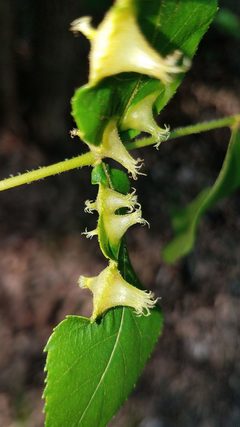
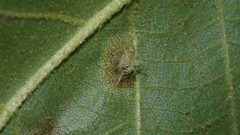
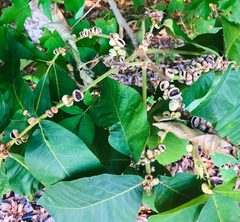
Phylloxera caryaefoliae is a tiny, soft-bodied, gall-forming insect closely related to aphids that infests pecan trees. It produces conspicuous galls exclusively on leaf tissue, distinguishing it from the more damaging pecan phylloxera (P. devastatrix) which attacks shoots and nuts. While extensive may cause some defoliation, this is generally less economically significant than shoot-attacking phylloxerans. The insect has a complex involving multiple and both winged and wingless forms.
Pronunciation
How to pronounce Phylloxera caryaefoliae: //fɪˈlɒksɪrə ˌkɛəriəˈfɒli.iː//
These audio files are automatically generated. While they are not always 100% accurate, they are a good starting point.
Identification
Distinguished from pecan phylloxera (P. devastatrix) by gall location: P. caryaefoliae forms galls on leaves only, while P. devastatrix attacks shoots and nuts. Galls on leaves appear during spring and early summer. Second and sometimes third occur if new growth is available, producing additional galls—unlike pecan phylloxera which forms no additional galls after the first generation. Survey orchards in May for galls to identify infested trees for targeted treatment the following spring.
Images
Habitat
Pecan orchards and native pecan ; restricted to areas where Carya illinoinensis (pecan) and related hickory (Carya spp.) occur. move slowly from tree to tree because cannot fly long distances.
Distribution
Pecan-growing regions of Texas and the southern United States; distribution corresponds to that of its plants in the Carya.
Seasonality
hatch in spring during bud break. Nymphs feed on new growth and induce gall formation. Winged emerge from galls when they crack open. Second and sometimes third occur during the growing season if new growth remains available. eggs are deposited by females in bark crevices or near old galls.
Diet
Feeds on phloem sap of pecan leaves; nymphs insert needle-like mouthparts into leaf tissue and secrete substances that stimulate abnormal plant growth, forming nutritive tissue within galls.
Host Associations
- Carya illinoinensis - primary pecan
- Carya spp. - hickory
Life Cycle
Overwinters as in bark crevices. In spring, nymphs emerge during bud break and feed on new leaf growth, inducing gall formation. Nymphs develop inside galls, which range from 1/10 to 1 inch in diameter. Galls eventually crack open, releasing winged . Some adult females deposit eggs producing second and sometimes third of galls if new growth is available. Other females overwinter, depositing eggs the following spring. Unlike pecan phylloxera, this does not form additional galls after the first generation in all cases—some females continue reproducing on new growth during the season.
Behavior
Nymphs feed by inserting mouthparts into leaf tissue and secreting chemical substances that manipulate plant development, causing to differentiate and form protective galls. The insect completes development entirely within these galls. are poor fliers and disperse slowly between trees.
Ecological Role
Acts as a gall-forming herbivore that manipulates plant tissue for nutrition and shelter. Serves as prey for natural enemies including lacewings, lady beetles, spiders, and parasitic . Galls may provide for other organisms; phylloxera galls have been observed to harbor hickory shuckworm larvae in spring.
Human Relevance
Agricultural pest of pecan trees. Causes leaf galls that may lead to defoliation in heavy , potentially reducing photosynthetic capacity and tree vigor. Less economically damaging than pecan phylloxera (P. devastatrix) which attacks reproductive structures. Managed in commercial orchards through targeted applications timed to kill nymphs after hatch but before gall formation protects them. Control is facilitated by the ' limited ability—infestations can be managed by treating only affected trees.
Similar Taxa
- Phylloxera devastatrixAlso attacks pecans; distinguished by gall location (shoots and nuts vs. leaves only) and more severe economic impact. P. devastatrix forms no additional galls after first , while P. caryaefoliae may produce second and third generations on new growth.
- Phylloxera caryaecaulisAnother hickory/pecan phylloxeran; specific differences in gall and preferences not detailed in available sources but represents a related gall-forming on Carya.
More Details
Management considerations
applications must be timed precisely: after hatch in spring but before nymphs are enclosed within galls. Optimal timing is after bud break when new growth is 1 to 2 inches long. Because cannot fly long distances, spot treatment of infested trees is often effective. Native trees and improved pecan varieties vary in susceptibility.
Taxonomic note
The specific epithet 'caryaefoliae' refers to the Carya (hickories and pecan) and 'foliae' (leaves), accurately describing this ' restriction to leaf tissue. Sometimes referred to as 'pecan leaf phylloxera' in agricultural literature.
Sources and further reading
- BugGuide
- GBIF taxonomy match
- iNaturalist taxon
- Catalogue of Life
- Insects and mites that feed on leaves - AgriLife Extension Entomology
- Managing Insect and Mite Pests of Commercial Pecans in Texas - AgriLife Extension Entomology
- Meet 'The Moth Man' at Bohart Museum's Moth Night | Bug Squad
- A Victory for the Bees | Bug Squad
- Gall darn it! Gall insects on hickory, oak, and elm, Phylloxera caryaecaulis, Andricus palustris, Colopha ulmicola — Bug of the Week
- grape phylloxera Archives - Entomology Today