
Aulacaspis
Cockerell, 1893
Species Guides
1- Aulacaspis yasumatsui(cycad aulacaspis scale)
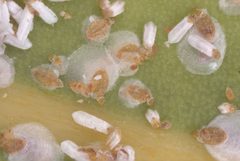
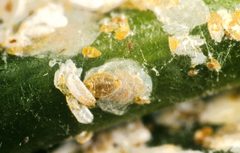
Aulacaspis is a of armored scale insects in the Diaspididae. These small, sap-sucking insects are characterized by their protective waxy coverings, called tests, which shield their soft bodies. The genus includes numerous , some of which are significant agricultural and horticultural pests. The type species is Aulacaspis rosae. Several species have become outside their native ranges, notably Aulacaspis yasumatsui, which has caused severe damage to cycad worldwide.
Pronunciation
How to pronounce Aulacaspis: //ˌɔːləˈkæspɪs//
These audio files are automatically generated. While they are not always 100% accurate, they are a good starting point.
Identification
Members of Aulacaspis possess coverings (tests) that differ between sexes: females typically have circular or oblong tests, while males have smaller, parallel-sided tests. The tests are formed from wax exuded through pores in the dermis, creating a protective cover over the insect's body. Under magnification, the body is soft and the insect possesses an elongated beak for piercing plant tissues. Specific identification to level requires examination of microscopic morphological features of the female, including pygidial structures and duct arrangements.
Images
Distribution
The has a broad distribution across tropical and subtropical regions. Individual show distinct ranges: Aulacaspis yasumatsui is native to Southeast Asia (Thailand, China, Hong Kong, Taiwan, Vietnam) but has been introduced to North America (Florida, Hawaii, Georgia, South Carolina, Texas, Alabama, Louisiana), the Caribbean, Central America, Europe (United Kingdom, Bulgaria, Croatia, Cyprus, Hungary, Poland, Slovenia), Africa (South Africa), and Oceania (Fiji, Guam, Palau). Aulacaspis tubercularis occurs across Africa, Asia, Australia, the Americas, and Pacific islands. Aulacaspis tegalensis and A. madiunensis are found in Asia and Africa.
Diet
Members of this are phloem feeders that use to extract contents from plants. The elongated beak penetrates plant tissues to access nutritious fluids, causing direct damage through tissue destruction and potential depletion of host .
Host Associations
- Cycas - Primary for A. yasumatsui, especially C. revoluta
- Cycas micronesica - Severely affected by A. yasumatsui
- Mangifera indica - for A. tubercularis
- Saccharum - for A. tegalensis and A. madiunensis
- Schima superba - for A. paralonganae
- Cinnamomum camphora - for A. guiyangensis
- Cinnamomum zeylanicum - for A. tubercularis
- Rosa - Type A. rosae
Life Cycle
Aulacaspis exhibit typical insect development. Females lay beneath their protective test; A. yasumatsui females produce more than 100 eggs. Eggs hatch into mobile first-instar nymphs called , which represent the stage. Crawlers move to new plant areas or disperse by wind or before becoming . After settling, crawlers produce waxy covers and remain fixed in place for subsequent instars. Multiple occur annually in warm climates; A. yasumatsui completes several generations per year in Florida.
Behavior
are the only mobile life stage and serve as the primary mechanism. are and remain permanently attached to plants beneath their protective tests. Females reproduce sexually and retain under their bodies. High densities can develop rapidly due to female and short pre-oviposition periods.
Ecological Role
Aulacaspis function as herbivores that can significantly impact plant health through sustained phloem feeding. Heavy deplete host and can cause plant death. The serves as prey for various natural enemies including coccinellid beetles (Chilocorus spp., Scymnus spp., C. melanophthalmus, C. nigritus, Telsimia sp.) and parasitic . A. yasumatsui has become a disruptive pest in many regions where natural enemy fail to suppress .
Human Relevance
Several Aulacaspis are economically important pests. A. yasumatsui (cycad ) has devastated ornamental cycad horticulture globally since its detection in Miami in 1996, causing severe dieback and plant death. A. tubercularis (mango scale) affects mango production across multiple continents. A. tegalensis and A. madiunensis are sugarcane pests. Management relies on , contact targeting , insecticides, and agents. The international nursery trade has facilitated spread of .
Similar Taxa
- DiaspisAlso in Diaspididae with tests; Aulacaspis distinguished by specific pygidial duct arrangements and test
- ChrysomphalusSimilar ; Aulacaspis differs in details of perivulvar pore distribution and patterns
- QuadraspidiotusOverlapping associations and appearance; separation requires microscopic examination of pygidial structures
Sources and further reading
- BugGuide
- Wikipedia
- GBIF taxonomy match
- iNaturalist taxon
- NCBI Taxonomy
- Catalogue of Life
- Destination Sarasota, Florida: To kill a cycad - Cycad scale, ‘Aulacaspis yasumatsui’ — Bug of the Week
- Archive — Bug of the Week
- Aulacaspis tubercularis . [Distribution map].
- Aulacaspis yasumatsui . [Distribution map].
- Aulacaspis yasumatsui . [Distribution map].
- Aulacaspis tubercularis . [Distribution map].
- Aulacaspis tegalensis . [Distribution map].
- Host range of Cybocephalus flavocapitis and Cybocephalus nipponicus, two potential biological control agents for the cycad aulacaspis scale, Aulacaspis yasumatsui
- Stem Carbohydrates and Adventitious Root Formation of Cycas micronesica following Aulacaspis yasumatsui Infestation
- Aulacaspis yasumatsui Delivers a Blow to International Cycad Horticulture
- Peer Review #2 of "Predicting the potential distributions of the invasive cycad scale Aulacaspis yasumatsui (Hemiptera: Diaspididae) under different climate change scenarios and the implications for management (v0.1)"
- Peer Review #2 of "Predicting the potential distributions of the invasive cycad scale Aulacaspis yasumatsui (Hemiptera: Diaspididae) under different climate change scenarios and the implications for management (v0.2)"
- Peer Review #3 of "Predicting the potential distributions of the invasive cycad scale Aulacaspis yasumatsui (Hemiptera: Diaspididae) under different climate change scenarios and the implications for management (v0.2)"
- Aulacaspis madiunensis . [Distribution map].
- Two new species of Aulacaspis Cockerell, 1893 (Hemiptera: Coccomorpha: Diaspididae) from China
- Distribution of sugarcane shield scale (Aulacaspis tegalensis) and coccinellid predators aggregation on sugarcane plants
- Peer Review #3 of "Predicting the potential distributions of the invasive cycad scale Aulacaspis yasumatsui (Hemiptera: Diaspididae) under different climate change scenarios and the implications for management (v0.3)"
- Ensemble Distribution Modeling of the Globally Invasive Asian Cycad Scale, Aulacaspis yasumatsui Takagi, 1977 (Hemiptera: Diaspididae).