
Aulacaspis yasumatsui
Takagi, 1977
cycad aulacaspis scale, cycad scale, sago palm scale, Asian cycad scale
Aulacaspis yasumatsui is a highly destructive insect native to Southeast Asia that has become a globally pest of cycads. First described from Thailand in 1977, it was detected in Florida in 1996 and has since spread to numerous countries across six continents, causing widespread mortality of ornamental and native cycad . The exhibits extreme in body form and produces multiple annually in warm climates, with populations capable of reaching densities that completely encrust fronds and ultimately kill the plant through depletion of photosynthetic tissue and nonstructural .
Pronunciation
How to pronounce Aulacaspis yasumatsui: //ˌɔːləˈkæspɪs ˌjæsʊˈmætsuː.iː//
These audio files are automatically generated. While they are not always 100% accurate, they are a good starting point.
Identification
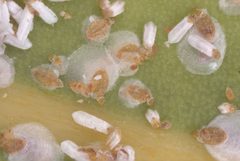
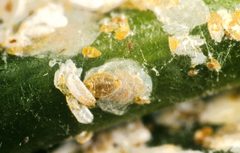
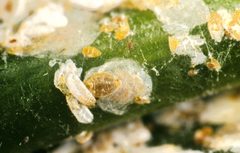
Distinguished from other armored scales by its strict association with cycads and the combination of circular white female covers with visible orange body beneath. The presence of shed on the cover margin is characteristic of the Aulacaspis. Separation from other Aulacaspis requires microscopic examination of morphological characters on the venter of the . In the field, heavy are recognizable by the distinctive white encrustation on fronds, often described as 'flocked' appearance. Similar-appearing white on non-cycad are certainly different species.
Images
Habitat
Strictly associated with cycad plants (order Cycadales). Found on all above-ground plant parts including fronds (both upper and lower surfaces), stems, and reproductive structures. In heavy , also present on roots to depths of approximately 60 cm. Thrives in tropical and subtropical climates with warm temperatures; multiple occur annually where temperatures permit year-round activity. Favored include King Sago (Cycas revoluta) and Sago, though the infests multiple cycad .
Distribution
Native to tropical and subtropical Southeast Asia: Thailand (type locality), Singapore, Malaysia, China, Vietnam, Indonesia, Philippines, and Taiwan. Introduced and established in: United States (Florida since 1996, Hawaii since 2000, Georgia, Alabama, Louisiana, South Carolina, Texas), Caribbean (Cayman Islands, Puerto Rico, U.S. Virgin Islands, Bahamas, Barbados, Bermuda, Guadeloupe, Martinique, Dominican Republic, Saint Kitts and Nevis, Saint Vincent and the Grenadines), Central America ( Rica, Guatemala, Mexico), South America (French Guiana), Oceania (Guam since 2003, Northern Mariana Islands, Palau, Fiji), Africa (South Africa), and Europe (United Kingdom, Bulgaria, Croatia, Cyprus, Hungary, Poland, Slovenia, Turkey).
Seasonality
Year-round activity in tropical and subtropical climates with no true . time approximately 28 days from to under favorable conditions, with multiple overlapping generations annually. Crawler peaks vary with local temperature regimes; in Florida, active crawlers have been observed in all months. In temperate invaded areas, activity is constrained by winter temperatures but continues on protected in greenhouse and indoor environments.
Diet
Phloem-feeding herbivore specializing on cycads. Uses elongated stylet-like mouthparts to pierce leaf and extract contents, causing direct tissue damage and depletion of plant nonstructural . Feeding occurs on all post- life stages.
Host Associations
- Cycas - primary Strongly preferred ; includes C. revoluta (King Sago), C. micronesica, C. edentata, and numerous other
- Dioon - Includes D. purpusii (Purpus' cycad)
- Encephalartos - African cycad
- Macrozamia - Australian cycad
- Microcycas - Includes M. calocoma, an endangered Cuban
- Stangeria - African cycad
Life Cycle
Hemimetabolous development with . female lays 100+ beneath her protective cover. Eggs hatch in 8–12 days into first-instar nymphs (), the only mobile stage. Crawlers settle on suitable feeding sites, insert mouthparts, and become . They develop through second and third instars (approximately 28 days total) before reaching adulthood. Adult males are winged and mobile, emerging from their covers to seek females. Females remain sessile beneath their expanding covers. In warm climates, overlapping occur continuously with no discrete seasonal cohorts. is sexual; no has been documented.
Behavior
are the primary stage, moving by to new plant areas or becoming airborne for wind transport. They may also disperse via on birds or human-mediated movement of infested plants. All post-crawler stages are and permanently attached to feeding sites. Heavy exhibit gregarious spatial distribution with forming dense, contiguous . Even after death, covers remain attached to tissue. Root-dwelling can serve as for re-infestation of aerial plant parts following control treatments.
Ecological Role
As a herbivore, A. yasumatsui functions as a stressor and mortality agent for cycad . In invaded regions where natural enemies are absent, it achieves 'enemy escape' and reaches densities that drive population declines. The has caused cascading ecological effects including reduced sites for specialist cycad-pollinating insects, with potential for coextinction risk. It serves as prey for introduced agents including lady beetles (Rhyzobius lophanthae, Chilocorus spp.) and , though natural control is often inadequate to prevent host mortality.
Human Relevance
Major economic pest of international cycad horticulture trade, causing plant mortality and rendering specimens unsalable. Responsible for listing of Cycas micronesica as Endangered under the U.S. Act in 2015. Management relies on combining inspection, , contact applied during , insecticides, and introductions. Conservation efforts for threatened cycad have been complicated by reducing propagation success from cuttings and seeds. The international nursery trade in Cycas revoluta has been the primary for global spread.
Similar Taxa
- Other Aulacaspis speciesCongeneric armored scales may appear superficially similar but differ in association and microscopic pygidial characters; A. yasumatsui is uniquely specialized on cycads
- Unaspis euonymi (Euonymus scale)Similar white covers on foliage, but restricted to Euonymus and with distinct female cover shape (oyster-shell-like rather than circular)
- Pseudaulacaspis pentagona (white peach scale)Circular white covers on woody plants, but differs in range and geographic distribution; lacks the strict cycad specificity of A. yasumatsui
More Details
Biological control efforts
Multiple natural enemy have been introduced to invaded regions, including the lady beetle Rhyzobius lophanthae from Australia and . However, establishment of effective has proven challenging, and the continues to cause significant mortality even in areas with introduced natural enemies. The tiny parasitoid wasps that do establish can be detected by small exit holes in scale covers.
Impact on conservation
Beyond direct plant mortality, chronic impair cycad by reducing megastrobilus size, ovule production, seed set, and seedling viability. This creates demographic bottlenecks that persist even after initial mortality events, constraining recovery for decades.
Cryptic infestation
The small size of individual and complex surface of cycad organs make complete visual detection difficult, allowing to reach damaging levels before detection. This characteristic has facilitated inadvertent international movement through the nursery trade.
Sources and further reading
- BugGuide
- Wikipedia
- GBIF taxonomy match
- iNaturalist taxon
- NCBI Taxonomy
- Catalogue of Life
- Aphytis Project Final Report | Entomology Research Museum
- Encyrtid Holdings | Entomology Research Museum
- Destination Sarasota, Florida: To kill a cycad - Cycad scale, ‘Aulacaspis yasumatsui’ — Bug of the Week
- Archive — Bug of the Week
- Aulacaspis yasumatsui . [Distribution map].
- Aulacaspis yasumatsui . [Distribution map].
- Aulacaspis yasumatsui Delivers a Blow to International Cycad Horticulture
- Stem Carbohydrates and Adventitious Root Formation of Cycas micronesica following Aulacaspis yasumatsui Infestation
- Cycas micronesica Megastrobilus Traits Respond to Chronic Herbivory by Aulacaspis yasumatsui
- Host range of Cybocephalus flavocapitis and Cybocephalus nipponicus, two potential biological control agents for the cycad aulacaspis scale, Aulacaspis yasumatsui
- Aulacaspis yasumatsui Invasion Reduced Cycas micronesica Microstrobilus Size and Pollinator Brood Site Competence
- Peer Review #2 of "Predicting the potential distributions of the invasive cycad scale Aulacaspis yasumatsui (Hemiptera: Diaspididae) under different climate change scenarios and the implications for management (v0.1)"
- Peer Review #2 of "Predicting the potential distributions of the invasive cycad scale Aulacaspis yasumatsui (Hemiptera: Diaspididae) under different climate change scenarios and the implications for management (v0.2)"
- Peer Review #3 of "Predicting the potential distributions of the invasive cycad scale Aulacaspis yasumatsui (Hemiptera: Diaspididae) under different climate change scenarios and the implications for management (v0.2)"
- Peer Review #3 of "Predicting the potential distributions of the invasive cycad scale Aulacaspis yasumatsui (Hemiptera: Diaspididae) under different climate change scenarios and the implications for management (v0.3)"
- Peer Review #3 of "Predicting the potential distributions of the invasive cycad scale Aulacaspis yasumatsui (Hemiptera: Diaspididae) under different climate change scenarios and the implications for management (v0.1)"
- Direct Aulacaspis yasumatsui Infestation of Pre-Harvest Cycas Seeds Reduces Germination and Performance of Seedlings
- Peer Review #1 of "Predicting the potential distributions of the invasive cycad scale Aulacaspis yasumatsui (Hemiptera: Diaspididae) under different climate change scenarios and the implications for management (v0.1)"
- The initial decade of conservation funding following the Aulacaspis yasumatsui (Diaspididae) invasion of Guam
- Ensemble Distribution Modeling of the Globally Invasive Asian Cycad Scale, Aulacaspis yasumatsui Takagi, 1977 (Hemiptera: Diaspididae).