
Unaspis euonymi
(Comstock, 1881)
Euonymus Scale
Unaspis euonymi is a diaspidid insect native to East Asia and now widespread as an pest. It infests Euonymus and several other ornamental plants, causing significant damage in urban and suburban landscapes. The species exhibits pronounced in both and feeding . It has been extensively studied as a target for using introduced and native natural enemies.
Pronunciation
How to pronounce Unaspis euonymi: /juːˈnæspɪs juːoˈnaɪmi/
These audio files are automatically generated. While they are not always 100% accurate, they are a good starting point.
Identification
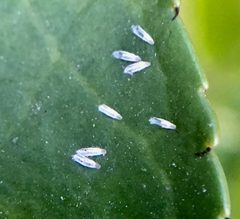
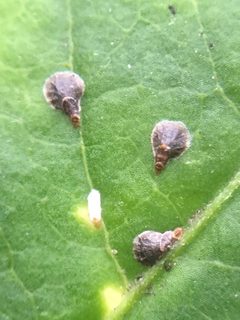
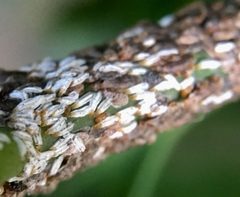
females are dark brown to gray, oyster-shaped or pear-shaped, approximately 1.5–2 mm long, with a characteristic dark zygotic cover. Adult males are smaller, elongated, and white with a three-lobed end. Males retain legs and as adults; females are legless and . Second-instar nymphs are the stage and can be distinguished by their flattened, -like appearance on stems and leaves.
Images
Habitat
Urban and suburban landscapes, nurseries, and ornamental plantings. Found on plants in both "protected" environments (higher rates) and "unprotected" environments. Older plants and certain cultivars of Euonymus show higher infestation levels.
Distribution
Native to East Asia (China, Japan, Korea). Introduced and established in North America (USA, Canada, Mexico), Europe (Austria, Britain, Bulgaria, France, Greece, Hungary, Italy, Spain, Switzerland, and others), Mediterranean region, Middle East (Israel, Turkey, Iran), North Africa (Algeria, Morocco, Egypt), South America (Argentina, Bolivia), and Central Asia.
Seasonality
Overwinters as second-instar nymphs. males emerge and mature earlier than females, with males producing multiple per year while females produce one generation annually. Peak activity timing varies by region; in Virginia, USA, highest recovery rates occurred in late May.
Diet
Phloem-feeding on Euonymus , particularly Euonymus japonicus. Also recorded from Prunus, Hibiscus, and other ornamentals.
Host Associations
- Euonymus japonicus - primary Main ; males feed primarily on leaves, females on stems
- Euonymus japonica var. aureovariegata - More frequently infested than other tested cultivars
- Prunus - Recorded from distribution sources
- Hibiscus - Recorded from distribution sources
Life Cycle
with distinct male and female developmental schedules. Males have shorter development time and produce multiple annually. Females have longer development and produce one generation per year. Both sexes overwinter as second-instar nymphs. Differential timing reduces between sexes.
Behavior
in feeding site selection: males feed primarily on leaves (75% upper surface, 25% lower surface), while adult females feed almost exclusively on stems (94% stems, 6% leaves). This spatial partitioning reduces . Males are mobile as adults; females remain .
Ecological Role
Pest of ornamental plants. Serves as for specialized (Encarsia citrina, Aspidiotiphagus spp., Encarsia spp.) and (Chilocorus kuwanae, Cybocephalus nipponicus) that have been introduced for . Subject of extensive biological control research and implementation.
Human Relevance
Significant economic pest of Euonymus and other ornamental shrubs in landscaping and nursery industries. Damage causes yellowing, defoliation, and plant death. Management relies on agents, , and . Older plants and certain cultivars are more susceptible.
Similar Taxa
- Quadraspidiotus perniciosusSan Jose ; shares (Encarsia citrina) and is congeneric in Diaspididae, but differs in range and female scale cover
- Other Unaspis species members share oyster-shaped female covers and similar ; identification requires examination of pygidial duct details and associations
Sources and further reading
- BugGuide
- GBIF taxonomy match
- iNaturalist taxon
- NCBI Taxonomy
- Catalogue of Life
- Unaspis euonymi . [Distribution map].
- Distribution of Natural Enemies of Euonymus Scale, Unaspis euonymi (Comstock), in Virginia
- Use of Host Plant Resources by the Euonymus Scale, Unaspis euonymi (Homoptera: Diaspididae)
- EUONYMUS SCALE, UNASPIS EUONYMI (COMSTOCK) (HOMOPTERA: DIASPIDIDAE): EFFECTS OF HOST CULTIVAR AGE, AND LOCATION ON INFESTATION LEVELS1
- Distribution of Natural Enemies of Euonymus Scale,Unaspis euonymi(Comstock) (Homoptera: Diaspididae), in New Jersey
- Biology of the Euonymus scale Unaspis euonymi (Hemiptera: Diaspididae) in Urban Areas of Ankara, Turkey
- HOST AGE PREFERENCE AND TEMPERATURE-DEPENDENT SEARCHING EFFICIENCY OF Encarsia citrina, A PARASITOID OF Unaspis euonymi IN AUSTRIA.
- Biological assessment ofEncarsia citrina(Hymenoptera: Aphelinidae) a parasitoid of euonymus scaleUnaspis euonymi(Hemiptera: Diaspididae)
- TARIM BİLİMLERİ DERGİSİ 2007, 13 (1) 47-53 ANKARA ÜNİVERSİTESİ ZİRAAT FAKÜLTESİ Biology of the Euonymus scale Unaspis euonymi (Hemiptera: Diaspididae) in Urban Areas of Ankara, Turkey* Özlem ÖZYURT1 S
- Ovipositional preferences and functional response of parasitoids of euonymus scale, Unaspis euonymi (Comstock) and San Jose scale, Quadraspidiotus perniciosus (Comstock) (Homoptera: Diaspididae)
- Effect of Temperature on Development, Fecundity, and Life Table Parameters ofEncarsia citrinaCraw (Hymenoptera: Aphelinidae), a Parasitoid of Euonymus Scale,Unaspis euonymi(Comstock), andQuadraspidiotus perniciosus(Comstock) (Homoptera: Diaspididae)