
Pseudaulacaspis cockerelli
(Cooley, 1897)
false oleander scale, fullaway oleander scale, magnolia white scale, mango scale, oleander scale, oyster scale
Pseudaulacaspis cockerelli is an insect (Hemiptera: Diaspididae) commonly known as false oleander . It is a pest with a broad global distribution spanning Europe, Asia, Africa, North America, Central America, the Caribbean, and Oceania. The infests numerous ornamental and agricultural plants, with documented including oleander (Nerium oleander), mango (Mangifera indica), magnolia, and various palms. As a member of the armored scales, it produces a protective waxy covering over its body while feeding on plant sap.
Pronunciation
How to pronounce Pseudaulacaspis cockerelli: //ˌsuː.dɔː.ləˈkæspɪs ˌkɒkəˈrɛlaɪ//
These audio files are automatically generated. While they are not always 100% accurate, they are a good starting point.
Identification
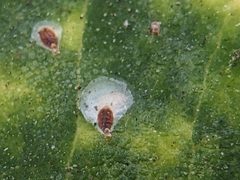
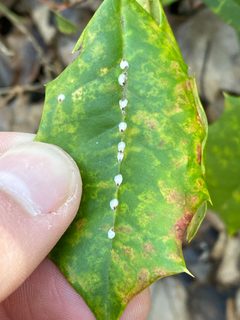
Distinguished from other armored scales by its combination of associations and geographic distribution. The female produces a white, oyster-shaped or pear-shaped protective cover (test) that is characteristic of the Pseudaulacaspis. Specific diagnostic features require microscopic examination of the ( body segment) and associated structures, which bear taxonomically significant characters for -level identification in Diaspididae. Separation from congeneric species relies on detailed morphological analysis of the perivulvar pores and other pygidial structures.
Images
Habitat
Occurs in tropical, subtropical, and temperate regions where plants are cultivated or grow naturally. Found in ornamental plantings, commercial nurseries, agricultural orchards, and naturalized vegetation. The thrives in warm climates and has established in protected environments such as greenhouses in cooler regions.
Distribution
Widely distributed across multiple continents: Europe (France, Italy, Russia, UK), Asia (Bangladesh, Cambodia, China, India, Indonesia, Japan, Korea, Malaysia, Maldives, Nepal, Philippines, Singapore, Sri Lanka, Taiwan, Thailand, Vietnam), Africa (Aldabra, Comoros, Egypt, Kenya, Madagascar, Mauritius, Mozambique, Reunion, Rodrigues Island, Seychelles, South Africa, Tanzania, Zambia, Zimbabwe), North America (USA: Alabama, California, Florida, Georgia, Hawaii, Kansas, Louisiana, Maryland, Mississippi, Missouri, North Carolina, Oregon, Pennsylvania, South Carolina, Tennessee, Texas, Virginia), Central America & Caribbean (Guatemala, US Virgin Islands), and Oceania (Australia, Federated States of Micronesia, Fiji, Guam, New Caledonia, Palau, Papua New Guinea, Solomon Islands, Vanuatu). Also recorded from Belgium (doubtful) and Corsica, France.
Diet
Phloem-feeding sap-sucker that extracts plant fluids using . Feeds on vascular tissues of plants.
Host Associations
- Nerium oleander - primary Source of 'false oleander '
- Mangifera indica - Source of 'mango '
- Magnolia spp. - Source of 'magnolia white '
- Various palms - Documented group
Behavior
Sedentary as ; females remain permanently attached to plant after settling. occurs primarily through the mobile (first-instar nymph) stage, which actively seeks suitable feeding sites. Wind and animal may aid in longer-distance dispersal.
Ecological Role
Herbivore that can cause direct damage to plants through sap extraction, potentially leading to , reduced vigor, and aesthetic damage. May serve as prey for natural enemies including and predatory insects, though specific ecological relationships are not well documented.
Human Relevance
Economic pest of ornamental plants and agricultural crops. can reduce plant vigor and marketability of nursery stock. On mango, it is considered a significant pest in some production regions. Management typically involves , insecticidal soaps, or ; options are limited.
Similar Taxa
- Aulacaspis spp.Similar of armored scales with comparable and associations; distinguished by pygidial characters and specific host relationships
- Other Pseudaulacaspis speciesCongeneric require microscopic examination of pygidial structures for definitive separation
More Details
Nomenclature
Originally described by Cooley in 1897. The specific epithet 'cockerelli' honors the entomologist Theodore D. A. Cockerell.
Taxonomic History
Has been known by various reflecting its association with different plants, leading to potential confusion in literature and trade.
Sources and further reading
- BugGuide
- Wikipedia
- GBIF taxonomy match
- iNaturalist taxon
- NCBI Taxonomy
- Catalogue of Life
- Bembicid Holdings | Entomology Research Museum
- UC Davis Researcher Targeting Zebra Chip: It's Not a Chip You Want | Bug Squad
- Encyrtid Holdings | Entomology Research Museum
- Publications | Entomology Research Museum
- Psyllid Movements Revealed Via Gut Content Analysis
- Wasps Used to Combat Citrus Greening Disease are Unlikely to Threaten Non-target Insects
- Pseudaulacaspis cockerelli . [Distribution map].