
Prociphilus
Koch, 1857
Woolly Aphids
Species Guides
3- Prociphilus caryae(hickory woolly aphid)
- Prociphilus fraxinifolii(leafcurl ash aphid)
- Prociphilus tessellatus(Woolly Alder Aphid)
Prociphilus is a of woolly aphids in the Aphididae, Eriosomatinae, comprising approximately 50 . These aphids are notable for inducing gall formation on plants, within which they reside and feed. The genus exhibits complex including host alternation and , with multiple distinct morphs adapted to different hosts and conditions. Several species have documented mutualistic relationships with ants, and some display remarkable seasonal phenomena such as the mass of Prociphilus oriens in Japan, which is culturally associated with the first snowfall.
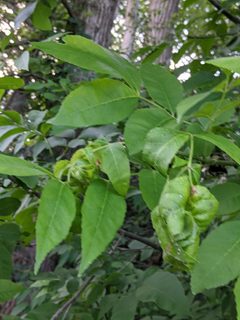
Pronunciation
How to pronounce Prociphilus: /proʊˈsɪfɪləs/
These audio files are automatically generated. While they are not always 100% accurate, they are a good starting point.
Identification
Distinguished from other by the combination of dense woolly wax secretions, gall-forming , and membership in Eriosomatinae. -level identification requires examination of associations, morphological details of cornicles and other structures, and characteristics. Prociphilus tessellatus (woolly alder aphid) is recognizable by its association with alder (Alnus). Prociphilus oriens is notable for its mass behavior in autumn. Cuticular hydrocarbon profiles differ among morphs and can be used for identification: -attended morphs have higher proportions of n-C25 to n-C27 alkanes, while non-ant-attended morphs have higher proportions of longer-chain n-alkanes (n-C27, n-C29).
Images
Habitat
Associated with plants on which galls are formed; specific vary by and stage. Some species utilize woody hosts including ash (Fraxinus), alder (Alnus), olive (Olea), grapevine (Vitis), and spruce (Picea). One documented species persists parthenogenetically on roots of secondary host Norway spruce (Picea abies) during . Found in forested areas, plantations, and riparian zones where host trees occur.
Distribution
occurs across temperate regions of the Northern Hemisphere. Documented distributions include: Japan (P. oriens, P. tessellatus), Central Europe (P. fraxini), Mediterranean Europe and Turkey (P. oleae), and North America (P. tessellatus). Specific locality records include Missouri, USA; Sapporo, Japan; and Vermont, USA. The genus has been observed in both native and introduced contexts.
Seasonality
vary by and climate. Prociphilus oriens in Japan exhibits mass in autumn (October-November), with appearance culturally linked to first snowfall in Hokkaido and Tohoku. Seasonal produces distinct morphs: spring migrants, summer residents, autumn migrants, and sexual forms. occurs as or, in some , as parthenogenetic forms on roots. -attended morphs and non-ant-attended morphs appear at different seasons.
Diet
Phloem-feeding on plants; specific hosts vary by and stage. Documented hosts include: Fraxinus lanuginosa (ash), Alnus glutinosa (alder), Olea europaea (olive), Vitis vinifera (grapevine), and Picea abies (spruce). Gall tissue may also be utilized.
Host Associations
- Fraxinus lanuginosa - primary Saplings and mature trees; P. oriens causes injuries to saplings with intensity decreasing with distance from mature trees
- Alnus glutinosa - primary P. tessellatus colonies observed on European alder
- Olea europaea - primary P. oleae ; distribution in Mediterranean
- Vitis vinifera - primary P. oleae
- Picea abies - secondary Roots serve as site for parthenogenetic of P. fraxini
Life Cycle
Complex involving alternation and . Prociphilus oriens exhibits five distinct morphs: sexual and forms adapted to different hosts. Some can persist anholocyclically (without sexual phase) via parthenogenetic on secondary host roots, facilitated by mutualism. produces overwintering in typical holocyclic populations. Cuticular hydrocarbon profiles vary among morphs and , reflecting different ecological roles.
Behavior
Gall-forming: induction of plant gall tissue within which aphids reside and feed. mutualism: several morphs are attended by ants (documented with Prenolepis nitens, Lasius brunneus, and Harmonia axyridis as ), with mutualistic relationships enabling persistence and protection. Mass : P. oriens exhibits dramatic autumn emergence in Japan. : strong tendency to aggregate near mature trees, with decreasing significantly with distance from source trees.
Ecological Role
Gall-forming herbivore that modifies plant tissue structure. Prey for including ladybird beetles (Harmonia axyridis observed preying on P. tessellatus). Partner in - mutualisms. Potential pest of young tree plantations and crops (olive, grapevine). May influence spatial patterns of host plant establishment through mother-tree effects.
Human Relevance
Cultural significance in Japan where P. oriens is called "yukimushi" (snow ) and associated with first snowfall. Agricultural pest status for some : P. oleae on olive and grapevine in Mediterranean region, P. oriens on ash plantations in Japan. Subject of scientific research on sex ratio evolution, frequency-dependent selection, and .
Similar Taxa
- Other Eriosomatinae generaShare woolly appearance and gall-forming habits; distinguished by associations, gall , and specific wax secretion patterns
- Flatidae (planthoppers)Similar white waxy appearance but different order (Hemiptera: Fulgoromorpha), not gall-forming, and have different body plan with enlarged hind wings
More Details
Cuticular hydrocarbons and polyphenism
Research on P. oriens demonstrates that cuticular hydrocarbon profiles differ significantly among the five morphs. -attended morphs are characterized by n-C25-n-C27 alkanes, while non-ant-attended morphs have longer-chain n-C27 and n-C29 alkanes. Methyl-branched alkanes in autumnal migrants may serve as recognition cues.
Sex ratio dynamics
P. oriens exhibits large fluctuations in sex ratio driven by climatic factors affecting plant growth and maternal conditions. Frequency-dependent selection acts on these fluctuations, with female proportions above or below approximately 60% associated with corrective shifts in subsequent years. Population-level female allocation averages 71-73%.
Ant-mediated overwintering
P. fraxini in Central Europe has been documented in mutualistic relationships with ants Prenolepis nitens and Lasius brunneus, enabling anholocyclic as parthenogenetic on spruce roots. This represents a coevolved strategy for persistence in unfavorable conditions.
Sources and further reading
- BugGuide
- Wikipedia
- GBIF taxonomy match
- iNaturalist taxon
- NCBI Taxonomy
- Catalogue of Life
- Coccinelidae | Beetles In The Bush
- These Insect Costume Designers are Dressed to Impress
- Missouri | Beetles In The Bush | Page 2
- Prociphilus oleae . [Distribution map].
- Ant-mediated anholocyclic overwintering of Prociphilus fraxini (Hemiptera: Aphididae) in Central Europe
- Effects of Mature Host Trees on Distribution of Prociphilus oriens Mordvilko(Homoptera: Aphididae) on Fraxinus lanuginosa Koidz.
- Seasonal changes in cuticular hydrocarbons in response to polyphenism in the host‐alternating aphid Prociphilus oriens
- Frequency‐dependent selection acting on the widely fluctuating sex ratio of the aphid Prociphilus oriens