
Macrosiphoniella
Del Guercio, 1911
Anthemid Aphids
Species Guides
6- Macrosiphoniella absinthii(Absinthe aphid)
- Macrosiphoniella glabra(Shining Green Tarragon Aphid)
- Macrosiphoniella ludovicianae(White Sage Aphid)
- Macrosiphoniella millefolii(Yarrow Aphid)
- Macrosiphoniella sanborni(Chrysanthemum Aphid)
- Macrosiphoniella tanacetaria(Tansy Aphid)
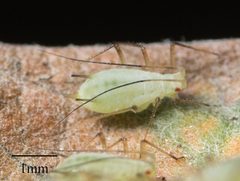
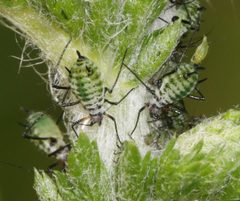
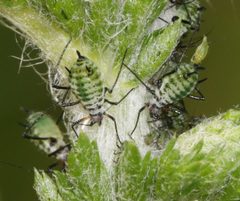
Macrosiphoniella is a of aphids in the Aphididae, comprising at least 150 described . The genus was established by Giacomo del Guercio in 1911 and is classified within the tribe Macrosiphini. Species in this genus exhibit notable color , with body colors ranging from green and red to white, orange, yellow, and intermediate forms. Several subgenera are recognized, including Asterobium, Ramitrichophorus, and Papillomyzus. The genus has been documented across Europe, Asia, and into North Africa.
Pronunciation
How to pronounce Macrosiphoniella: /ˌmækroʊˌsaɪfəˈniɛlə/
These audio files are automatically generated. While they are not always 100% accurate, they are a good starting point.
Identification
Macrosiphoniella can be distinguished from related by features associated with their subgeneric classification. The subgenus Ramitrichophorus is characterized by specific morphological traits that separate it from other Macrosiphoniella subgenera. Species-level identification requires examination of multiple morphs including females, viviparous females, females, and males, as these morphs often show distinct diagnostic characters. Color within species (green, red, orange, yellow, white, and intermediate forms) can complicate field identification.
Images
Distribution
Documented from Europe (Spain, Scandinavia, Kazakhstan), Asia (Iran, Mongolia, China), with distribution records from Denmark, Norway, and Sweden. Individual show varying ranges: M. davazhamci occurs in Kazakhstan, Mongolia, China, and Iran; M. nikolajevi is known from south Kazakhstan and Iran; Spanish fauna includes 24 species across four subgenera.
Host Associations
- Helichrysum - primary M. (M.) valdeorresa collected on Helichrysum stoechas; -level association for subgenus Ramitrichophorus
- Artemisia - primary M. (M.) monegrina collected on Artemisia herba-alba; M. yomogicola associated with Artemisia spp. (yomogi)
- Artemisia herba-alba - primary for M. (M.) monegrina in Los Monegros region, Spain
- Helichrysum stoechas - primary for M. (M.) valdeorresa in Valdeorras region, Spain
Life Cycle
involves both and modes. viviparous females (winged parthenogenetic morphs) and oviparous females (-laying sexual morphs) occur, along with males. Some had certain morphs undescribed until recently: alate vivipara of M. nikolajevi and ovipara and alate male of M. davazhamci were first described in 2021.
Behavior
Color varies temporally and spatially among plant patches. Color diversity within host plant shoots has been observed to correlate negatively with mortality in some , suggesting that diverse color morphs may experience reduced or risk.
Human Relevance
Some serve as study organisms for investigating the maintenance of genetic in natural . The contributes to understanding of - plant and speciation patterns.
Similar Taxa
- OrobionBoth are within tribe Macrosiphini; Macrosiphoniella was historically or alternatively classified under Orobion in some taxonomic treatments according to Catalogue of Life
- Other Macrosiphini generaMacrosiphoniella share the tribe Macrosiphini with numerous other but are distinguished by subgeneric structures (Asterobium, Ramitrichophorus, Papillomyzus) and associations primarily with Asteraceae
Sources and further reading
- BugGuide
- Wikipedia
- GBIF taxonomy match
- iNaturalist taxon
- NCBI Taxonomy
- Catalogue of Life
- Hitherto unknown and poorly known morphs of Macrosiphoniella davazhamci and M. nikolajevi (Hemiptera: Aphididae)—aphid species new to Iran
- The effect of color polymorphism on mortality in the aphid Macrosiphoniella yomogicola
- Revision of the aphid subgenus Ramitrichophorus Hille Ris Lambers of genus Macrosiphoniella (Hemiptera, Homoptera: Aphididae, Macrosiphini), with redescriptions of all known species and identification keys
- The genus Macrosiphoniella (Hemiptera, Aphididae, Macrosiphini) in Spain, with description of two new species