
Macrosiphoniella tanacetaria
(Kaltenbach, 1843)
Tansy Aphid
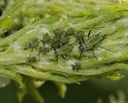
Macrosiphoniella tanacetaria is a small sap-sucking that feeds on tansy (Tanacetum vulgare). Unlike some , it is not attended by ants and produces minimal honeydew. Its gut physiology differs markedly from -attended aphids: it lacks significant oligosaccharide synthesis for , instead producing erlose as its primary honeydew sugar.
Pronunciation
How to pronounce Macrosiphoniella tanacetaria: //ˌmæ.kroʊ.sɪ.fəˈnaɪ.ə.lə ˌtæn.ə.sɪˈtɛə.ri.ə//
These audio files are automatically generated. While they are not always 100% accurate, they are a good starting point.
Identification
Distinguished from the -attended Metopeurum fuscoviride, which shares the same plant, by its ecological status: M. tanacetaria is never attended by ants. Morphological separation from other Macrosiphoniella requires examination of siphuncular and caudal characters not detailed in available sources.
Images
Habitat
Associated with tansy (Tanacetum vulgare) in temperate regions; specific microhabitat requirements beyond plant association are not documented.
Distribution
Recorded from Belgium (Flemish Region, Walloon Region, Brussels-Capital Region) and Flores (Azores, Portugal); broader European distribution likely but not confirmed in provided sources.
Diet
Feeds on phloem sap of tansy (Tanacetum vulgare); and sucrose composition of ingested sap matches plant phloem.
Host Associations
- Tanacetum vulgare - primary confirmed plant; phloem sap composition documented as basis for artificial feeding studies
Behavior
Ecological Role
Herbivore on tansy; lacks mutualistic associations. Minimal honeydew production suggests limited role as source for other organisms.
Similar Taxa
- Metopeurum fuscovirideSympatric on Tanacetum vulgare but readily distinguished by attendance, high honeydew production, and synthesis of melezitose and for and ant attraction.
- Macrosiphoniella millefoliiCongeneric on Achillea; separation requires morphological examination of diagnostic features.