
Aphis nasturtii
Kaltenbach, 1843
Buckthorn Aphid, Buckthorn-Potato Aphid
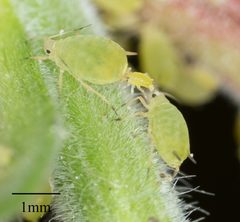
Aphis nasturtii is a known primarily as a pest of agricultural crops, particularly potatoes, sunflowers, lettuce, and beets. It is a phloem-feeding insect that extracts plant sap using . The species is of significant economic concern due to its direct feeding damage and its role as a for at least 15 plant viruses. reflect its association with buckthorn (likely a primary or ) and potato (a major agricultural host).
Pronunciation
How to pronounce Aphis nasturtii: /ˈæfɪs næˈstɜrti.aɪ/
These audio files are automatically generated. While they are not always 100% accurate, they are a good starting point.
Images
Habitat
Agricultural fields and crop systems; distribution data from suction traps and water traps indicates aerial and open-field . Specific natural or non-cultivated habitats are not well documented in available sources.
Distribution
distribution with established across multiple continents. In Europe, the northern range limit extends to southern Karelia, Arkhangelsk Region, and southwestern Komi Republic. High harmfulness zones include the Central Chernozem region of European Russia, western and northern Ukraine, Moldova, and southern Belarus. Low harmfulness zones occur in steppe Ukraine, Crimea, North Caucasus, and Transcaucasia. Distribution records also include the Azores (Faial, Flores, São Miguel, Santa Maria, Terceira).
Diet
Phloem-feeding; sucks sap from plants. Documented agricultural include potato, sunflower, lettuce, and beets. Buckthorn is implied as a host based on the , though specific host plant relationships require further verification.
Host Associations
- Solanum tuberosum - agricultural pest major crop pest
- Helianthus annuus - agricultural pest sunflower pest
- Lactuca sativa - agricultural pest lettuce pest
- Beta vulgaris - agricultural pest beet pest
- Rhamnus spp. - implied inferred from 'buckthorn '; specific association not verified in sources
Behavior
Aerial has been documented through capture in suction traps and water traps, indicating capacity for long-distance movement.
Ecological Role
Agricultural pest causing direct feeding damage rated up to 3 points in severity in high harmfulness zones. of at least 15 plant viruses, contributing to indirect crop damage through transmission.
Human Relevance
Major economic pest of multiple agricultural crops including potatoes, sunflowers, lettuce, and beets. Virus status amplifies economic impact beyond direct feeding damage. Subject of research and monitoring programs.
More Details
Virus Vector Status
The is documented as a for 15 plant viruses, though specific virus names are not provided in available sources.
Harmfulness Zones
Research in European Russia has delineated specific zones of harmfulness based on and crop impact, with the Central Chernozem region identified as a high-harmfulness zone.
Sources and further reading
- BugGuide
- Wikipedia
- GBIF taxonomy match
- iNaturalist taxon
- NCBI Taxonomy
- Catalogue of Life
- Ian Grettenberger Targets a Variety of Pests | Bug Squad
- Incredible Work, and Timely, on 22 Species of Hornets | Bug Squad
- Bohart Museum Virtual Open House: Think Pests of Alfalfa and Rice | Bug Squad
- It Takes a Village: Our Continued Efforts to Manage Invasive Species in the U.S.
- Orange and Black II: Milkweed leaf beetle, Labidomera clivicollis; Oleander aphid, Aphis nerii; Milkweed Bug, Oncopeltus fasciatus; Monarch, Danaus plexippus — Bug of the Week
- Orange and Black Bugs- Milkweed leaf beetle, Labidomera clivicollis; Oleander aphid, Aphis nerii; Milkweed Bug - Oncopeltus fasciatus; Monarch butterfly, Danaus plexippus — Bug of the Week
- External Anatomy and Life Cycle of Aphis nasturtii (Hemiptera: Aphididae)
- THE DISTRIBUTION AND ZONES OF HARMFULNESS OF BUCKTHORN APHID APHIS NASTURTII (HOMOPTERA, APHIDIDA)