
Aleurotrachelus
Quaintance & Baker, 1914
Aleurotrachelus is a of whiteflies (Hemiptera: Aleyrodidae) established by Quaintance & Baker in 1914. Several are economically significant agricultural pests. Aleurotrachelus socialis is a major pest of cassava in South America, causing yield losses up to 79% through direct feeding and promotion. Aleurotrachelus trachoides, known as the solanum or pepper whitefly, attacks Solanaceae crops including tomato, eggplant, chili, and sweet potato across tropical and subtropical regions. Aleurotrachelus atratus infests palms, particularly coconut, and has spread to islands in the southwestern Indian Ocean. Species in this genus are characterized by distinct puparial used in taxonomic identification.
Pronunciation
How to pronounce Aleurotrachelus: /əˌleɪəroʊˈtrækələs/
These audio files are automatically generated. While they are not always 100% accurate, they are a good starting point.
Identification
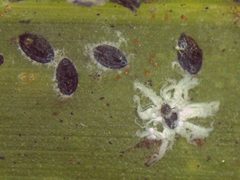
Identification of Aleurotrachelus relies primarily on puparial characters, following standard whitefly taxonomic practice. vary in color, shape, and wax secretion patterns. Aleurotrachelus trachoides puparia are distinguished from other Florida whiteflies by size and shape comparisons with Bemisia tabaci, Paraleyrodes bondari, Aleurodicus rugioperculatus, and Aleurodicus dugesii. Species-level identification requires examination of microscopic puparial features including vasiform orifice structure, caudal furrow, and wax filament arrangement.
Images
Distribution
The has a broad tropical and subtropical distribution. Aleurotrachelus trachoides occurs in Asia (India, Singapore), Africa (Comoros, Mayotte, Mozambique, Nigeria, Réunion, Tanzania), North America (USA: California, Florida, Hawaii, Louisiana, Texas; Mexico), Central America and Caribbean, and South America. Aleurotrachelus atratus has been recorded from the Neotropics and has expanded to islands in the southwestern Indian Ocean including La Réunion, Seychelles, and Comoros. Aleurotrachelus socialis is established in northern South America.
Diet
in this are phloem-feeding herbivores. Aleurotrachelus socialis feeds on cassava (Manihot esculenta) phloem sap. Aleurotrachelus trachoides feeds on Solanaceae including Solanum spp., Capsicum spp., tomato, eggplant, chili, okra, and sweet potato (Ipomoea batatas). Aleurotrachelus atratus feeds on palms (Arecaceae), with Cocos nucifera as the main .
Host Associations
- Manihot esculenta - cassava, primary of A. socialis
- Manihot flabellifolia - wild relative with resistance to A. socialis
- Manihot peruviana - wild relative with resistance to A. socialis
- Solanum spp. - of A. trachoides
- Capsicum spp. - chili, pepper; of A. trachoides
- Lycopersicon esculentum - tomato; of A. trachoides
- Solanum melongena - eggplant; preferred of A. trachoides
- Abelmoschus esculentus - okra; of A. trachoides
- Ipomoea batatas - sweet potato; of A. trachoides
- Cocos nucifera - coconut palm; main of A. atratus
- Arecaceae - palms; A. atratus recorded on 56
Life Cycle
Aleurotrachelus atratus has a relatively long pre-imaginal development of approximately 48 days at 25–27°C. The sex ratio in field-collected A. atratus from La Réunion is approximately 1 male per 1022 females, indicating . Development includes , four nymphal instars (with the fourth instar being the ), and stages. Eggs close to hatching are the most susceptible stage to fungi.
Behavior
Aleurotrachelus trachoides exhibits preference (antixenosis) for certain Solanaceae, with eggplant being highly preferred. On chili, with more non-glandular trichomes are favored. The whitefly does not show correlation between oviposition preference and leaf morphological traits (trichome , , palisade, thickness). Aleurotrachelus socialis reduces plant through direct phloem feeding and of substances promoting growth. Aleurotrachelus atratus disperse to colonize new palm hosts, facilitating rapid geographic spread.
Ecological Role
Aleurotrachelus serve as for . Eretmocerus cocois is the parasitoid of A. atratus in La Réunion. Encarsia cubensis parasitizes A. trachoides and A. atratus. Natural enemies including the predatory Delphastus pallidus and parasitoid Baeoentodon balios have been observed on related whitefly species in Florida. Heavy promote growth through honeydew , reducing photosynthetic capacity of host plants.
Human Relevance
Multiple are significant agricultural pests. Aleurotrachelus socialis causes up to 79% yield loss in cassava, representing a major threat to food security in South America. Aleurotrachelus trachoides damages vegetable crops in the Solanaceae across tropical and subtropical regions. Aleurotrachelus atratus threatens ornamental and agricultural palms, as well as natural palm in regions where effective are absent. Management relies on (neonicotinoids), though resistance is a concern; breeding and are active research areas. The Nymphstar image analysis tool was developed specifically for high-throughput phenotyping of cassava resistance to A. socialis.
Similar Taxa
- Singhiella simplexBoth are whitefly pests of Ficus; distinguished by puparial and damage patterns
- Bemisia tabaciCo-occurs with A. trachoides in Florida; distinguished by puparial size and shape, and more feeding habits
- Aleurodicus rugioperculatusCo-occurs with A. trachoides in Florida; distinguished by puparial characteristics and spiral wax patterns
- Paraleyrodes bondariCo-occurs with A. trachoides in Florida; distinguished by nesting and puparial
- Aleurodicus dugesiiCo-occurs with A. trachoides in Florida; larger size and distinct puparial features distinguish this giant whitefly
More Details
Taxonomic Revision
The has undergone taxonomic revision; five were transferred from Aleurotrachelus to Cohicaleyrodes and Crenidorsum based on puparial characters. Aleurotrachelus anonae and the genus Cohicaleyrodes were newly recorded from Taiwan.
Resistance Research
Wild Manihot (M. flabellifolia, M. peruviana) show resistance to A. socialis and are being exploited for breeding cassava varieties through inter-specific crosses.
Biological Control Research
fungi including bassiana, Verticillium lecanii (strain CIAT 215 showing 67.3% mortality), and fumosoroseus have been evaluated for control of A. socialis under greenhouse conditions.
Sources and further reading
- BugGuide
- GBIF taxonomy match
- iNaturalist taxon
- NCBI Taxonomy
- Catalogue of Life
- Don't Bet Your Hedges: IPM Guide Outlines Ficus Whitefly Management
- whitefly size comparison - Entomology Today
- Aleurotrachelus atratus Hempel. [Distribution map].
- Aleurotrachelus trachoides . [Distribution map].
- Aleurotrachelus trachoides . [Distribution map].
- Aleurotrachelus Quaintance & Baker (Hemiptera: Aleyrodidae) and allied genera from Taiwan
- NYMPHSTAR: an accurate high-throughput quantitative method for whitefly (Aleurotrachelus socialis Bondar) resistance phenotyping in cassava
- Solanum Whitefly, Pepper Whitefly (Suggested Common Names) Aleurotrachelus trachoides Back (Insecta: Hemiptera: Aleyrodidae: Aleyrodinae)
- Aleurotrachelus trachoides Back’s (Hemiptera: Aleyrodidae) preference on different host plants
- Occurrence of exotic parasitoid Encarsia cubensis (Hymenoptera: Aphelinidae) on Neotropical woolly whitefly Aleurothrixus floccosus and solanum whitefly Aleurotrachelus trachoides in India
- Description of Eretmocerus cocois sp. n. (Hymenoptera: Chalcidoidea), a parasitoid of Aleurotrachelus atratus (Hemiptera: Aleyrodidae) on the coconut palm
- First report of Encarsia cubensis Gahan (Hymenoptera: Aphelinidae) an exotic parasitoid on the Neotropical Whitefly Aleurotrachelus atratus Hempel (Hemiptera: Aleyrodidae) in India
- Pathogenicity of Different Fungal Entomopathogens for the Control of Aleurotrachelus Socialis (Homoptera: Aleyrodidae) Under Greenhouse Conditions
- Increasing distribution and damage to palms by the Neotropical whitefly,Aleurotrachelus atratus(Hemiptera: Aleyrodidae)
- Resistance of Manihot species to Mononychellus tanajoa (Acariformes), Aleurotrachelus socialis , and Phenacoccus herreni (Hemiptera)
- Nymphstar: An accurate high‐throughput quantitative method for whitefly (Aleurotrachelus socialis Bondar) resistance phenotyping in cassava