
Aleurodicus dugesii
Cockerell, 1896
giant whitefly, spiralling whitefly
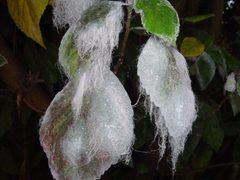
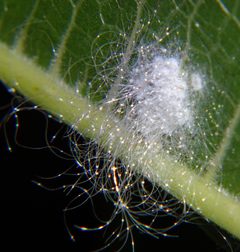
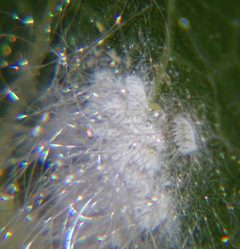
Aleurodicus dugesii, commonly known as the giant whitefly, is a pest of horticultural crops native to the Americas and in Asia. It produces distinctive long wax filaments during the nymph stage that resemble a beard. densities can exceed 1,900 individuals per leaf on preferred , causing severe defoliation and plant damage. The serves as host for several introduced used in programs.
Pronunciation
How to pronounce Aleurodicus dugesii: /ˌæl.jʊˈrɒ.dɪ.kʌs duːˈɡeɪ.si.aɪ/
These audio files are automatically generated. While they are not always 100% accurate, they are a good starting point.
Identification
Distinguished from other whiteflies by larger size of and . Nymphs uniquely produce long, beard-like wax filaments from compound pores on and submarginal areas. Puparia with compound pores and wax-producing papillae. Vasiform orifice with lingula extending beyond orifice borders. Can be separated from congeneric by wax filament and puparial pore arrangement.
Images
Habitat
Horticultural crop systems, including eggplant plantations and ornamental landscapes. Found on mulberry plants and diverse agricultural settings. Thrives on cultivated plants in tropical and subtropical regions.
Distribution
Native to Americas (United States, Mexico). in Indonesia (Bali, West Java), reported since 2008. Present in Hawaii. Established in Florida and southern California, USA.
Diet
Phloem-feeding on plant sap. on horticultural crops.
Host Associations
- dutch eggplant (Solanum melongena) - High densities recorded; up to 184.6 nymphs, 131.3 pupae, and 152.2 per leaf
- tamarillo (Solanum betaceum) - Highest recorded : 1,986 individuals per leaf
- mulberry plants - First report of Aschersonia placenta association
- Ficus - One of six whitefly feeding on Ficus in Florida
Life Cycle
stage: eggs placed circularly following wax paths on leaf undersides. Nymph stage: produces soft, long wax filaments resembling a beard from compound pores on and submarginal areas. Pupal stage: produces wax from papillae; used as taxonomic diagnostic. () stage. Development occurs across temperature range of 15°C to 30°C.
Behavior
Produces extensive external wax filaments during nymph stage, likely serving protective function against water loss and natural enemies. Wax production follows circular patterns that guide placement. and immatures aggregate on leaf undersides.
Ecological Role
Agricultural pest causing up to 62% damage severity in infested crops. Defoliation, stunting, and plant death reported at high densities. for fungus Aschersonia placenta in Indonesia. Serves as host for introduced Encarsia noyesi, Idioporus affinis, and Entedononecremnus krauteri used in .
Human Relevance
Significant pest of horticultural and ornamental industries. Economic losses from defoliation and plant death in eggplant, tamarillo, and other crops. Subject of programs using in United States. Management complicated by wax filaments that may interfere with efficacy.
Similar Taxa
- Aleurodicus rugioperculatus (rugose spiraling whitefly)Congeneric whitefly in Florida; distinguished by puparial rugosity and wax patterns
- Singhiella simplex (ficus whitefly)Also feeds on Ficus in Florida; smaller size, different puparial , lacks beard-like wax filaments
- Bemisia tabaci (sweetpotato whitefly)Common whitefly pest; much smaller and , no beard-like wax production
- Aleurodicus floccosusCongeneric with different wax filament and puparial characteristics
More Details
Wax biochemistry
External wax structures contain 94% hydrocarbons, with unique cellular organization including wax canal filaments connecting secretory to exterior in compound pores.
Genetic diversity
COI gene sequencing shows >97% between Indonesian and US , confirming identification across range.
Parasitoid development
Three introduced (Encarsia noyesi, Idioporus affinis, Entedononecremnus krauteri) successfully develop at 15-30°C; development time decreases as nymphal stage age increases.
Sources and further reading
- BugGuide
- GBIF taxonomy match
- iNaturalist taxon
- NCBI Taxonomy
- Catalogue of Life
- Don't Bet Your Hedges: IPM Guide Outlines Ficus Whitefly Management
- whitefly size comparison - Entomology Today
- Current status of research on Aleurodicus dugesii (Hemiptera: Aleyrodidae) on dutch eggplant
- Natural association of the entomopathogenic fungi Aschersonia placenta with spiralling whitefly (Aleurodicus dugesii) in Bali, Indonesia
- Waxes and lipids associated with the external waxy structures of nymphs and pupae of the giant whitefly, Aleurodicus dugesii
- Host-produced wax affects the searching behavior and efficacy of parasitoids of the giant whitefly Aleurodicus dugesii (Hemiptera: Aleyrodidae)
- Host Stage Preferences of Encarsia noyesi, Idioporus affinis, and Entedononecremnus krauteri: Parasitoids of the Giant Whitefly Aleurodicus dugesii (Hemiptera: Aleyrodidae)
- The Effects of Temperature and Host Stage on Development Rate of Parasitoids of Giant WhiteflyAleurodicus dugesii(Hemiptera: Aleyrodidae)
- Host range and population density of the giant whitefly Aleurodicus dugesii Cockerell (Hemiptera: Aleyrodidae) on horticultural crops in Cipanas-Cianjur, West Java, Indonesia
- Climate and seasonal effects on phenology and biological control of giant whitefly Aleurodicus dugesii (Hemiptera: Aleyrodidae) with parasitoids in southern California, USA