
Aleurodicus
Douglas, 1892
whiteflies, spiraling whiteflies, rugose spiraling whitefly (for A. rugioperculatus), giant whitefly (for A. dugesii)
Species Guides
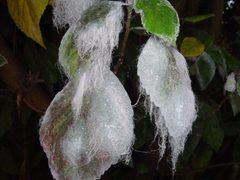
1- Aleurodicus dugesii(giant whitefly)
Aleurodicus is a of whiteflies (Hemiptera: Aleyrodidae) comprising at least 30 described distributed across tropical and subtropical regions worldwide. Several species are significant agricultural and ornamental pests, including the spiraling whitefly (A. rugioperculatus) and the spiraling whitefly (A. dispersus). The genus is characterized by distinctive wax-producing capabilities and puparial used extensively in taxonomic identification.
Pronunciation
How to pronounce Aleurodicus: /ælˌjʊəroʊˈdaɪkəs/
These audio files are automatically generated. While they are not always 100% accurate, they are a good starting point.
Identification
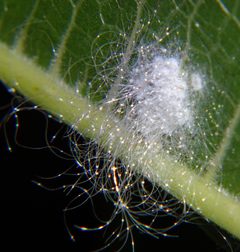
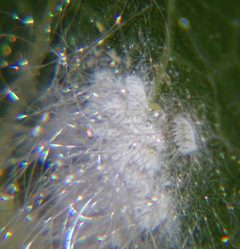
Identification relies primarily on puparial —specifically shape, coloration, wax pattern type and placement, and opercular structure. A. rugioperculatus distinguished by puparial surface with spiraling wax; A. dugesii by larger size and prominent waxy filaments; A. dispersus by spiral wax patterns on leaves. require microscopic examination for definitive identification. Field keys for Florida compare adult and puparial size and shape against common and other whitefly .
Images
Habitat
Tropical and subtropical environments; occupy agricultural fields, orchards, ornamental landscapes, and natural vegetation. Many species associated with palm-dominated . A. rugioperculatus found on coconut palms, gumbo limbo, and diverse ornamentals in Florida. A. dispersus occurs in banana plantations and mixed cropping systems.
Distribution
Pantropical and subtropical distribution. Native range includes Central America, Caribbean, and parts of South America. established in Florida (USA), India, Southeast Asia, Pacific Islands, and elsewhere. A. rugioperculatus reported from Florida (2009), India (2016), and expanding. A. dispersus widespread across Caribbean, Central America, Pacific Islands, Asia, and Africa.
Diet
Phloem-feeding on plant sap; all are obligate plant-feeders with .
Host Associations
- Cocos nucifera - Major for A. rugioperculatus and A. destructor
- Musa - Documented for multiple including A. dispersus and A. rugioperculatus
- Ficus benjamina - Primary for ficus whitefly (Singhiella simplex), not Aleurodicus; some Aleurodicus reported from Ficus
- Persea americana - for A. dispersus
- Psidium guajava - for A. dispersus and A. rugioperculatus
- Elaeis guineensis - for A. rugioperculatus
- Bursera simaruba - Gumbo limbo, for A. rugioperculatus in Florida
Life Cycle
Hemimetabolous development with , four nymphal instars, and stages. First instar () mobile; subsequent instars , forming . Development time varies with temperature and plant—A. dispersus development and thermally mediated. Multiple overlapping per year in tropical climates.
Behavior
weak fliers, dispersing short distances to locate new . Nymphs , feeding in place. Heavy wax production creates conspicuous spiraling or filamentous patterns on leaf undersides. Honeydew promotes growth. A. rugioperculatus adults and nymphs produce extensive wax, creating nuisance conditions in urban landscapes.
Ecological Role
Phloem-feeding herbivores that can reach pest densities causing plant stress, defoliation, and reduced productivity. Honeydew production alters microhabitat conditions via . Serve as for specialized (Encarsia spp., Encarsiella spp.) and (Delphastus pallidus, Nephaspis spp., mites, spiders) that contribute to .
Human Relevance
Several are economically significant pests of coconut, banana, avocado, guava, and ornamental plants. A. rugioperculatus and A. dispersus are causing substantial damage to Florida's ornamental industry and agriculture in invaded regions. Management relies on (neonicotinoids), agents, and strategies. Defoliation of landscape hedges creates aesthetic and economic impacts; from honeydew produces nuisance conditions.
Similar Taxa
- Singhiella simplexAlso feeds on Ficus and causes similar defoliation damage; distinguished by puparial and characteristics
- Aleurotrachelus trachoidesSolanum whitefly, similar size and in Florida; distinguished by puparial shape and wax patterns
- Paraleyrodes bondariBondar's nesting whitefly, similar whitefly ; produces distinct nesting wax patterns unlike Aleurodicus spiraling patterns
- Bemisia tabaciSweetpotato/silverleaf whitefly, similar agricultural pest; and differ in size, shape, and wax production
More Details
Invasive Species Status
A. rugioperculatus identified as pest in Florida (2009) and India (2016), with expanding range documented across 67+ plant . A. dispersus established across multiple tropical regions as invasive pest.
Taxonomic Characteristics
defined by puparial features including vasiform orifice structure, caudal furrow, and wax gland distribution. descriptions rely heavily on fourth-instar nymphal (puparial) rather than characters.
Natural Enemies
Encarsia guadeloupae is the of A. rugioperculatus in India and Florida; parasitization affected by plant and symbiotic bacteria. Predatory Delphastus pallidus and parasitoid Baeoentodon balios significant in Florida .
Sources and further reading
- BugGuide
- Wikipedia
- GBIF taxonomy match
- iNaturalist taxon
- NCBI Taxonomy
- Catalogue of Life
- Don't Bet Your Hedges: IPM Guide Outlines Ficus Whitefly Management
- whitefly size comparison - Entomology Today
- Aleurodicus rugioperculatus . [Distribution map].
- Host Plant Preference of the Whitefly, Aleurodicus dispersus Russell
- Pest Identification Guide: Rugose Spiraling Whitefly, Aleurodicus rugioperculatus
- Host Plants of Invasive Whiteflies - Rugose Spiralling Whitefly, Aleurodicus rugioperculatus Martin and Bondar's Nesting Whitefly, Paraleyrodes bondari Peracchi
- Host Range of Coconut Rugose Spiralling Whitefly Aleurodicus rugioperculatus Martin
- Aleurodicus dispersus . [Distribution map].
- Aleurodicus dispersus . [Distribution map].
- Thermal and Host-Plant Mediated Variation in Development and Reproductive Performance of Aleurodicus Dispersus Russell (Hemiptera: Aleyrodidae)
- Enemigos naturales de la mosca blanca Aleurodicus dispersus Russell (Homoptera: Aleyrodidae): parasitoides y depredadores.
- Bio-ecology and management of spiraling whitefly, Aleurodicus dispersus Russell through insecticides : A review
- Aleurodicus destructor . [Distribution map].
- Parasitic efficiency of Encarsia guadeloupae (Hymenoptera: Aphelinidae) on symbiotic and antibiotic treated invasive whitefly, Aleurodicus rugioperculatus (Hemiptera: Aleyrodidae)
- Rugose spiraling whitefly Aleurodicus rugioperculatus Martin (Hemiptera: Aleyrodidae)