
Perillus confluens
(Herrich-Schaeffer, 1839)
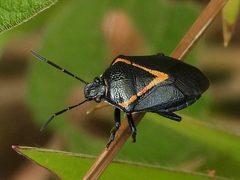
Perillus confluens is a of in the Pentatomidae. It is found in Central America and North America. As a member of the Perillus, it is a true that actively hunts and kills prey using toxic venom and digestive .


Pronunciation
How to pronounce Perillus confluens: //pɛˈrɪləs kənˈfluːɛnz//
These audio files are automatically generated. While they are not always 100% accurate, they are a good starting point.
Identification
Members of the Perillus can be distinguished from other predatory stink bugs by their characteristic coloration and markings. The specific identification features for P. confluens are not well documented in available sources. The genus is related to other predatory pentatomids such as Podisus (spined soldier bug) and Perillus bioculatus (two-spotted stink bug), which are known for their orange and black coloration.
Images
Distribution
Central America and North America.
Ecological Role
As a , Perillus confluens likely functions as a agent, preying on other insects. Related in the are known to prey on pest species such as Colorado potato beetle larvae and .
Similar Taxa
- Perillus bioculatusClosely related congeneric , also a with similar and appearance; known as the two-spotted stink bug
- Podisus maculiventrisAnother in the same with similar predatory and ecological role; known as the spined soldier bug
More Details
Taxonomic note
The was described by Herrich-Schaeffer in 1839. Available sources provide minimal information beyond basic taxonomic classification and geographic distribution.
Sources and further reading
- BugGuide
- Wikipedia
- GBIF taxonomy match
- iNaturalist taxon
- Bugs in orange and black, predator and prey: Two-spotted stink bug, Perillus bioculatus, and Colorado potato beetle, Leptinotarsa decemlineata — Bug of the Week
- Bugs in orange and black, Part 3 – Trick or treat? Two-spotted stink bug, Perillus bioculatus, has a lethal trick that turns Colorado potato beetle, Leptinotarsa decemlineata, into a tasty treat — Bug of the Week
- mimicry | Beetles In The Bush
- Archive — Bug of the Week
- The one that got away! | Beetles In The Bush
- Art and Bob and Ted’s Excellent Adventure | Beetles In The Bush