
Perillus bioculatus
(Fabricius, 1775)
two-spotted stink bug, double-eyed soldier bug
Perillus bioculatus is a native to North America that has been introduced to Europe and Asia as a agent. Both nymphs and are specialized of Colorado potato beetle (Leptinotarsa decemlineata) and larvae, using toxic venom and digestive to subdue and liquefy prey. The has established expanding in southeastern Europe, with recent records from Serbia, Hungary, Romania, and Turkey. Research demonstrates its ability to locate prey by detecting volatile compounds released by -damaged potato plants.
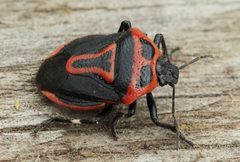
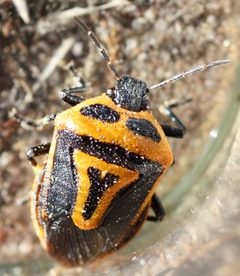
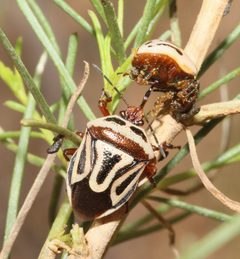
Pronunciation
How to pronounce Perillus bioculatus: //pɛˈrɪləs baɪˌɒkjʊˈleɪtəs//
These audio files are automatically generated. While they are not always 100% accurate, they are a good starting point.
Identification
Distinguished from herbivorous stink bugs by predatory and association with Colorado potato beetle prey. Distinguished from the similar spined soldier bug (Podisus maculiventris) by specific color pattern and association. The 'two-spotted' or 'double-eyed' markings are diagnostic. First instar nymphs can be identified by their unusual behavior of feeding on potato stems before transitioning to .
Images
Appearance
exhibit the shield-shaped body typical of Pentatomidae, with coloration combining black and orange or red markings. The 'two-spotted' or 'double-eyed' refers to distinctive paired markings. Nymphs display variable coloration that may differ from adults, with markings commonly varying among instars. Like other stink bugs, possesses a large triangular scutellum covering the rear and .
Habitat
Agricultural systems, particularly potato fields and associated Solanaceae crops. Established in Europe also occupy semi-natural environments including ragweed (Ambrosia artemisiifolia) stands. Requires presence of suitable prey populations for persistence.
Distribution
Native to North America; introduced to Eastern Europe, North India, and expanding across southeastern Europe including Serbia, Hungary, Romania, Bulgaria, Moldova, Ukraine, Russia (Krasnodar), and Turkey. Recent citizen science data confirm establishment throughout Hungary as of 2024.
Seasonality
Activity patterns tied to prey availability and . enter reproductive under short-day conditions, with critical photoperiod around 15L:9D when feeding on large prey. Preoviposition period varies with prey type and photoperiod.
Diet
Specialized of Colorado potato beetle (Leptinotarsa decemlineata) and larvae at all post-first-instar stages. First instar nymphs feed by sucking juices from potato stems before transitioning to . In Europe, has been observed preying on Ophraella communa leaf beetles on ragweed, and alternative prey including larvae and caterpillars have been reported.
Host Associations
- Leptinotarsa decemlineata - preyPrimary prey; and larvae consumed
- Ophraella communa - preyAlternative prey on ragweed in Europe
- Solanum tuberosum - Potato; primary agricultural
- Ambrosia artemisiifolia - Ragweed; for alternative prey in Europe
Life Cycle
with , nymph, and stages. Barrel-shaped eggs laid in clusters, initially white to pale green, darkening over time. Five nymphal instars; first instar feeds on plant stems before transitioning to . Adults overwinter in under short . Females capable of producing hundreds of eggs over their lifespan.
Behavior
Active that hunts rather than ambushes prey. Locates prey-damaged plants by detecting airborne volatile sesquiterpenoid compounds released when feed on potato foliage, using positive odour-conditioned anemotaxis. Attack involves piercing prey with beak, injecting toxic venom to immobilize, then injecting digestive to liquefy tissues before sucking nutrient-rich fluids with muscular pump in . Exhibits strong tendency to aggregate, influencing patterns. Dispersal rate influenced by temperature, instar size, physiological age, and predator .
Ecological Role
agent suppressing of agricultural pests, particularly Colorado potato beetle. pressure significant: nymphs consume approximately five larvae daily. Contributes to top-down regulation of herbivorous beetle populations in potato agroecosystems and, increasingly, in European ragweed through predation on leaf beetles.
Human Relevance
Intentionally introduced to Europe and Asia as agent for Colorado potato beetle. Mass release programs into potato fields have proven economically unfeasible due to and establishment limitations. Now subject of renewed interest due to natural range expansion in Europe and potential for . Citizen science campaigns tracking expansion in Hungary and surrounding regions.
Similar Taxa
- Podisus maculiventrisSpined soldier bug; also predatory pentatomid used for biocontrol, but with broader prey range including caterpillars and other insects, and different coloration/spination pattern
- Euthyrhynchus floridanusFlorida predatory stink bug; similar predatory and orange-black warning coloration, but native to southeastern US with different body shape and marking pattern
More Details
Olfactory Foraging Mechanism
Research demonstrates that P. bioculatus detects specific sesquiterpenoid volatile compounds released by potato plants damaged by Colorado potato beetle feeding, not mechanical damage alone. This chemically-mediated location allows efficient foraging in spatially heterogeneous agricultural environments.
Photoperiod-Mediated Diapause
Critical for induction varies with prey type: approximately 15 hours light when feeding on large larvae versus 14.5 hours light when feeding on and small larvae. Females feeding on large larvae show longer preoviposition periods and slightly higher mortality rates.
European Establishment History
Multiple introduction attempts to Europe from the 1950s onward were initially considered unsuccessful. Small self-sustaining now confirmed in Balkan Peninsula, Southern Russia, and Turkey, with recent rapid expansion into Eastern Europe facilitated by dietary drift to alternative prey .
Sources and further reading
- BugGuide
- Wikipedia
- GBIF taxonomy match
- iNaturalist taxon
- NCBI Taxonomy
- Stink Bugs Suck | Bug Squad
- Bugs in orange and black, predator and prey: Two-spotted stink bug, Perillus bioculatus, and Colorado potato beetle, Leptinotarsa decemlineata — Bug of the Week
- Bugs in orange and black, Part 3 – Trick or treat? Two-spotted stink bug, Perillus bioculatus, has a lethal trick that turns Colorado potato beetle, Leptinotarsa decemlineata, into a tasty treat — Bug of the Week
- Heroes of the true bug clan: Two spotted stink bug, Perillus bioculatus, and spined soldier bug, Podisus maculiventris — Bug of the Week
- Archive — Bug of the Week
- Bug of the Week celebrates ten years! — Bug of the Week
- Distribution of Perillus bioculatus (Fabricius, 1775) in Serbia
- Dispersal of Perillus bioculatus, a Stinkbug Predator of the Colorado Potato Beetle
- The Introduction of Perillus bioculatus into Europe to Control the Colorado Beetle
- First records of Mustha spinosula and Perillus bioculatus (Heteroptera: Pentatomidae) in Romania
- Past, present and future of the two-spotted stink bug (Perillus bioculatus) in Europe revealed by citizen science
- Life History and Cost Analysis for Continuous Rearing of Perillus bioculatus (Heteroptera: Pentatomidae) on a Zoophytogenous Artificial Diet
- EFFECTS OF PHOTOPERIOD AND PREY TYPE ON DIAPAUSE TENDENCY AND PREOVIPOSITION PERIOD IN PERILLUS BIOCULATUS (HEMIPTERA: PENTATOMIDAE)
- Life History and Cost Analysis for Continuous Rearing of <I>Perillus bioculatus</I> (Heteroptera: Pentatomidae) on a Zoophytogenous Artificial Diet
- Orientation behaviour of the predatory hemipteran Perillus bioculatus to plant and prey odours