
Ophraella communa
LeSage, 1986
ragweed leaf beetle
Ophraella communa is a small leaf beetle native to North America that has been introduced to Europe and Asia as a agent for the weed common ragweed (Ambrosia artemisiifolia). and larvae feed on leaves and flowers of Asteraceae, with a strong preference for ragweed. The has demonstrated rapid adaptive evolution of cold in newly colonized regions, facilitating northward expansion. Multiple mating is positively associated with in this species, with females preferring larger males that confer reproductive advantages through seminal fluid proteins.
Pronunciation
How to pronounce Ophraella communa: /ɒfˈraɪɛlə kəˈmjuːnə/
These audio files are automatically generated. While they are not always 100% accurate, they are a good starting point.
Identification
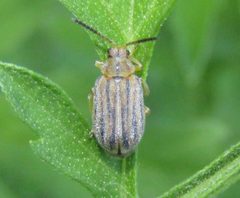
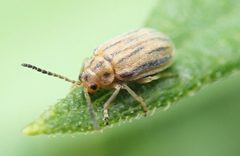
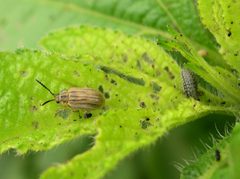
Distinguished from by the combination of yellowish to pale brown with dark brown longitudinal stripes, three dark spots on the pronotum, and small body size. The specific association with Ambrosia artemisiifolia in regions where it has been introduced provides a strong ecological indicator. Molecular identification may be necessary where sympatric with related Ophraella .
Images
Appearance
Small leaf beetle with males measuring 3.4–4.1 mm and females 3.9–4.3 mm in length. yellowish with dark brown spots posteriorly. Pronotum yellowish to pale brown with three black or dark brown spots. yellowish to pale brown with dark brown longitudinal stripes. Body surface coarsely punctured. dark brown.
Habitat
Primarily associated with plants in the Asteraceae tribe Heliantheae, especially common ragweed (Ambrosia artemisiifolia). Found in disturbed , degraded meadows, agricultural areas, and roadsides where ragweed grows abundantly. In introduced ranges, often occurs near transportation corridors and cargo centers.
Distribution
Native to North America (Canada, United States, Mexico). Introduced to Asia and Europe; first recorded in Europe in 2013, with subsequent establishment in Italy, Switzerland, Slovenia, Croatia, and Hungary. In Asia, established in China with spreading northward from initial introductions in southern provinces.
Diet
Oligophagous herbivore feeding almost exclusively on leaves and flowers of Asteraceae tribe Heliantheae. Strong preference for common ragweed (Ambrosia artemisiifolia). Capable of completing on sunflower (Helianthus annuus) and rough cocklebur (Xanthium strumarium) in laboratory conditions, but field studies demonstrate strong preference for ragweed. Occasional feeding on Helianthus decapetalus and other Asteraceae recorded but at low intensity.
Host Associations
- Ambrosia artemisiifolia - primary common ragweed; preferred for feeding, oviposition, and complete
- Helianthus annuus - secondary sunflower; laboratory confirmed but rarely used in field conditions
- Xanthium strumarium - secondary rough cocklebur; occasional feeding observed
Life Cycle
laid on undersides of young leaves of plants; pear-shaped with hexagonal microsculpture, initially yellow changing to orange. Larvae feed on host plant foliage. Before , larvae form loosely woven cocoons on leaf tips. Pupation lasts one to two weeks. emerge and initially remain on host plants; later capable of migrating up to 25 km in a single day. Entire can be completed on Ambrosia artemisiifolia.
Behavior
and larvae aggregate on plants. Host location mediated by olfaction through odorant-binding protein OcomOBP7, which specifically binds α-pinene and ocimene from ragweed volatiles. Adults capable of long-distance (up to 25 km/day) after initial post- period. Multiple mating observed with positive consequences. Females prefer larger males, which confer developmental and reproductive fitness advantages to offspring through differential expression of seminal fluid protein genes (OcACE, OcCBP, OcSFP).
Ecological Role
natural enemy and agent of common ragweed (Ambrosia artemisiifolia). Suppresses ragweed through defoliation and damage to reproductive structures, potentially reducing pollen production and allergen exposure. Non-target effects on native European vegetation appear minimal based on field surveys; occasional presence on cultivated sunflower requires monitoring but field damage remains low.
Human Relevance
Intentionally introduced and established in Europe and Asia as a agent for common ragweed, which causes agricultural damage and serious allergic rhinitis and asthma. Reduces ragweed growth and pollen production in managed landscapes. Potential concern for sunflower , though field studies indicate minimal economic impact. Cold enhancement through plant acclimation or selection may improve efficacy in northern regions.
Similar Taxa
- Other Ophraella species may overlap in native North American range; require morphological examination and association for differentiation
- Generalist chrysomelid leaf beetlessimilar size and coloration possible; O. communa distinguished by specific pronotal spot pattern, elytral striping, and strong association with Ambrosia
More Details
Rapid cold adaptation
introduced to Beijing (39.98°N) from southern China (23.62°N) in 2012 successfully established and overwintered, demonstrating rapid adaptive evolution. High-latitude populations show elevated levels of , proline, glycerol, total sugar, and lipid cryoprotectants, and upregulated expression of genes involved in trehalose transport (Tret1a, Tret1b, Tret1-2), proline biosynthesis (P5CS), and glutathione S-transferase activation (GST). Cold can be enhanced by feeding beetles cold-acclimated ragweed from high latitudes.
Olfactory mechanism
The odorant-binding protein OcomOBP7, specifically expressed in , mediates plant recognition. RNAi of OcomOBP7 significantly reduces antennal response to α-pinene and ocimene, key volatile compounds from Ambrosia artemisiifolia. This olfactory specialization underlies the 's host-finding .
Mating system
Multiple mating is maintained by through direct benefits. Compared to single mating, unrestricted mating increases longevity by 48%, by 75%, and hatch rate by 55%. Female preference for larger males is mediated by seminal fluid proteins; larger males show biased expression of genes OcACE, OcCBP, and OcSFP that enhance offspring fitness.
Sources and further reading
- BugGuide
- Wikipedia
- GBIF taxonomy match
- iNaturalist taxon
- NCBI Taxonomy
- Mowing Grass in Water-Detention Basins Increases Mosquito Populations
- A Tiger Beetle Aggregation | Beetles In The Bush
- Why Larvae of One Wasp Species Often Eat Their Siblings
- Day hike at Little Lost Creek Conservation Area | Beetles In The Bush
- Get them when they're little - Eastern tent caterpillar, Malacosoma americanum — Bug of the Week
- Bug Eric: Spider Sunday: Marbled Cellar Spider
- First record of Ophraella communa in Hungary (Coleoptera: Chrysomelidae)
- Characterization and Functional Analysis of OcomOBP7 in Ophraella communa Lesage
- Mating frequency positively associates with fitness in Ophraella communa
- Rapid Adaptive Evolution of Ophraella Communa in New Low Temperature Environment
- Larger males facilitate population expansion in Ophraella communa
- The first record on Xanthium strumarium and Helianthus decapetalus as host plants of ragweed leaf beetle (Ophraella communa L.) in Serbia
- Effects of Periodical Heat Stress on Life History Parameters and Body Size of Ophraella Communa
- Biological and behavioral studies onOphraella communaLeSage (Chrysomelidae: Galerucinae), potential biocontrol candidate agent of common ragweed(Ambrosia artemisiifoliaL.) in Europe.
- Effect of horizontal transfer of cold-tolerant substances of Ambrosia artemisiifolia on the low temperature adaptability of Ophraella communa
- Tests of Inbreeding Effects on Host-Shift Potential in the Phytophagous Beetle Ophraella communa
- Genetic Constraints and the Phylogeny of Insect-Plant Associations: Responses of Ophraella communa (Coleoptera: Chrysomelidae) to Host Plants of its Congeners
- Ambrosia artemisiifolia control in agricultural areas: effect of grassland seeding and herbivory by the exotic leaf beetle Ophraella communa
- Host-use pattern of the ragweed beetle Ophraella communa LeSage (Coleoptera: Chrysomelidae) for overwintering and reproduction in Tsukuba
- Ambrosia artemisiifolia control in agricultural areas: effect of grassland seeding and herbivory by the exotic leaf beetle Ophraella communa
- Relationship Between Host Searching and Wind Direction in Ophraella communa (Coleoptera: Chrysomelidae)