
Ophraella
Wilcox, 1965
Species Guides
10- Ophraella americana(American Goldenrod Leaf Beetle)
- Ophraella bilineata(Skeletonizing leaf beetle)
- Ophraella californiana
- Ophraella communa(ragweed leaf beetle)
- Ophraella conferta(Crowded Leaf Beetle)
- Ophraella cribrata(skeletonizing leaf beetle)
- Ophraella notata(Boneset Leaf Beetle)
- Ophraella notulata(Marsh Elder Leaf Beetle)
- Ophraella sexvittata(Six-lined Goldenrod Leaf Beetle)
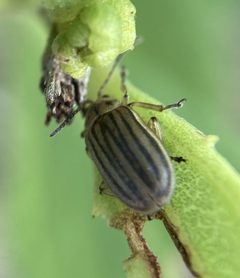
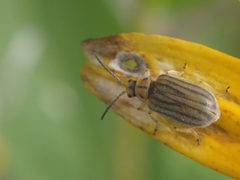
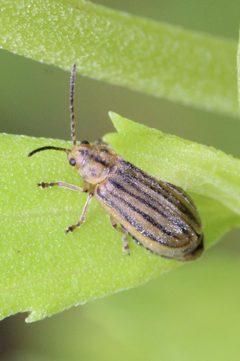
Ophraella is a of leaf beetles in the Chrysomelidae, Galerucinae. The genus comprises approximately 20 described distributed across North America, with some species introduced to Europe and Asia as agents. Species within Ophraella exhibit specialized herbivory on Asteraceae plants, with documented associations including ragweeds (Ambrosia), marsh elders (Iva), and sunflowers (Helianthus). The genus has been extensively studied for its host plant specialization, rapid adaptive evolution, and potential for weed biological control.
Pronunciation
How to pronounce Ophraella: /ɒfˈraɪɛlə/
These audio files are automatically generated. While they are not always 100% accurate, they are a good starting point.
Images
Habitat
are defined by plant distribution. occur in disturbed meadows, roadsides, agricultural fields, and coastal salt marshes where Asteraceae host plants grow. Ophraella communa is found in degraded urban meadows near transportation corridors in Europe. Ophraella notulata inhabits coastal salt marsh habitats associated with marsh elder (Iva spp.).
Distribution
Native to North America from Mexico to Canada. Ophraella communa has been introduced to China (southern China, Beijing), and established in Europe since 2013 including Italy, Switzerland, Slovenia, Croatia, and Hungary. Distribution models suggest limited potential in northern parts of introduced ranges.
Human Relevance
Ophraella communa is deployed as a agent for common ragweed (Ambrosia artemisiifolia), an agricultural weed and human health hazard due to allergenic pollen. The reduces ragweed and pollen production. Concerns exist regarding non-target risks to sunflower (Helianthus annuus), as laboratory studies and occasional field observations confirm feeding capability on sunflower.
Sources and further reading
- BugGuide
- Wikipedia
- GBIF taxonomy match
- iNaturalist taxon
- NCBI Taxonomy
- Biology of Ophraella notulata (Coleoptera: Chrysomelidae)2
- First record of Ophraella communa in Hungary (Coleoptera: Chrysomelidae)
- Characterization and Functional Analysis of OcomOBP7 in Ophraella communa Lesage
- Mating frequency positively associates with fitness in Ophraella communa
- Rapid Adaptive Evolution of Ophraella Communa in New Low Temperature Environment
- The first record on Xanthium strumarium and Helianthus decapetalus as host plants of ragweed leaf beetle (Ophraella communa L.) in Serbia
- Genetic and phylogenetic aspects of host plant affiliation in Ophraella (Chrysomelidae: Galerucinae)
- Genetic Constraints on Macroevolution: The Evolution of Host Affiliation in the Leaf Beetle Genus Ophraella
- Effect of horizontal transfer of cold-tolerant substances of Ambrosia artemisiifolia on the low temperature adaptability of Ophraella communa
- Biological and behavioral studies onOphraella communaLeSage (Chrysomelidae: Galerucinae), potential biocontrol candidate agent of common ragweed(Ambrosia artemisiifoliaL.) in Europe.
- Effects of Periodical Heat Stress on Life History Parameters and Body Size of Ophraella Communa
- Apparent transgenerational effects of host plant in the leaf beetle Ophraella notulata (Coleoptera: Chrysomelidae)
- Phylogeny and the Evolution of Host Plant Associations in the Leaf Beetle Genus Ophraella (Coleoptera, Chrysomelidae)
- Tests of Inbreeding Effects on Host-Shift Potential in the Phytophagous Beetle Ophraella communa
- PHYLOGENY AND THE EVOLUTION OF HOST PLANT ASSOCIATIONS IN THE LEAF BEETLE GENUSOPHRAELLA(COLEOPTERA, CHRYSOMELIDAE)