
Ophraella notulata
(Fabricius, 1801)
Marsh Elder Leaf Beetle
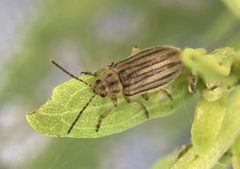
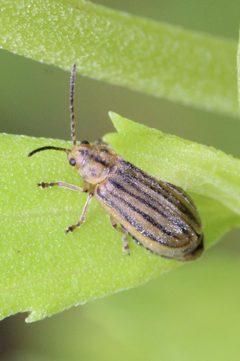
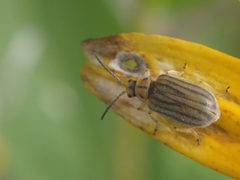
Ophraella notulata is a Nearctic skeletonizing leaf beetle in the Chrysomelidae, found in Gulf Coast states of the United States and Mexico. It was previously described as O. integra (LeConte), now synonymized with O. notulata (Fabricius). The is specialized on plants in the Asteraceae family, primarily Iva frutescens (marsh elder), with documented ability to utilize Ambrosia artemisiifolia (ragweed) as an alternative host. Research has demonstrated complex transgenerational effects of host plant on offspring and .
Pronunciation
How to pronounce Ophraella notulata: //ˌɒfˈreɪ.lə noʊˈtjuː.læ.tə//
These audio files are automatically generated. While they are not always 100% accurate, they are a good starting point.
Identification
Previously synonymized with Ophraella integra (LeConte); distinguished from by distribution in Gulf Coast states and association with Iva . Within the Ophraella, species are distinguished by subtle morphological differences and host plant specificity; O. notulata specifically associated with coastal marsh elder .
Images
Habitat
Coastal and Gulf Coast environments; associated with marsh elder (Iva frutescens) vegetation.
Distribution
Gulf Coast states of the United States and Mexico; eastern North America extending to Central America.
Seasonality
active on plants until early autumn; overwinter in leaf litter. Likely with one per year, though specific for this not fully documented.
Diet
Skeletonizes leaves; larvae and feed on tender leaf tissue of Asteraceae plants, leaving only . Natural host is Iva frutescens (marsh elder); capable of utilizing Ambrosia artemisiifolia (ragweed) under experimental conditions.
Host Associations
- Iva frutescens - primary plantmarsh elder, natural in coastal
- Ambrosia artemisiifolia - alternative plantragweed; utilized in laboratory experiments and potentially in nature
Life Cycle
laid in clusters on undersides of young leaves. Larvae are epigeal (exposed, not concealed), skeletonizing young leaves. Before , larva spins loose cocoon attached to leaf tip. Pupation lasts 1–2 weeks. emerge and remain on plants until early autumn, then enter leaf litter to overwinter. time likely (one per year), though this inferred from -level patterns.
Behavior
Demonstrates transgenerational plasticity in response to plant: both maternal and paternal host plant environment influence offspring survival to adulthood, feeding responses, and oviposition . Hatchling feeding behavior shows interaction between maternal and paternal host history. Paternal effects on offspring traits observed, suggesting nongenetic paternal transmission or cryptic selection mechanisms. No maternal effects detected on offspring feeding or oviposition preferences.
Ecological Role
Herbivorous leaf beetle contributing to leaf damage and nutrient cycling in coastal marsh vegetation; specialized consumer of Asteraceae in coastal wetland .
Similar Taxa
- Ophraella confertaOverlaps in eastern North America but restricted to northeastern states; feeds on Solidago canadensis and S. rugosa rather than Iva
- Ophraella sexvittataSoutheastern distribution on Solidago spp.; distinguished by plant and more interior southeastern range
- Ophraella communaTranscontinental distribution including Mexico; specialized on Ambrosia artemisiifolia as primary rather than Iva
- Ophraella cribrataCoast-to-coast distribution in United States; feeds on Solidago subgenus Virgaurea, not Iva
Sources and further reading
- BugGuide
- Wikipedia
- GBIF taxonomy match
- iNaturalist taxon
- NCBI Taxonomy
- Wolbachia in Cockroaches: A New Paradigm for Urban Pest Management?
- cockroaches - Entomology Today
- Biology of Ophraella notulata (Coleoptera: Chrysomelidae)2
- Apparent transgenerational effects of host plant in the leaf beetle Ophraella notulata (Coleoptera: Chrysomelidae)
- A TAXONOMIC MONOGRAPH OF THE NEARCTIC GALERUCINE GENUSOPHRAELLAWILCOX (COLEOPTERA: CHRYSOMELIDAE)