
Ophraella sexvittata
(J.L.LeConte, 1865)
Six-lined Goldenrod Leaf Beetle
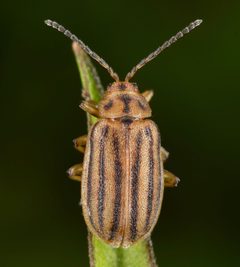
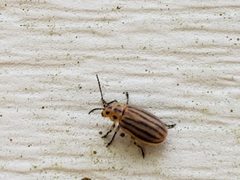
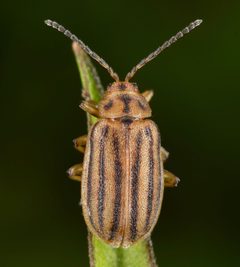
Ophraella sexvittata is a skeletonizing leaf beetle in the Chrysomelidae. It is one of 13 recognized in the Nearctic Ophraella. The species is a herbivore associated with goldenrods (Solidago spp.) in the southeastern United States.
Pronunciation
How to pronounce Ophraella sexvittata: /ˌɒf.rəˈɛl.lə sɛks.vɪˈtɑː.tə/
These audio files are automatically generated. While they are not always 100% accurate, they are a good starting point.
Identification
Belongs to the Ophraella, characterized by skeletonizing leaf-feeding larvae. Distinguished from by its distribution in the southeastern United States and association with Solidago plants. Specific diagnostic morphological features for separating O. sexvittata from other Ophraella are not documented in available sources.
Images
Habitat
Southeastern United States; associated with supporting Solidago spp. (goldenrods).
Distribution
Southeastern United States.
Seasonality
active on plants until early autumn, then enter leaf litter for . Likely one per year based on -level patterns.
Diet
Herbivorous; feeds on Solidago spp. (goldenrods).
Host Associations
- Solidago spp. - obligateprimary plant; larvae and feed on goldenrods
Life Cycle
laid in clusters on undersides of young leaves. Larvae skeletonize leaves, feeding exposed on tender tissue. Before , larva spins a loose cocoon attached to leaf tip; pupation lasts 1–2 weeks. Newly emerged remain on plants until early fall, then overwinter in leaf litter.
Behavior
enter leaf litter for in early autumn. Larvae feed openly on leaf surfaces rather than mining or rolling leaves.
Ecological Role
Herbivore; consumer of Solidago. Larval skeletonizing feeding damages leaf tissue between .
Similar Taxa
- Ophraella cribrataOverlaps in use (Solidago) but distributed coast-to-coast in the United States rather than restricted to the Southeast.
- Ophraella confertaAlso feeds on Solidago in eastern North America, but restricted to northeastern states with preference for S. canadensis and S. rugosa.
- Ophraella americanaFeeds on Solidago in eastern North America; broader distribution not limited to southeastern states.
More Details
Taxonomic context
Described by J.L. LeConte in 1865; one of six new recognized in the 1986 revision of the , though O. sexvittata itself was not among the newly described species.