
Trirhabda diducta
Horn, 1893
skeletonizing leaf beetle
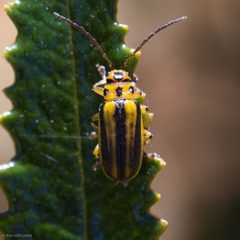
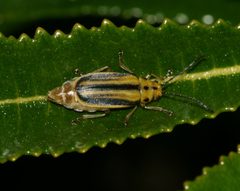
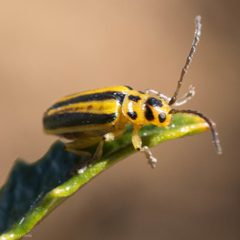
Trirhabda diducta is a of skeletonizing in the Chrysomelidae, first described by George Henry Horn in 1893. The Trirhabda comprises approximately 26 North American species, most of which are associated with goldenrod (Solidago) and related Asteraceae . Like , T. diducta is expected to be a herbivore with larvae that mine leaves and that skeletonize foliage. The species occurs across North America, though specific host associations and detailed remain poorly documented compared to better-studied relatives such as T. canadensis and T. virgata.
Pronunciation
How to pronounce Trirhabda diducta: /traɪˈræbdə daɪˈdʌktə/
These audio files are automatically generated. While they are not always 100% accurate, they are a good starting point.
Identification
Definitive identification requires examination of male genitalia and comparison with described type material. Externally, T. diducta may be distinguished from the widespread T. canadensis and T. virgata by subtle differences in elytral punctation , pronotal shape, and color pattern intensity, though these characters overlap and are unreliable without dissection. Geographic distribution and plant associations may provide supporting evidence where ranges do not overlap. Larval identification is not established.
Images
Habitat
Inferred to occupy open, sunny supporting its plants, including prairies, meadows, old fields, and roadsides where Asteraceae, particularly goldenrods (Solidago), are abundant. Specific microhabitat preferences are undocumented.
Distribution
Documented from North America; precise range boundaries are poorly defined due to historical taxonomic confusion and limited modern collecting. GBIF records indicate presence across the continent, but of observations is low relative to more common .
Seasonality
activity period is not explicitly documented for this . Related Trirhabda species are active primarily in late summer and early autumn (August–October), coinciding with goldenrod flowering and peak larval development.
Ecological Role
Expected to function as a herbivore on Asteraceae, with potential for localized that reduce plant . Congeneric have demonstrated keystone effects in old-field by suppressing goldenrod and facilitating plant diversity; whether T. diducta exhibits comparable ecological impacts is unknown.
Human Relevance
No documented direct interactions with humans. Potential indirect relevance through impacts on native plant and as a subject for studies of insect-plant specialization.
Similar Taxa
- Trirhabda canadensisWidespread North American with similar yellow-green coloration and goldenrod association; reliably distinguished only by male genitalia and subtle external characters.
- Trirhabda virgataBroadly sympatric with overlapping range; external similarity requires dissection for confident separation.
- Trirhabda bacharidisAssociated with Baccharis rather than Solidago; may occur in similar but plant provides initial separation.
More Details
Taxonomic note
The Trirhabda has undergone repeated taxonomic revision, with many historically confused under broadly defined names. T. diducta was described from limited material and has received little modern taxonomic attention, contributing to uncertainty in its identification and distribution.
Research needs
Basic including plant range, larval development, and remain unstudied. Molecular phylogenetic analysis of the may clarify boundaries and improve identification tools.