
Trirhabda virgata
LeConte, 1865
goldenrod beetle, goldenrod leaf beetle
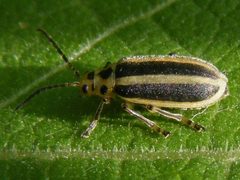
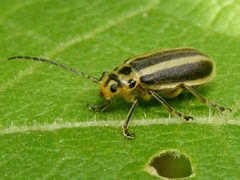
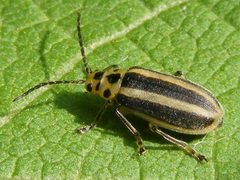
Trirhabda virgata is a leaf beetle in the Chrysomelidae, commonly known as the goldenrod . It is native to North America and specializes on goldenrod plants (Solidago spp.) in the Asteraceae family. The has been extensively studied for its plant relationships, -dependent , and potential role as a keystone herbivore in old field . and larvae feed on goldenrod foliage, with larvae causing significant defoliation during conditions.
Pronunciation
How to pronounce Trirhabda virgata: /traɪˈræbdə vɜrˈɡeɪtə/
These audio files are automatically generated. While they are not always 100% accurate, they are a good starting point.
Images
Habitat
Old fields, meadows, and open areas where goldenrod (Solidago spp.) plants grow. Associated with host patches ranging from isolated stands to continuous goldenrod .
Distribution
North America. Documented in Canada (New Brunswick, Nova Scotia, Ontario) and the United States.
Diet
Herbivorous; feeds on Asteraceae plants. Primary include Solidago canadensis var. canadensis, Solidago graminifolia (flat-topped goldenrod), Solidago altissima (tall goldenrod), and Aster lateriflorus. feed on leaves in the upper portion of plants; larvae feed on leaf tissue between upper and lower surfaces.
Host Associations
- Solidago canadensis var. canadensis - primary Preferred ; emerge with greater mass and higher compared to other hosts
- Solidago graminifolia - Accepted but results in lower
- Solidago altissima - Tall goldenrod; subject of and studies
- Aster lateriflorus - Accepted but results in lower
Life Cycle
overwinter and hatch in spring. larvae feed on foliage, progressing through instars in field conditions until the last instar, then complete development in laboratory or protected conditions until . emerge, mate, and oviposit. Under laboratory over multiple , performance on previously suboptimal hosts can improve.
Behavior
and larvae are gregarious. Long-distance is -dependent: beetles emigrate from crowded, heavily defoliated patches but remain in low-density, lightly defoliated patches. Dispersal is triggered by conditions experienced during the adult phase, not by developmental conditions alone. Females prefer lush, undefoliated patches and avoid patches with simulated or actual chewing damage. Males aggregate on plants containing adult conspecifics, apparently to increase mating opportunities. Most arriving females have already mated, enabling lone females to colonize empty stands.
Ecological Role
Herbivore; can act as a in old field . can dramatically reduce goldenrod , , height, , and , increasing light penetration and promoting higher abundance, , and flowering in other plant . This herbivory can indirectly accelerate woody plant invasion and old field toward tree-dominated communities.
Sources and further reading
- BugGuide
- Wikipedia
- GBIF taxonomy match
- iNaturalist taxon
- NCBI Taxonomy
- Grasshoppers of Colorado
- Grasshoppers of Colorado
- Green Light: New ID Test Ready for Invasive Mealybug Pest
- Goldenrod Leaf Miner | Beetles In The Bush
- Heliconiidae | Beetles In The Bush
- PERFORMANCE OF TRIRHABDA VIRGATA (COLEOPTERA: CHRYSOMELIDAE) ON THREE POTENTIAL HOSTS
- Effects of Population Density on Long‐Distance Dispersal in the Goldenrod Beetle Trirhabda Virgata
- Colonization of host patches following long‐distance dispersal by a goldenrod beetle, Trirhabda virgata
- Disarming the paradox of sublethal plant defense against insects: Trirhabda virgata larval development time and leaf tissue loss on Solidago altissima