
Berytinus minor
(Herrich-Schaeffer, 1835)
common stiltbug
Berytinus minor is a stilt bug ( Berytidae) native to Europe, North Africa, and parts of Asia that has been introduced to North America. The exhibits wing , occurring in both long-winged and short-winged forms with associated morphological differences in the pronotum. It is strongly associated with white clover (Trifolium repens) as a food plant and has been studied in detail at introduced in New York State.
Pronunciation
How to pronounce Berytinus minor: /bɛˈrɪtɪnəs ˈmaɪnɔr/
These audio files are automatically generated. While they are not always 100% accurate, they are a good starting point.
Identification
Distinguished from other Berytidae by the combination of wing ( and brachypterous forms) and associated pronotal . The two B. m. minor and B. m. hybridus differ in wing and pronotal characteristics. In North America, identification relies on morphological examination of wing development and pronotum structure; however, the applicability of standard macropterous/brachypterous terminology has been questioned for this .
Images
Appearance
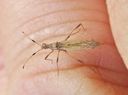
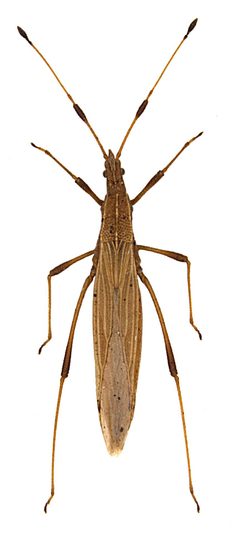
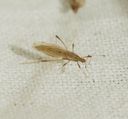
Small stilt bug with characteristically elongated legs that give the its . Two distinct wing forms exist: long-winged individuals with fully developed wings and short-winged individuals with reduced wings. The pronotum shape differs between forms, with morphological variation in the thoracic structure. Body size and coloration typical of the Berytinus.
Habitat
Strongly associated with white clover (Trifolium repens) as a food plant. In North American introduced , found in open where white clover grows, including lawns, meadows, and agricultural fields. Specific study at Ithaca, New York indicates occupation of clover-dominated vegetation patches.
Distribution
Native to Europe, North Africa, and Northern Asia (excluding China). Introduced to North America, with established in the northeastern United States and Canada. North American records include New York State and other locations; specific introduction site and remain subjects of discussion.
Seasonality
Overwinters as an . to food plants occurs in April. Mating and oviposition begin in late April and May. New adults of the season mature in late July or August, completing a single in temperate regions.
Diet
Feeds on white clover (Trifolium repens). The precise feeding mechanism (phloem feeding, seed feeding, or other) is not explicitly documented in available sources.
Host Associations
- Trifolium repens - food plantPrimary plant association documented in North American ; to this plant occurs in spring
Life Cycle
Hemimetabolous development typical of Hemiptera. Overwinters as . Mating and oviposition in late spring. Nymphal development through summer, with new adults maturing in late July or August. Single per year in temperate North America.
Behavior
Seasonal : move to food plants in April after . Wing suggests potential differences in dispersal capacity between forms, though this has not been explicitly tested. No other specific behaviors documented.
Ecological Role
Herbivore associated with leguminous plants; specific functions (pollination, nutrient cycling, food source for ) not documented.
Human Relevance
Introduced in North America, associated with white clover in lawns and agricultural settings. Not documented as a significant pest or beneficial species. Presence indicates successful establishment of a Palearctic insect in the Nearctic region.
Similar Taxa
- Other Berytinus speciesShare elongated leg and general body plan; require examination of wing development and pronotal structure for separation
- Other Berytidae generaSimilar stilt-like leg ; distinguished by genitalic and detailed structural characters
More Details
Wing polymorphism terminology
The author of the primary North American study questioned the applicability of the terms '' and 'brachypterous' as applied to B. minor, suggesting that the morphological differences do not fit standard definitions of these terms.
Subspecies
Two recognized: Berytinus minor minor (Herrich-Schaeffer, 1835) and Berytinus minor hybridus (Horvath, 1891), differing in morphological features.
Sources and further reading
- BugGuide
- Wikipedia
- GBIF taxonomy match
- iNaturalist taxon
- NCBI Taxonomy
- Catalogue of Life
- Six new Dracula ants from Madagascar: Minor workers become queens in Mystrium | Blog
- Litaneutria minor – agile ground mantid | Beetles In The Bush
- Bug Eric: Priocnemis minorata
- New ant species explodes to defend its colony | Blog
- BERYTINUS MINOR (HEMIPTERA: BERYTIDAE) IN NORTH AMERICA