
Berytidae
Fieber, 1851
stilt bugs, thread bugs
Subfamily Guides
3- Berytinae(stilt bugs)
- Gampsocorinae(stilt bugs)
- Metacanthinae
, commonly known as stilt bugs or thread , is a of true bugs (Hemiptera: Heteroptera) characterized by exceptionally long, slender legs and elongated bodies. The family contains approximately 200 worldwide, classified into three : Berytinae, Gampsocorinae, and Metacanthinae. Members range from 3-10 mm in length and display coloration from brown to yellow. While most species are phytophagous, feeding on plant sap, some exhibit predatory on small insects. Several species are economically significant as pests of cultivated crops, particularly tomatoes and tobacco, where feeding damage can cause flower abortion, fruit distortion, and unsalable produce.
Pronunciation
How to pronounce Berytidae: //bəˈrɪtɪdiː//
These audio files are automatically generated. While they are not always 100% accurate, they are a good starting point.
Identification
Distinguished from superficially similar thread-legged bugs (Emesinae, Reduviidae) by non- forelegs—Emesinae have forelegs modified for grasping prey like mantids, while forelegs resemble other legs in form and function. Antennal club usually more pronounced in Berytidae. protrusion between bases present in most Berytidae, absent in Emesinae. Wing venation and tarsal claw structure provide additional diagnostic characters. identification requires examination of genitalia and detailed morphometric analysis.
Images
Appearance
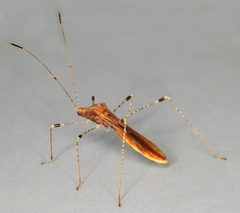
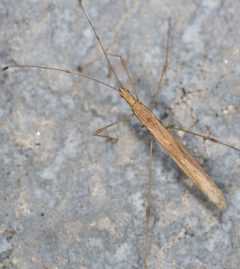
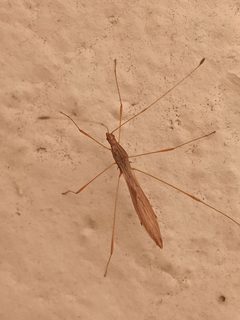
Extremely gracile insects with disproportionately long, slender legs that inspire the "stilt bugs." Body elongated and cylindrical, typically 3-10 mm in length. long, four-segmented, geniculate (elbowed), with distinct clubbed or swollen tips. often bears a forward-facing protrusion between antennal bases. Forelegs similar in form and function to mid- and hindlegs, not . Some exhibit slight swellings at ends of . Wing with five longitudinal . Wing common: both long-winged () and short-winged (brachypterous) forms occur within species. Many species possess split or toothed claws, apparently adaptations for traversing glandular-hairy plant surfaces. Some species have spine-like protrusions at base of forewings with pores for chemical secretion.
Habitat
Associated with herbaceous vegetation, particularly plants with glandular trichomes (sticky hairs). Common in gardens, agricultural fields, meadows, and disturbed . Found on diverse plants including tomatoes, tobacco, clover, evening primrose, zinnia, and grasses in the Panicum. Some occupy greenhouses and hot-houses. Elevation range from sea level to montane regions, with distribution closely tied to host plant availability.
Distribution
Worldwide distribution with approximately 200 described . Documented from North America, South America, Europe, Asia, Africa, and Australia. In North America, multiple species established including introduced Berytinus minor. Canadian fauna comprises five species including Acanthophysa echinata, Berytinus minor, and others. Polish fauna includes nine species. Well-represented in temperate and tropical regions; specific distribution patterns vary by species and plant associations.
Seasonality
Activity patterns vary by and latitude. Berytinus minor overwinters as , dispersing to food plants (white clover) in April; mating and ovipitation occur late April through May; new adults mature July-August. In temperate regions, most active spring through fall. Multiple per year possible in warmer climates. Greenhouse may reproduce year-round.
Diet
Mixed feeding strategy: primarily phytophagous, feeding on plant sap from stems, flowers, and fruits, with opportunistic and scavenging. Jalysus wickhami documented feeding on 40+ plant across 17 . Jalysus spinosus specializes on Panicum grasses. Some species confirmed of small soft-bodied insects: of hornworms (Manduca), aphids, mites, and whiteflies (Trialeurodes vaporariorum). Scavenging on insects trapped by sticky plant trichomes reported. Feeding punctures cause localized death, appearing as blackened on plant tissue.
Host Associations
- Solanum lycopersicum - pesttomato; flower and fruit damage, economic pest
- Nicotiana tabacum - pesttobacco; released as biocontrol agent for pest
- Trifolium repens - white clover; primary for Berytinus minor
- Oenothera biennis - evening primrose; common foraging site
- Panicum spp. - grasses; primary for Jalysus spinosus
- Zinnia spp. - common garden
- Manduca spp. - preyed upon
- Trialeurodes vaporariorum - greenhouse whitefly; nymphs preyed upon
Life Cycle
Hemimetabolous development with , nymph, and stages. stage varies: Berytinus minor overwinters as adult. Eggs deposited on plant tissue. Nymphs resemble adults but lack fully developed wings and reproductive structures. Five nymphal instars typical. Wing (/brachypterous) expressed in adult stage; environmental and genetic factors influence form. Multiple per year in favorable conditions. Development rate temperature-dependent.
Behavior
Slow, deliberate locomotion across vegetation using long legs for balance on narrow stems and hairy surfaces. observed: individuals collect fluid from beak with legs and apply to body surfaces. Mating pairs remain coupled for extended periods; females may multitask by grooming during copulation. Probing behavior: jabbing beak into plant tissue to extract contents. Some aggregate on plants. Chemical defense: some species possess spine-like protrusions at forewing bases with pores for secreting defensive compounds. Not capable of rapid ; winged forms disperse by slow, fluttering flight.
Ecological Role
Herbivores contributing to plant tissue damage and potential for plant through feeding wounds. and scavengers providing of pest insects: documented consumption of , aphids, mites, and whiteflies. Facilitators of nutrient cycling through scavenging on insects trapped by plant trichomes. Prey for larger including spiders, predatory , and birds. Indicators of plant quality and disturbance in agricultural and natural systems.
Human Relevance
Economic pests of tomato and tobacco production: Jalysus wickhami causes flower abortion, fruit distortion, and unsalable produce in outdoor and greenhouse tomatoes. Feeding punctures create entry points for secondary . Managed as biocontrol agents: Jalysus wickhami nymphs and commercially reared and released in tobacco fields to augment on pest . Subject of entomological research on wing , plant-insect interactions, and potential. Occasionally encountered by gardeners and agricultural ; can inflict painful prick with beak when handled.
Similar Taxa
- Emesinae (thread-legged bugs, Reduviidae)Extremely long legs and slender bodies create superficial similarity; distinguished by forelegs modified for prey capture, less pronounced antennal clubs, and absence of protrusion between
- Mantidae (mantids) forelegs of Emesinae resemble forelegs, leading to confusion; lack raptorial modifications
- Mantispidae (mantidflies) forelegs and slender bodies may cause confusion; distinct neuropteran wing venation and different body plan separate them from
More Details
Wing polymorphism
Berytinus minor and likely other exhibit dimorphic wing forms with morphological consequences beyond wing length: pronotal shape differs between and brachypterous forms, challenging traditional terminology application.
Claw adaptations
Split or toothed tarsal claws, combined with elongated legs, represent apparent coevolutionary response to plant defenses involving sticky trichomes, enabling movement on glandular-hairy surfaces that trap other insects.
Taxonomic history
authority Fieber, 1851. Three currently recognized: Berytinae (tribes Berytini, Berytinini), Gampsocorinae, and Metacanthinae. Approximately 30 and 200 described globally.
Sources and further reading
- BugGuide
- Wikipedia
- GBIF taxonomy match
- iNaturalist taxon
- NCBI Taxonomy
- Catalogue of Life
- 2023: These Are a Few of My Favorite Things | Bug Squad
- The Stilt Walkers | Bug Squad
- Small, strange bugs with very long legs: Stilt bugs, Berytidae — Bug of the Week
- Archive — Bug of the Week
- THE STILT BUGS (HETEROPTERA: BERYTIDAE) OF CANADA
- Review of Stilt Bug (Hemiptera: Berytidae) Host Plants
- BERYTINUS MINOR (HEMIPTERA: BERYTIDAE) IN NORTH AMERICA
- Stilt bugs (Hemiptera: Heteroptera: Berytidae) of Poland: check-list, distribution, bionomics
- Neides muticus (Hemiptera: Berytidae): life History and Description of Fifth Instar
- Notes on the occurrence of Gampsocoris Fuss, 1852 (Hemiptera: Heteroptera: Berytidae) in Poland
- Bad but not so bad: Jalysus sobrinus Stål, 1862 (Hemiptera: Heteroptera: Berytidae: Metacanthinae) on tomato, integrative taxonomy and progress in the knowledge of its feeding habits